10 Crazy Ways Finland Fought Off Soviet Domination
03 Feb 2018 Leave a comment
in defence economics, war and peace Tags: World War II
The Great WW1 Helmet Mystery
31 Jan 2018 Leave a comment
in defence economics, war and peace Tags: World War I
CIA field sabotage manual 1944 was an early classic in managerial economics. Identified countless shortcomings in organisations.
29 Jan 2018 1 Comment
in defence economics, industrial organisation, managerial economics, organisational economics
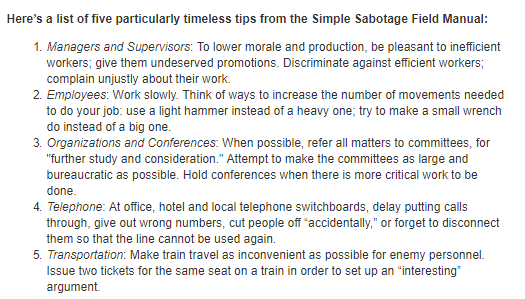
Organizations and Conferences
-
Insist on doing everything through “channels.” Never permit short-cuts to be taken in order to expedite decisions.
-
Make “speeches.” Talk as frequently as possible and at great length. Illustrate your “points” by long anecdotes and accounts of personal experiences.
-
When possible, refer all matters to committees, for “further study and consideration.” Attempt to make the committee as large as possible — never less than five.
-
Bring up irrelevant issues as frequently as possible.
-
Haggle over precise wordings of communications, minutes, resolutions.
-
Refer back to matters decided upon at the last meeting and attempt to re-open the question of the advisability of that decision.
-
Advocate “caution.” Be “reasonable” and urge your fellow-conferees to be “reasonable” and avoid haste which might result in embarrassments or difficulties later on.
Managers
-
In making work assignments, always sign out the unimportant jobs first. See that important jobs are assigned to inefficient workers.
-
Insist on perfect work in relatively unimportant products; send back for refinishing those which have the least flaw.
-
To lower morale and with it, production, be pleasant to inefficient workers; give them undeserved promotions.
-
Hold conferences when there is more critical work to be done.
-
Multiply the procedures and clearances involved in issuing instructions, pay checks, and so on. See that three people have to approve everything where one would do.
Employees
-
Work slowly
-
Work slowly.
-
Contrive as many interruptions to your work as you can.
-
Do your work poorly and blame it on bad tools, machinery, or equipment. Complain that these things are preventing you from doing your job right.
-
Never pass on your skill and experience to a new or less skillful worker.
When terrorists run a country
26 Jan 2018 Leave a comment
in defence economics, economics of crime, law and economics, laws of war, war and peace Tags: Gaza Strip, Israel
How A Cargo Ship Helped Win WW2: The Liberty Ship Story
26 Jan 2018 Leave a comment
in defence economics, transport economics, war and peace Tags: World War II
Invasions, Naval Battles and German Raiders – WW1 in the Pacific I THE GREAT WAR Special
24 Jan 2018 Leave a comment
in defence economics, war and peace Tags: World War I
Did The Soviets Build A Better Space Shuttle? The Buran Story
22 Jan 2018 Leave a comment
in defence economics, transport economics Tags: space
Donald Pleasance and the moral fibre of fellow pacifists
21 Jan 2018 Leave a comment
in defence economics, war and peace

The Post was a lot better than I anticipated
20 Jan 2018 Leave a comment
in defence economics, economic history, movies, politics - USA, war and peace Tags: Vietnam war, World War II
Second movie this week on it is heroic (Darkest Hour), treasonous (The Post) to fight on in a war you can’t win against murderously evil monsters in the hope something might turn up.
Winston Churchill “Blood, Toil, Tears and Sweat””
18 Jan 2018 1 Comment
in defence economics, war and peace Tags: Winston Churchill, World War II
Hawaiian civil defence seems to have room for improvement
17 Jan 2018 1 Comment
in defence economics, economics of bureaucracy
Imperialism: Crash Course World History #35
14 Jan 2018 Leave a comment
in defence economics, development economics, economic history, economics of bureaucracy, Public Choice, rentseeking Tags: Age of Discovery, age of empires, economics of colonialism
Interesting but flawed. The age of empires was prior to the industrial revolution.
Bill Clinton on Israel and Palestine war
08 Jan 2018 Leave a comment
in defence economics Tags: Israel
.@Lorde #BDS mapping Russian revanchism
04 Jan 2018 Leave a comment
in defence economics, economic history, Music Tags: economics of borders, Israel, political correctness, Russia
DANIEL PIPES: ACHIEVING PEACE THROUGH ISRAELI VICTORY
03 Jan 2018 Leave a comment
in defence economics, war and peace Tags: game theory, Middle-East politics, Palestine
We need the Israelis to impose their will on their enemy, the Palestinians. The Palestinians need to accept the permanent existence of a Jewish state. The U.S. government should encourage the Israeli government to do everything within the bounds of the practical, the moral, and the legal to effect that victory.
This doesn’t mean murdering people but taking steps to compel Palestinians to give up, to cry uncle, to say, “The jig is up. We can’t continue this. We need to coexist with our neighbor.” At that point, liberated from their foul, irredentist goal of eliminating their neighbor, Palestinians can begin to build their own polity, economy, society and culture.
Ironically, the Palestinians will win even more from their defeat than will the Israelis. Israelis won’t get blown up on the way to the pizzeria, but they basically a good life economically, legally, culturally, and so forth. The Palestinian live in oppression and poverty. They can only leave that once they give up the monstrous goal of eliminating their enemy.
https://player.vimeo.com/video/245475235
Edward Luttwak argued the same thing ten years ago in general terms
An unpleasant truth often overlooked is that although war is a great evil, it does have a great virtue: it can resolve political conflicts and lead to peace. This can happen when all belligerents become exhausted or when one wins decisively. Either way the key is that the fighting must continue until a resolution is reached. War brings peace only after passing a culminating phase of violence. Hopes of military success must fade for accommodation to become more attractive than further combat.
Since the establishment of the United Nations and the enshrinement of great-power politics in its Security Council, however, wars among lesser powers have rarely been allowed to run their natural course. Instead, they have typically been interrupted early on, before they could burn themselves out and establish the preconditions for a lasting settlement. Cease-fires and armistices have frequently been imposed under the aegis of the Security Council in order to halt fighting. NATO’s intervention in the Kosovo crisis follows this pattern.
But a cease-fire tends to arrest war-induced exhaustion and lets belligerents reconstitute and rearm their forces. It intensifies and prolongs the struggle once the cease-fire ends — and it does usually end.


Recent Comments