A 10% increase in the use of the internet in a country can lead to a 1.9% increase in trade: wrld.bg/LYPXu http://t.co/TdjRTz69fW—
World Bank (@WorldBank) April 23, 2015
Technology diffusion in poor countries is quickening
24 Apr 2015 Leave a comment
in applied welfare economics, development economics, economic history, growth disasters, growth miracles, technological progress Tags: global poverty, international technology diffusion, technology diffusion, The Great Fact
Comparison of shipping density in North and South Korea
23 Apr 2015 Leave a comment
Comparison of shipping density in North and South Korea http://t.co/8W6gaHYgqL—
Amazing Maps (@amazinmaps) April 23, 2015

The world is vastly better and more equal in terms of health
21 Apr 2015 Leave a comment
in development economics, growth miracles, health economics Tags: The Great Escape, The Great Fact
It is India, not China that will be the standout growth miracle between now and 2030
18 Apr 2015 Leave a comment
in development economics, growth miracles Tags: capitalism and freedom, China, extreme poverty, global poverty, India
25 years after the fall of communism – the economic scorecard
17 Apr 2015 3 Comments
in development economics, economic history, growth disasters, growth miracles, Marxist economics

Putin is actually the best of a bad lot
16 Apr 2015 Leave a comment
in constitutional political economy, development economics, growth disasters, growth miracles, Public Choice Tags: Putin, Russia
Cell phones are pretty well everywhere now
16 Apr 2015 Leave a comment
in development economics, economics of media and culture, growth disasters, growth miracles Tags: cellphones, global poverty
Smartphones are coming to Africa: penetration rate expected to exceed 50% in 2019 http://t.co/aYpxoWDOyN—
Laurence Chandy (@laurencechandy) March 05, 2015
/cdn0.vox-cdn.com/uploads/chorus_asset/file/3578930/Dubai_Islands_1920x1200.0.jpg)
60 years ago North Korea was richer than the South
15 Apr 2015 1 Comment
in comparative institutional analysis, constitutional political economy, development economics, economic history, growth disasters, growth miracles Tags: capitalism and freedom, China, North Korea, South Korea


How widespread is use of the Internet across the globe
15 Apr 2015 Leave a comment
in development economics, economics of media and culture, growth disasters, growth miracles, technological progress Tags: flags, Internet, technology diffusion, technology usage
A (Developed) World of Things Connected to the Internet http://t.co/J6Mxnglmsy—
ian bremmer (@ianbremmer) March 30, 2015

Real GDP per Japanese and American aged 15-64, 2013 price level, updated 2005 EKS PPP, detrended, 1970-2013
13 Apr 2015 Leave a comment
in development economics, economic growth, global financial crisis (GFC), great recession, growth miracles, macroeconomics Tags: GFC, great recession, Japan, Lost Decade
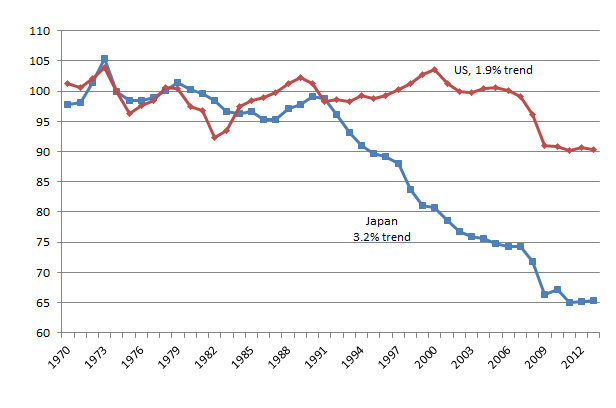
Source: Computed from OECD StatExtract and The Conference Board, Total Database, January 2014, http://www.conference-board.org/economics.
Note: When the line is flat, the economy is growing at its trend growth rate. A falling line means below trend growth; a rising line means of above trend growth. Detrended with values used by Edward Prescott.
The Japanese decline after 1992 are the Lost Decades. Japan recently returned to its 3.2% trend growth rate of the 1970s and 1980s for working age Japanese.
It could be argued that Japan is now on a permanently lower growth rate that implies no further catch up with the USA.
Where does democracy figure in the cycle of development thinking?
13 Apr 2015 Leave a comment
in comparative institutional analysis, constitutional political economy, development economics, growth disasters, growth miracles Tags: capitalism and freedom, democracy and freedom, IMF, ODA, rule of law, UN, World Bank
just brilliant: hype cycle for development ideas by @dalgoso http://t.co/UQX3tRHOBJ—
Laurence Chandy (@laurencechandy) January 03, 2014
Where will be the remnants of extreme poverty in 2030?
11 Apr 2015 Leave a comment
in development economics, growth disasters, growth miracles Tags: extreme poverty, global poverty, The Great Fact
Hot off the press: @WorldBank publishes new global poverty estimates and forecasts. 1.01 billion < $1.25/day in 2011 http://t.co/cGfdEAdOMo—
Laurence Chandy (@laurencechandy) October 08, 2014


Recent Comments