The world’s most dangerous road
07 Oct 2015 Leave a comment
in development economics, transport economics Tags: Bolivia, road safety
The world’s most dangerous road – Yungas Road ("death road") in Bolivia, claims the lives of 200-300 people every yr. http://t.co/P7CvCWHJoa—
The World (@World) September 25, 2015
Jane Kelsey oppose handcuffs on the democratic choices of future governments! Does she opposes labour and environmental standards in trade agreements too?
06 Oct 2015 Leave a comment
in development economics, international economic law, international economics, International law, politics - New Zealand, politics - USA Tags: colonialism, GATT, Leftover Left, preferential trading agreements, TPA, TPPA
What's in the #TPP? Robust enforceable environmental protections. Get the facts ustr.gov/tpp #LeadOnTrade http://t.co/hzapJwGaCa—
USTR (@USTradeRep) October 05, 2015What's in the #TPP? Protections for American workers. Get the facts: ustr.gov/tpp #MadeInAmerica http://t.co/VPeV70zaPT—
USTR (@USTradeRep) October 05, 2015https://twitter.com/JimRose69872629/status/651230008875220992
One of my policy essays for my Masters of Public Policy Degree in Japan was on the social clauses of the GATT. I described the labour and environmental clauses is a new form of colonialism.
My classmates were government officials from all around Asia, more than 20 countries. As they spoke English as a second language, they were pleased to learn of a new way of describing social clauses in trade agreements in English.
A Filipino friend had a blunter way of referring to social clauses in trade agreements: “the whites are back, telling us what to do”.
Environmentalists are praising wildlife measures in the Trans-Pacific Partnership trade deal nyti.ms/1hlu7hS http://t.co/ZLYarL9QE7—
The New York Times (@nytimes) October 05, 2015
Utopia, you are standing in it!
Jane Kelsey in a television interview said she opposes the reductions in sovereignty in trade agreements that result from investor-state dispute settlement (ISDS) provisions because they limit the democratic choices of future governments.
If so, she must oppose environmental and labour standards in trade agreements and, more importantly, binding the hands of future governments with climate treaties. All international treaties are about restrictions on sovereignty.
Environmental and labour clauses in trade agreements and climate treaties all limit the powers of governments to legislate on environmental and employment law in accordance with the will of the people as expressed in the most recent election and change of government. Power to the people.
https://twitter.com/rorymccourt/status/625540621457960960
Jane Kelsey would do better focusing on those parts of the TPPA deal that lowers the net value of the deal such as those extending the term of patents over the drugs. All international treaties are about trade-offs.
View original post 212 more words
@oxfamnz still more mass kidnappings of #ODA & #Occupy activists
05 Oct 2015 Leave a comment
in development economics, economic history, growth disasters, growth miracles Tags: capitalism and freedom, ODA, The Great Enrichment, The Great Escape, The Great Fact
Why are they not dancing in the streets on the news today that extreme poverty has fallen below 10% of the world’s population for the first time ever.
The only possible explanation is these principled activists for the cause of the poor and oppressed not celebrating the latest achievements of capitalism and freedom is they have been kidnapped by nefarious forces.
We pray for their safe return so they can join the celebrations of The Great Fact and The Great Escape.
.@Worldbank: Est. 702M ppl living in #extremepoverty in 2015, down from 902M in 2012: wrld.bg/SZKfZ http://t.co/y6r1gVlciH—
World Bank (@WorldBank) October 05, 2015

Rising incomes helped bottom 40% of income earners in most countries over last 10 yrs -WBG: wrld.bg/SZM2M http://t.co/f9vdfA2htk—
World Bank (@WorldBank) October 05, 2015
How can we eradicate #poverty by 2030? @Winnie_Byanyima wef.ch/1QvSVPW #development http://t.co/reBsT24BU3—
World Economic Forum (@wef) September 24, 2015
Which are the poorest countries in the world? wef.ch/1RcYiVo #economics http://t.co/uK1BFlcZQb—
World Economic Forum (@wef) October 05, 2015
The Great Era of Global Development: Steve Radelet
04 Oct 2015 Leave a comment
in development economics, economic history, growth disasters, growth miracles Tags: The Great Enrichment, The Great Escape, The Great Fact
Economic liberty and human flourishing: A discussion with Deirdre McCloskey, Susan Shell, and Yuval Levin
04 Oct 2015 Leave a comment
in comparative institutional analysis, constitutional political economy, development economics, economic history, Marxist economics Tags: Deirdre McCloskey, The Great Enrichment, The Great Fact
Bono – Capitalism Reduces Poverty
03 Oct 2015 Leave a comment
in development economics, economic history, economics of media and culture, growth disasters, growth miracles, Music Tags: Africa, Bono, China, The Great Enrichment, The Great Fact, U2
The % of the world living on less than $1.25 a day will fall to 5% by 2030
02 Oct 2015 Leave a comment
in development economics, economic history, growth disasters, growth miracles Tags: extreme poverty, global poverty, The Great Enrichment, The Great Escape, The Great Fact
The portion of the world population living on less than $1.25 a day will fall to 5% by 2030: j.mp/1Lvk5D4 http://t.co/vd6dkCYpoY—
Cato Institute (@CatoInstitute) September 16, 2015
Belonging to the freest countries in the world greatly improves the average person’s income: j.mp/1JWMi93 http://t.co/mMEDCklcis—
Cato Institute (@CatoInstitute) September 12, 2015
@AlexEpstein on why you should love fossil fuels
02 Oct 2015 Leave a comment
in development economics, energy economics, environmental economics Tags: Alex Epstein, climate alarmism, energy poverty, The Great Enrichment, The Great Escape
RT @oxfamnz @Oxfam what halved global poverty in 15 years? @NZGreens @RusselNorman @GreenpeaceNZ
30 Sep 2015 Leave a comment
in comparative institutional analysis, constitutional political economy, development economics, economic history, growth disasters, growth miracles, liberalism, Public Choice Tags: capitalism and freedom, Leftover Left, New Zealand Greens, Oxfam, The Great Enrichment, The Great Escape, The Great Fact, Twitter left
How can we eradicate #poverty by 2030? @Winnie_Byanyima wef.ch/1QvSVPW #development http://t.co/reBsT24BU3—
World Economic Forum (@wef) September 24, 2015
@syed17005919 @Noahpinion Look at what happened in a "world where corporations rule:" http://t.co/tAbbJW1Gvd—
David Andolfatto (@dandolfa) June 28, 2015
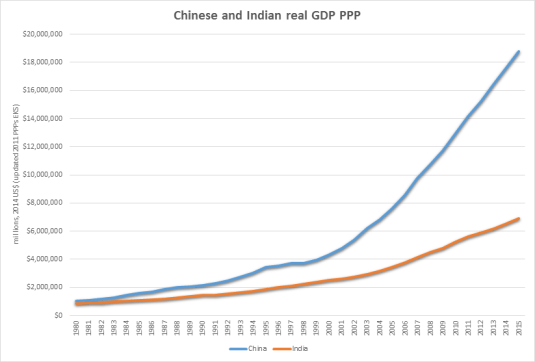
In 1980, the average American was 42x wealthier than the average Chinese. Now it's 4x wapo.st/1j6YcDc http://t.co/7afGdDf6mp—
Ana Swanson (@AnaSwanson) September 22, 2015
Parliament debates the Sustainable Development Goals today. But how did the MDGs fare? bit.ly/1gbcH6W http://t.co/r12PKVmPzK—
Commons Library (@commonslibrary) September 10, 2015
How the UN works: Set an unverifiable goal and then claim you achieved it. goo.gl/onJjCm http://t.co/bKm7zgeynH—
Steve Milloy (@JunkScience) September 29, 2015
How to lie about statistics on inequality and global poverty @oxfamnz @Oxfam
29 Sep 2015 Leave a comment
in applied price theory, applied welfare economics, development economics, econometerics, economic history, growth disasters, growth miracles, human capital, labour economics, Marxist economics, poverty and inequality, rentseeking Tags: activists, do gooders, expressive voting, Leftover Left, Oxfam, rational ignorance, rational irrationality, Twitter left
Gandhi’s worldly possessions
27 Sep 2015 Leave a comment
in development economics, economic history, economics of religion Tags: Gandhi
All of Gandhi’s worldly possessions. http://t.co/RRiLQZxiwd—
Lost In History (@SadHappyAmazing) September 11, 2015
How did the MDGs fare?
27 Sep 2015 Leave a comment
in comparative institutional analysis, constitutional political economy, development economics, economic history, growth disasters, growth miracles Tags: do gooders, MDG, ODA, overseas aid, United Nations
Parliament debates the Sustainable Development Goals today. But how did the MDGs fare? bit.ly/1gbcH6W http://t.co/r12PKVmPzK—
Commons Library (@commonslibrary) September 10, 2015
RT @NZGreens @GreenpeaceNZ @KevinHague Allow Golden Rice Now
25 Sep 2015 Leave a comment
in development economics, economics of regulation, environmental economics, growth disasters, growth miracles, health economics Tags: child mortality, child poverty, economics of agriculture, extreme poverty, global hunger, global poverty, GMOs, golden rice, Greenpeace, infant mortality, Luddites, malnutrition, New Zealand Greens, unintended consequences
Good as Gold: Can Golden Rice and Other Biofortified Crops Prevent Malnutrition? ow.ly/QQ1VT #Harvard http://t.co/O3SwpGhsXD—
Golden Rice (@Golden_Rice) August 13, 2015
The Great Fact in China
25 Sep 2015 Leave a comment
in development economics, economic history, growth disasters, growth miracles Tags: China, The Great Fact
In 1980, the average American was 42x wealthier than the average Chinese. Now it's 4x wapo.st/1j6YcDc http://t.co/7afGdDf6mp—
Ana Swanson (@AnaSwanson) September 22, 2015
Recent Comments