How We Got Rich: A Liberal Climate of Ideas
02 Sep 2017 Leave a comment
in development economics, economic history, growth disasters, growth miracles Tags: The Great Enrichment
Wealthier is healthier
01 Sep 2017 Leave a comment
in development economics, economic history, environmental economics, global warming


A 100-year old Japanese typewriter. There are 2273 characters on the keyboard.
24 Aug 2017 Leave a comment
How Freedom Made Us Rich
17 Aug 2017 Leave a comment
in applied price theory, comparative institutional analysis, constitutional political economy, development economics, economic history Tags: The Great Enrichment
.@XTOTL claim that women & Maori being screwed by neoliberalism since 1984
13 Aug 2017 Leave a comment
in discrimination, economic history, gender, labour economics, politics - New Zealand
Toby Morris claimed in an inequality graphic on thewireless.com in 2015 that subsequent to the 1980s economic reforms, the rich got the income of the rich double while the incomes of the majority of New Zealanders was largely static. He then claimed that
in short, regular Kiwis were screwed, especially women, Maori and Pacific Island communities
Figure 1 shows that real household incomes increased pretty much evenly across all 10 income deciles between 1994 and 2013, ranging between 40 to 50%.
Figure 1: Real household incomes (BHC), changes for top of income deciles, 1994 to 2013
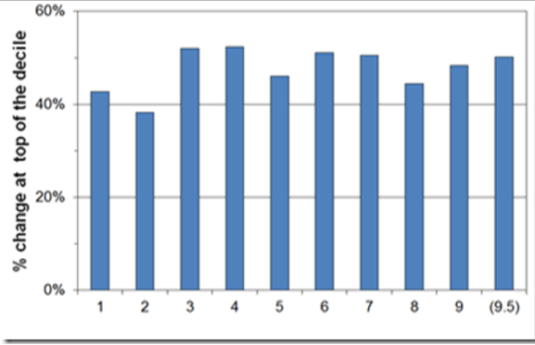
Source: Bryan Perry, Household incomes in New Zealand: Trends in indicators of inequality and hardship 1982 to 2013. Ministry of Social Development (July 2014).
The figure below shows that since the end of the recession in the early 1990s, there has been rapid income growth including from Maori and Pacifika, at least 50%, if not 70%.
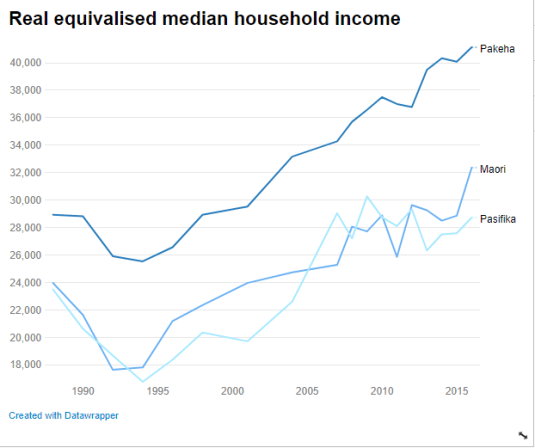
Source: Bryan Perry, Household incomes in New Zealand: Trends in indicators of inequality and hardship 1982 to 2016. Ministry of Social Development (2017).
The massive improvements in Māori incomes since 1992 were based on rising Māori employment rates, fewer Māori on benefits, more Māori moving into higher paying jobs, and greater Māori educational attainment. Māori unemployment reached a 20-year low of 8 per cent from 2005 to 2008.
New Zealand has the smallest gender wage gap of any country; 60% of university graduates are now women.


Recent Comments