Extreme poverty in Uganda, Swaziland and Botswana @jasonhickel @Carolyn_nth

Since 1985, extreme poverty has halved in Botswana and dropped by a 3rd in Swaziland and Uganda.

extreme poverty in Swaziland Botswana and Uganda

Source: World Poverty – Our World In Data.

Life expectancies are increasing again in Swaziland and Botswana after the HIV epidemic has come under more control.

LE by Age in swaziland

Source: Life Expectancy by Age in selected Country from 1990 to 2013 | Health Intelligence

LE by Age in Botswana

Source: Life Expectancy by Age in selected Country from 1990 to 2013 | Health Intelligence

Rockefeller: The Richest American Who Ever Lived

Brexit: the Movie 

Source: Brexit: the Movie | Catallaxy Files

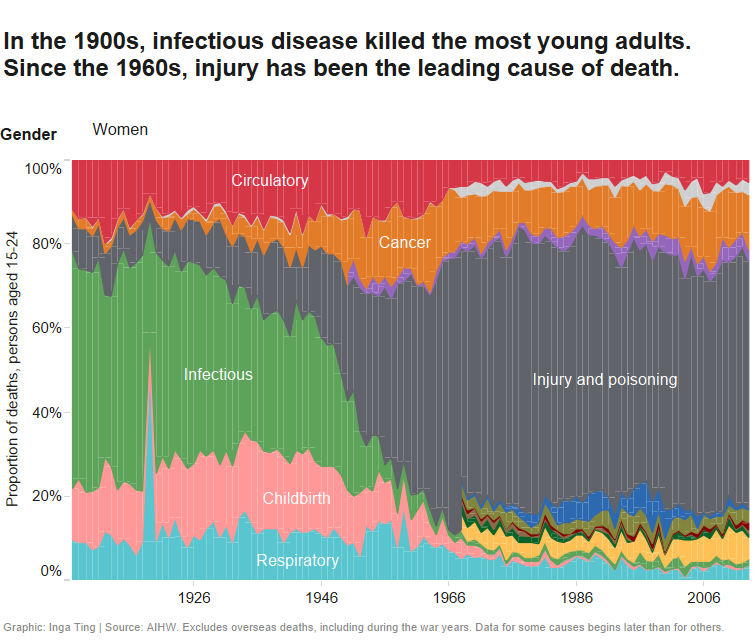
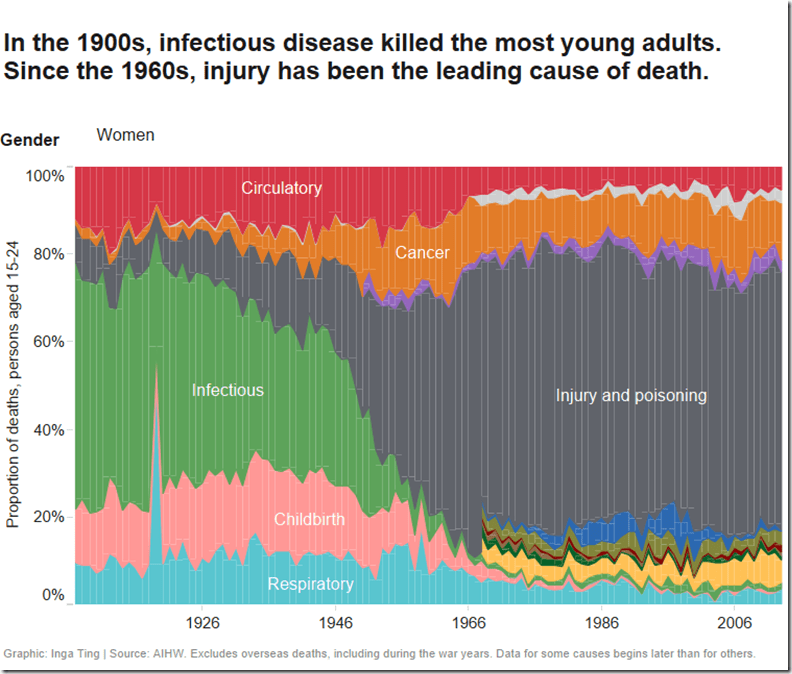
Giving birth in Australia was seriously dangerous until the mid-20th century

Medical progress contributed more than people realise to women’s liberation. The key area of progress was far fewer deaths in childbirth as the chart below for Australia shows. Deaths from childbirth disappeared from mortality statistics in the 1940s and 1950s.
death rates of women in Australia from all causes

Source: Australian Institute of Health and Welfare via Sydney Morning Herald This chart shows how you will probably die, and it’s changed a lot in 100 years.

The next key area of medical progress was fewer disabling injuries subsequent because of childbirth that kept women out of the workforce for several years if not permanently. In Gender Roles and Medical Progress, Stefania Albanesi and Claudia Olivetti say

Consider a typical woman born around 1900. She married at 21 and gave birth to more than three live children between age 23 and 33. The high fetal mortality rate implied an even greater number of pregnancies, so that she would be pregnant for 36% of this time.

Health risks in connection to pregnancy and childbirth were severe. Septicemia, toxaemia, hemorrhages and obstructed labour could lead to prolonged physical disability and, in the extreme, death. In 1920 one mother died for each 125 living births. At a rate of 3.6 pregnancies per woman, the compounded risk of death from maternal causes was 2.9%.

For every death, twenty times as many mothers were estimated to suffer different degrees of disablement annually. Many maternal conditions had very long lasting or chronic effects on health, hindering women’s ability to work beyond their childbearing years.

Death in childbirth and serious complications from childbirth been forgotten in modern memory. So much so that there can be an entire year in New Zealand when no child nor mother dies in childbirth. When that does happen, there is a coroner’s enquiry.

The implications of medical progress around childbirth for female life expectancy has been equally forgotten as Albanesi and Olivetti explain

The development of bacteriology, the introduction of sulfominydes and antibiotics, and the diffusion of blood banks dramatically decreased the death rate from sepsis and hemorrhage. More specific interventions, such as the standardization of obstetric practices and the increased availability of pre-natal care, reduced the incidence of hypertensive disorders of pregnancy and obstructed labour, a causal factor for many forms of post-partum disability.

These developments lead to a stark decline in maternal mortality and a rise in the female-male differential in life expectancy at age 20 from 1.5 years in 1920 to 6 years in 1960.

At the beginning of the last century, the burden of childbirth and breastfeeding simply made it impossible for married women to work in any significant number as Albanesi and Olivetti explain

In addition, due to the lack of reliable alternatives, most infants were exclusively breast fed. Women would then be nursing for approximately a third of the time between age 23 and 33.

Since the average time required to feed one child ranges between 14 and 17 hours per week, with a 40 hour workweek, mothers would be nursing for 35%-43% of their potential working time in childbearing years.

Not surprisingly given this burden, few married women worked. Only 5.4% of married women aged 25 to 34 were in the labour force in 1900.

There was an extraordinary reduction in the number of years lost in disablement after childbirth in the early and mid-20th century as Albanese in Olivetti’s explain

…the years lost to disabilities associated with maternal conditions declined from 2.31 per pregnancy in 1920 to just 0.17 in 1960.

Medical progress  around childbirth is the most important force driving the rise in the participation of married women during childbearing years and post-childbearing between 1935 and 1965. The health burden of giving birth is now measured in weeks rather than years.

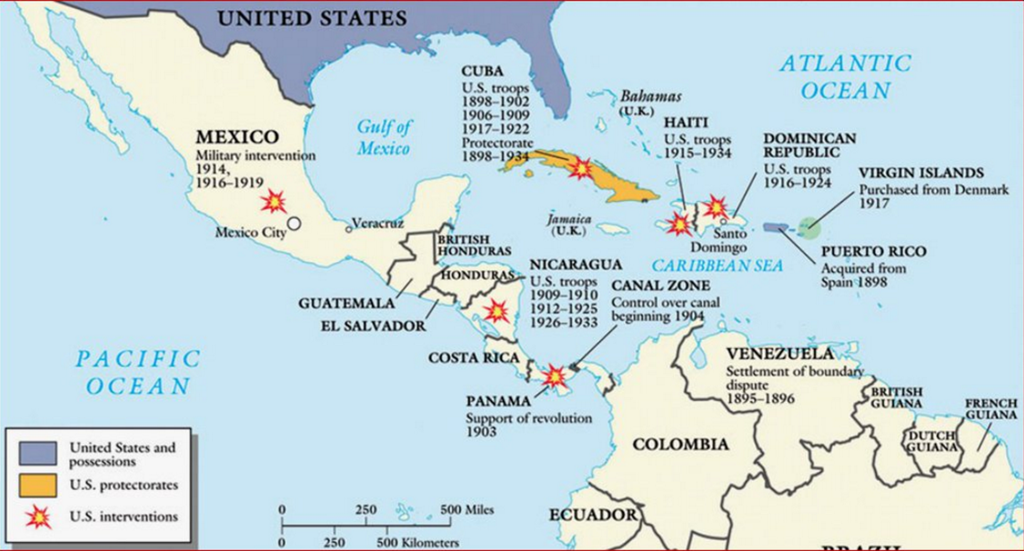
US Military Interventions in America & the Caribbean

image

Image

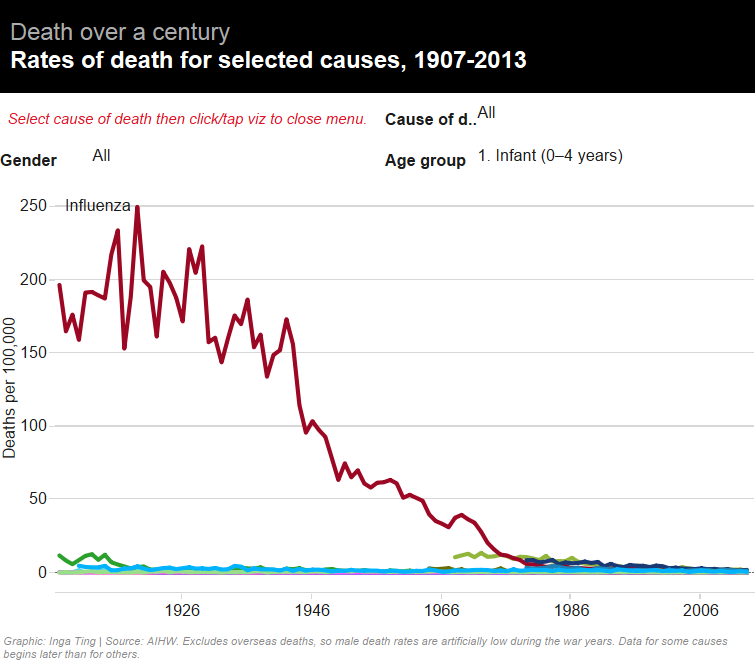
A lot of Australian babies used to die of influenza prior to the 1960s

causes of death but it is aged 0 to 4 Australia

Image

New Zealand energy consumption

image

Image

The Mongol Empire

https://twitter.com/historyfacts247/status/704029069118205952

Basic Facts of Growth and Development

Evolution of The United States of America

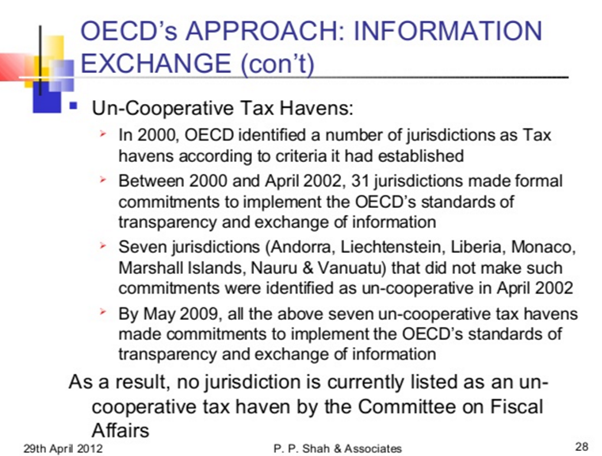
I hope no one in @OxfamGB’s #taxhaven clip were fresh from a #TPPANoWay march?

I hope none in this clip protesting against tax havens as short changing everybody else were fresh from protesting how international economic agreements such as the TPPA infringe on the sovereignty of countries.

If you standing up for national sovereignty that includes standing up for the right of other countries doing things that you do not like within their own country.

If countries have the right to set taxes and tariffs as high as they like, they have just the same right to set them as low as they like.

All that plucky rhetoric of TPPA no way and how international economic agreements violate the sovereignty of countries and developing countries in particular is forgotten in a flash by Oxfam.

Oxfam manages the blinding hypocrisy of opposing the Transpacific Partnership on national sovereignty grounds and at the same time call for international treaties to bully small countries about their tax policies, which overrides their economic sovereignty.

image

The sovereign rights of developing countries to find their own way does not extend to undermining the tax bases of the rich countries struggling to finance their welfare states.

The Pacific Islands, the once were heroes of the recent Paris climate talks, turn into pariahs once they start looking out for themselves and setting up offshore financial centres and tax havens.

Developing countries are free to impoverish themselves by embracing socialism, but if they decide to attract investment and jobs through low tax rates and offshore financial centres, a new form of colonialism is embraced by the reactionary left as embodied by Oxfam.

Is the Cost of Living Really Rising?

In 1900, 25% died before age 20.

Creative destruction in video chains

Image

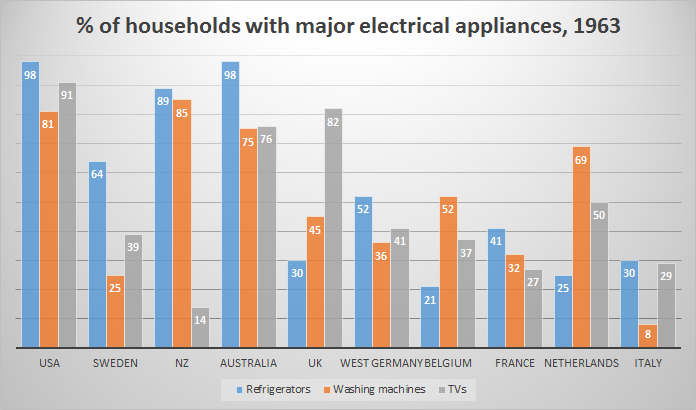
Household penetration of major electrical appliances, 1963, USA, Western Europe and Down Under

Michael Reddell stumbled across a fascinating 1965 research paper in an old bookshop. In addition to re-blogging his post, I charted the data he found on household penetration of major electrical appliances in the good old days of the regressive left when everyone was equal, in a union and happy.

image

Source: New Zealand Institute of Economic Research (1965), Electric Household Durable Goods: Economic Aspects of their Manufacture in New Zealand via Twenty companies manufacturing TVs | croaking cassandra.

In the early 1960s, there were really big differences not only the number of TV sets, but much more basic appliances we take for granted such as refrigerators and washing machine.

The three indicators  in the chart above suggest that life was much better in the USA, Australia and New Zealand than in Western Europe. Television aside, New Zealand seemed to be better off than Australia.

Watch the video by Hans Rosling about what happened when a washing machine first came to his parent’s house. Truly insightful about how living standards are so much better than those of our parents and grandparents.

Previous Older Entries Next Newer Entries

Arin’s Substack

Celebrating humanity's flourishing through the spread of capitalism and the rule of law

David Andolfatto

Celebrating humanity's flourishing through the spread of capitalism and the rule of law

Monetary Non-Neutrality

Celebrating humanity's flourishing through the spread of capitalism and the rule of law

Reason Magazine

Celebrating humanity's flourishing through the spread of capitalism and the rule of law

Coyote Blog

Celebrating humanity's flourishing through the spread of capitalism and the rule of law

Thoughts from the North

Celebrating humanity's flourishing through the spread of capitalism and the rule of law

Fardels Bear

A History of the Alt-Right

Vincent Geloso

Econ Prof at George Mason University, Economic Historian, Québécois

Bassett, Brash & Hide

Celebrating humanity's flourishing through the spread of capitalism and the rule of law

Truth on the Market

Scholarly commentary on law, economics, and more

The Undercover Historian

Beatrice Cherrier's blog

Matua Kahurangi

Celebrating humanity's flourishing through the spread of capitalism and the rule of law

Temple of Sociology

Celebrating humanity's flourishing through the spread of capitalism and the rule of law

Velvet Glove, Iron Fist

Celebrating humanity's flourishing through the spread of capitalism and the rule of law

Why Evolution Is True

Why Evolution is True is a blog written by Jerry Coyne, centered on evolution and biology but also dealing with diverse topics like politics, culture, and cats.

NoTricksZone

Celebrating humanity's flourishing through the spread of capitalism and the rule of law

Homepaddock

A rural perspective with a blue tint by Ele Ludemann

Kiwiblog

DPF's Kiwiblog - Fomenting Happy Mischief since 2003

The Dangerous Economist

Celebrating humanity's flourishing through the spread of capitalism and the rule of law

Watts Up With That?

The world's most viewed site on global warming and climate change

The Logical Place

Tim Harding's writings on rationality, informal logic and skepticism

Doc's Books

A window into Doc Freiberger's library

The Risk-Monger

Let's examine hard decisions!

Uneasy Money

Commentary on monetary policy in the spirit of R. G. Hawtrey

Barrie Saunders

Thoughts on public policy and the media

Liberty Scott

Celebrating humanity's flourishing through the spread of capitalism and the rule of law

Point of Order

Politics and the economy

James Bowden's Blog

A blog (primarily) on Canadian and Commonwealth political history and institutions

Science Matters

Reading between the lines, and underneath the hype.

Peter Winsley

Economics, and such stuff as dreams are made on

A Venerable Puzzle

"The British constitution has always been puzzling, and always will be." --Queen Elizabeth II

The Antiplanner

Celebrating humanity's flourishing through the spread of capitalism and the rule of law

Bet On It

Celebrating humanity's flourishing through the spread of capitalism and the rule of law

History of Sorts

WORLD WAR II, MUSIC, HISTORY, HOLOCAUST

Roger Pielke Jr.

Undisciplined scholar, recovering academic

Offsetting Behaviour

Celebrating humanity's flourishing through the spread of capitalism and the rule of law

JONATHAN TURLEY

Res ipsa loquitur - The thing itself speaks

Conversable Economist

In Hume’s spirit, I will attempt to serve as an ambassador from my world of economics, and help in “finding topics of conversation fit for the entertainment of rational creatures.”

The Victorian Commons

Researching the House of Commons, 1832-1868

The History of Parliament

Articles and research from the History of Parliament Trust

Books & Boots

Reflections on books and art

Legal History Miscellany

Posts on the History of Law, Crime, and Justice

Sex, Drugs and Economics

Celebrating humanity's flourishing through the spread of capitalism and the rule of law

European Royal History

Exploring the Monarchs of Europe

Tallbloke's Talkshop

Cutting edge science you can dice with

Marginal REVOLUTION

Small Steps Toward A Much Better World