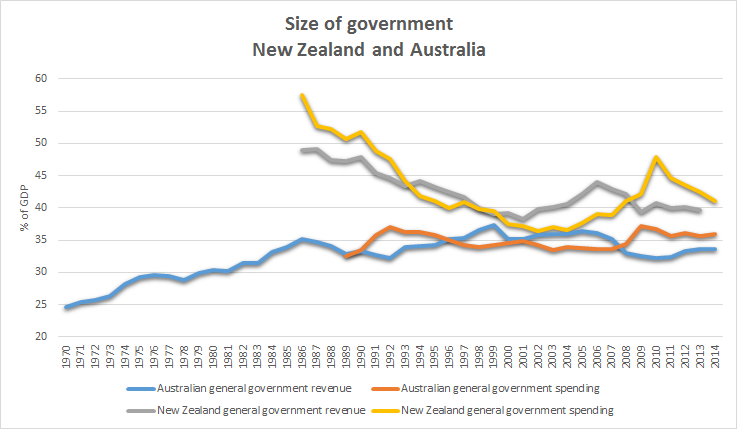
General government expenditure and general government revenue as a % of Australian and New Zealand GDP since 1970

I do not trust the numbers for New Zealand prior to the early 1990s released by the OECD. New Zealand simply did not have a tax structure including a GST in the double digits back then to support estate of that size. Nonetheless, the size of government in New Zealand is systematically larger than in Australia, a richer country which can afford a large government and generous welfare state.

image

Source: General government – General government revenue – OECD Data and Data extracted on 12 Feb 2016 08:45 UTC (GMT) from OECD.Stat from OECD Economic Outlook November 2015.

The discovery void in antibiotic drugs

No new classes of antibiotics has been discovered since 1987. They are looked upon as a poor investment by pharmaceutical entrepreneurs because there are so many generic competitors. To make it even more complicated, any new antibiotic that might be invented would have to be held in reserve for a major case of an antibiotic resistant infection.

Source: Global Risks 2013 – Reports – World Economic Forum.

Wealth and Health of Nations

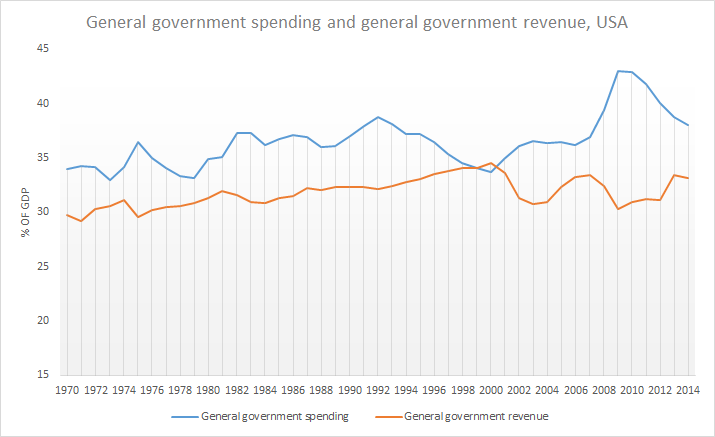
General government spending and general government revenue as % of US GDP since 1970

image

Source: General government – General government spending – OECD Data and Source: General government – General government revenue – OECD Data.

Hours worked per working age American and French and per American and French workers since 1950

American workers are working fewer hours per year but more labour has been supplied by the working age population especially in the 1980s and 1990s. In France, there has been a steady decline of hours worked per worker and, up until 1985, hours worked per working age French.

image

Data extracted on 10 Mar 2016 22:34 UTC (GMT) from OECD.Stat, Data extracted on 10 Mar 2016 22:02 UTC (GMT) from OECD.Stat, and The Conference Board. 2015. The Conference Board Total Economy Database™, May 2015, http://www.conference-board.org/data/economydatabase/

Fruits and vegetables, wild vs. domesticated

https://twitter.com/freakonometrics/status/695365967761666048

Live from the moon in @BernieSanders good old days

Creative destruction in car phones

image

Image

Hong Kong’s per capita GDP has bested that of Western Europe

@BernieSanders view of Cuba

Image

New Zealand’s tourism industry halved in size in the last 2 years but it is only a statistical revision

At 4% of GDP and employment in 2014, that is half estimated size of the New Zealand tourism sector in 2012. Statistics are only estimates. The trouble is politicians and bureaucrats make decisions on the base of them that might not be able to be reversed. Little wonder that Hong Kong prospered by as collecting as few as statistics as possible.

Source: OECD Tourism Trends and Policies 2016 | OECD READ edition.

Source: OECD Tourism Trends and Policies 2014 | OECD READ edition.

The earlier New Zealand data referred to direct and indirect contributions while the latest data refers only to direct contributions. New Zealand is no longer top of the world.

Tom Sargent on how jobs are always available

Source: How Sweden’s Unemployment Became More Like Europe’s, Lars Ljungqvist, Thomas J. Sargent 2010.

Absolute poverty from 1820 to 2015

Image

Everybody is at least 40% richer than in 1979

Inequality is not getting worse and worse says @WJRosenbergCTU!?

Bill Rosenberg of the Council of Trade Unions is one of many economists who point out that income inequality has not been getting worse and worse in New Zealand since the 1990s. Inequality rose sharply in the late 1980s and early 90s but has remained high but nevertheless stable since then as he says in his 2014 paper of trends in living standards:

This is another symptom of the sharp rise in income inequality between the mid 1980s and mid 1990s, which remains high.

His employer, the Council of Trade Unions when it was denouncing the Employment Contracts Act 1991 as the reason for low wages growth has also drawn attention to the early 1990s as a turning point in the relationship between inequality, union bargaining power and wages growth.

As the Council of Trade Unions showed in the chart it published during the last election campaign, which I snapshoted below and also annotated, from 1970 to 1975 there was rapid real wages growth, well in excess of real growth in per capita GDP. This wages breakout was followed by some ups and downs but essentially wages in 1995 were no higher per hour from what they were in 1975. Real wages were about $24 per hour in real terms in New Zealand for about 20 years – from 1975 to 1995.
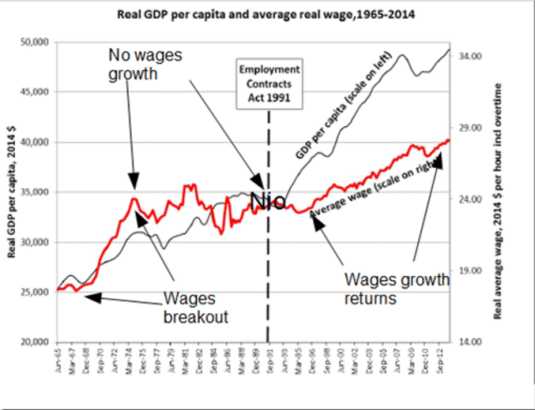
There was no real GDP per capita growth from 1975 until 1979 nor in the five years leading up to the passage of the Employment Contracts Act 1991. The period leading up to 1975 wages breakout wages was the zenith of union membership; nearly 70% of all workers belonging to a union. Less than 20% do now and less than 10% in the private sector.
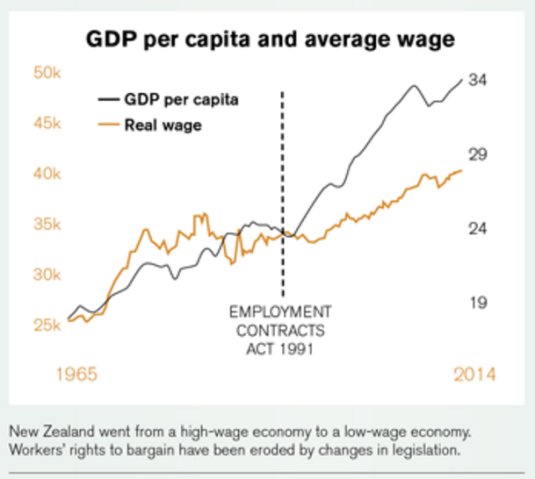
Source: Income Gap | New Zealand Council of Trade Unions – Te Kauae Kaimahi.

After staying at about $24 per hour for 20 years from 1975 to the early 1990s, following the passage of the Employment Contracts Act in 1991, average wages in New Zealand have increased steadily from $24 an hour to about $28 per hour by 2014 in one of the most deregulated labour markets in the world.

As Rosenberg, who is chief economist at the Council of Trade Unions, and the Council of Trade Unions itself pointed out, there were major changes in the New Zealand economy in terms of inequality of incomes and union bargaining power in the late 80s and early 1990s.

These changes referred to by the unions as an erosion of workers bargaining power, brought an end to wage stagnation. Steady real wages growth returned after two lost decades: next to no growth in either GDP per capita or incomes of workers.
Previous Older Entries Next Newer Entries

Arin’s Substack

Celebrating humanity's flourishing through the spread of capitalism and the rule of law

David Andolfatto

Celebrating humanity's flourishing through the spread of capitalism and the rule of law

Monetary Non-Neutrality

Celebrating humanity's flourishing through the spread of capitalism and the rule of law

Reason Magazine

Celebrating humanity's flourishing through the spread of capitalism and the rule of law

Coyote Blog

Celebrating humanity's flourishing through the spread of capitalism and the rule of law

Thoughts from the North

Celebrating humanity's flourishing through the spread of capitalism and the rule of law

Fardels Bear

A History of the Alt-Right

Vincent Geloso

Econ Prof at George Mason University, Economic Historian, Québécois

Bassett, Brash & Hide

Celebrating humanity's flourishing through the spread of capitalism and the rule of law

Truth on the Market

Scholarly commentary on law, economics, and more

The Undercover Historian

Beatrice Cherrier's blog

Matua Kahurangi

Celebrating humanity's flourishing through the spread of capitalism and the rule of law

Temple of Sociology

Celebrating humanity's flourishing through the spread of capitalism and the rule of law

Velvet Glove, Iron Fist

Celebrating humanity's flourishing through the spread of capitalism and the rule of law

Why Evolution Is True

Why Evolution is True is a blog written by Jerry Coyne, centered on evolution and biology but also dealing with diverse topics like politics, culture, and cats.

NoTricksZone

Celebrating humanity's flourishing through the spread of capitalism and the rule of law

Homepaddock

A rural perspective with a blue tint by Ele Ludemann

Kiwiblog

DPF's Kiwiblog - Fomenting Happy Mischief since 2003

The Dangerous Economist

Celebrating humanity's flourishing through the spread of capitalism and the rule of law

Watts Up With That?

The world's most viewed site on global warming and climate change

The Logical Place

Tim Harding's writings on rationality, informal logic and skepticism

Doc's Books

A window into Doc Freiberger's library

The Risk-Monger

Let's examine hard decisions!

Uneasy Money

Commentary on monetary policy in the spirit of R. G. Hawtrey

Barrie Saunders

Thoughts on public policy and the media

Liberty Scott

Celebrating humanity's flourishing through the spread of capitalism and the rule of law

Point of Order

Politics and the economy

James Bowden's Blog

A blog (primarily) on Canadian and Commonwealth political history and institutions

Science Matters

Reading between the lines, and underneath the hype.

Peter Winsley

Economics, and such stuff as dreams are made on

A Venerable Puzzle

"The British constitution has always been puzzling, and always will be." --Queen Elizabeth II

The Antiplanner

Celebrating humanity's flourishing through the spread of capitalism and the rule of law

Bet On It

Celebrating humanity's flourishing through the spread of capitalism and the rule of law

History of Sorts

WORLD WAR II, MUSIC, HISTORY, HOLOCAUST

Roger Pielke Jr.

Undisciplined scholar, recovering academic

Offsetting Behaviour

Celebrating humanity's flourishing through the spread of capitalism and the rule of law

JONATHAN TURLEY

Res ipsa loquitur - The thing itself speaks

Conversable Economist

In Hume’s spirit, I will attempt to serve as an ambassador from my world of economics, and help in “finding topics of conversation fit for the entertainment of rational creatures.”

The Victorian Commons

Researching the House of Commons, 1832-1868

The History of Parliament

Articles and research from the History of Parliament Trust

Books & Boots

Reflections on books and art

Legal History Miscellany

Posts on the History of Law, Crime, and Justice

Sex, Drugs and Economics

Celebrating humanity's flourishing through the spread of capitalism and the rule of law

European Royal History

Exploring the Monarchs of Europe

Tallbloke's Talkshop

Cutting edge science you can dice with

Marginal REVOLUTION

Small Steps Toward A Much Better World