From 1950, Japan doubled their standard of living every 8 years
02 Feb 2016 Leave a comment
in development economics, economic history, growth miracles Tags: East Asian Tigers, Japan
NZ households spending 30% plus of disposable income on housing, 1988–2013
01 Feb 2016 Leave a comment
in economic history, economics of regulation, urban economics
The importance of correctly measuring income growth over the decades
31 Jan 2016 Leave a comment
in applied welfare economics, economic history Tags: measurement error
US, UK Australian and New Zealand measles vaccination rates since 1980
31 Jan 2016 Leave a comment
in economic history, health economics Tags: measles, vaccinations, vaccines
The USA led the way in measles vaccinations. Herd immunity is a 93% vaccination rate. Countries have been coming close to measles immunity immunity only in recent years.
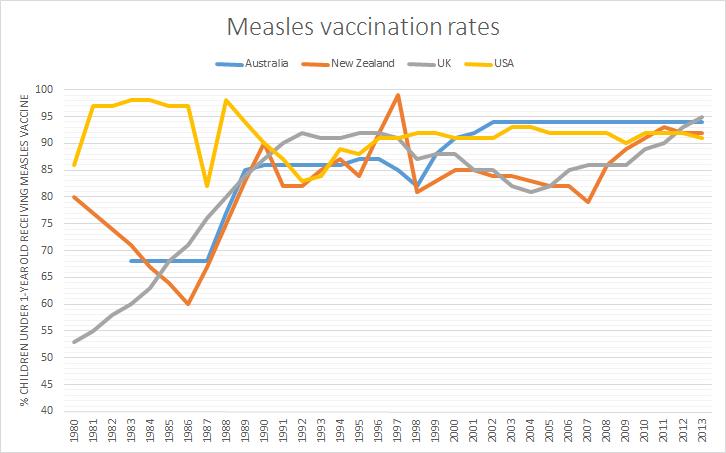
Source: OECD Health Statistics.
@TrevorMallard what next for #TPPANoWay? Repeal CER?
31 Jan 2016 Leave a comment
in economic history, international economics, International law, law and economics, politics - Australia, politics - New Zealand, Public Choice, television, TV shows Tags: CER, closer economic relations, Hollywood economics, ISDS, preferential trading agreements, rational irrationality, single market, TPPA, Twitter left

New Zealand filmmakers have used trade treaties to pry open access to foreign markets by challenging failures to honour promises of nondiscrimination in trade and investment in the Federal Court of Australia.
This should please the Twitter Left because they are also a film going left as are most members of the educated middle class as a point of identity and snobbery.
Back in the day, New Zealand television programming was sold cheaply into the Australian market. Many cultural and other products are exported into foreign markets and sold for whatever they can get above the price of shipping or digital transmission. What else explains all that rubbish on cable TV?
Under the Closer Economic Relations agreement that creates a single market between Australia and New Zealand, New Zealand made television programming content must be treated the same way as Australian content so it was included in their 50% local content rules for commercial television back from whenever I remember this story from.
There was a Federal Court of Australia case that ruled that New Zealand television programming was Australian content programming for the purposes of the relevant media regulations because of Closer Economic Relations.
From the late 1990s, with revival of the New Zealand film and television industry, New Zealand content was starting to flood the Australian market, especially in the off-season in the summer when stations were looking for cheap content to fill a low ratings period.
Naturally, this Kiwi invasion did not please the rent seeking Australian television programme production industry and many a mendicant actor, writer and producer
Where there is a will, where there is a way: minimum quality standards are introduced into the Australian content rules defined by price – a price that happen to be above what the television stations used to pay for New Zealand made programming in the off-season.
This court victory in favour of various New Zealand film industry in enforcing a trade and investment treaty puts the Twitter left in a bit of a conundrum. Which is more important? The New Zealand film industry or their hatred of globalisation and the rule of law.
Unions are not the cause of our 40 hour workweek
31 Jan 2016 Leave a comment
in applied price theory, applied welfare economics, economic history, labour economics, labour supply, unions Tags: 40 hour week, hours worked, living standards, union power, union wage premium, working hours, working week
% of American children living with a single parent
31 Jan 2016 Leave a comment
in economic history, economics, economics of love and marriage, gender, labour economics, labour supply, population economics
Share market losses during previous financial crises in the USA and UK
31 Jan 2016 Leave a comment
in business cycles, economic history, fisheries economics, global financial crisis (GFC), great depression, great recession, macroeconomics Tags: banking crises, financial crises, sovereign debt crises, sovereign defaults
Indirect taxes as % of US, UK, Danish, Australian and New Zealand GDPs
30 Jan 2016 Leave a comment
in economic history, fiscal policy, public economics
There are big differences between the USA, between the USA and Australia and the rest with a mild exception for the UK.
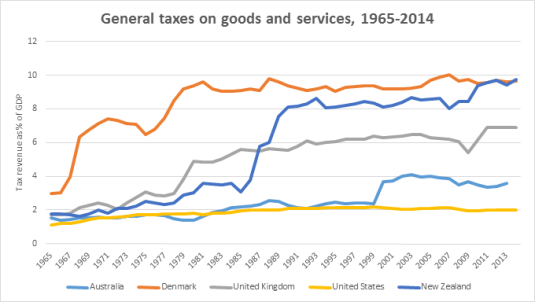
Data extracted on 30 Jan 2016 03:05 UTC (GMT) from OECD.Stat.
10 years ago today Facebook was founded
30 Jan 2016 Leave a comment
in economic history, economics of media and culture, entrepreneurship
The 1st @NYTimeskrugman on #TPPANoWay @Oxfamnz #JaneKelsey
30 Jan 2016 Leave a comment
in applied price theory, applied welfare economics, development economics, economic history, growth disasters, growth miracles, international economics Tags: customs unions, free trade agreements, globalisation, Jane Kelsey, Leftover Left, Oxfam, Paul Krugman, preferential trading agreements, rational irrationality, TPP, Twitter left, Yes Minister
https://twitter.com/TPPMediaMarch/status/692055631579185152
If George Bush had not won the 2000 presidential election, Paul Krugman would have taken over as the best communicator of economics since Milton Friedman. Instead, he became patient number no.1 of George Bush derangement syndrome. Ann Coulter was patient no. 1 of Clintons derangement syndrome.

Source: Enemies of the WTO.
% global GDP with negative central bank interest rates
30 Jan 2016 Leave a comment
in economic history, global financial crisis (GFC), monetary economics
Devonport in the good old days
29 Jan 2016 Leave a comment
in economic history, economics of media and culture
HT: Julian Weeks.


Recent Comments