In the early 1990s, almost 300 million people in China were undernourished. And today? Data: http://t.co/QrxVt2dCMN pic.twitter.com/sYmHJncMmj
— Human Progress (@HumanProgress) October 17, 2015
The Great Escape in China
18 Oct 2015 Leave a comment
in development economics, economic history, entrepreneurship, growth disasters, growth miracles Tags: China, The Great Escape
@AndrewLittleMP @jamespeshaw @BillEnglishMP Real housing prices New Zealand, Australia & USA: 1975 January quarter – 2015 June quarter
17 Oct 2015 Leave a comment
in economic history, economics of regulation, politics - Australia, politics - New Zealand, politics - USA, rentseeking, urban economics Tags: green rentseeking, housing affordability, land supply, New Zealand Greens, New Zealand Labour Party, RMA
mg src=”https://utopiayouarestandinginit.com/wp-content/uploads/2015/10/101715_0817_andrewlittl1.png” alt=”” />
Source and notes: International House Price Database – Dallas Fed June 2015; nominal housing prices for each country is deflated by the personal consumption deflator for that country.
New Zealand housing prices were pretty stable until the passage of the Resource Management Act in 1993. After that, prices took off New Zealand and didn’t slow that much for the recession subsequent to the Global Financial Crisis.
American prices just had a bubble because of loose monetary policy by the Fed and loose lending criteria by banks at the behest of regulators. Real housing prices in the USA started to rise again last year after a dramatic fall.
Australian prices were rising steadily until about 2000 but then took off with a strong economy and the usual restrictions on land supply by local governments at the behest of the existing homeowners.
Creative destruction in newspapers
17 Oct 2015 Leave a comment
in economic history, economics of media and culture, entrepreneurship, industrial organisation, survivor principle Tags: creative destruction, entrepreneurial alertness
Iran is the only Middle Eastern country never conquered by a European power—but it came close
17 Oct 2015 Leave a comment
in economic history Tags: age of empires, British imperialism, imperialism, Iran, Middle-East politics
Iran is the only Middle Eastern country never conquered by a European power—but it came close bit.ly/VoxMidEastMaps http://t.co/nmMYnJet3m—
Vox Maps (@VoxMaps) September 28, 2015
Creative destruction in Twitter
17 Oct 2015 Leave a comment
in economic history, economics of media and culture, entrepreneurship, industrial organisation, survivor principle Tags: creative destruction, entrepreneurial alertness, Twitter
2015 has not been a particularly good year for Twitter. Will share prices go further down? econ.st/1PfOAmW http://t.co/ME1RbnlmNE—
The Economist (@TheEconomist) October 14, 2015
Our interactive chart explains why Twitter remains a minnow in the tech industry econ.st/1LkhVqi http://t.co/sCQWStMEC3—
The Economist (@TheEconomist) October 14, 2015
It certainly is expensive in Norway
16 Oct 2015 Leave a comment
in applied welfare economics, economic history
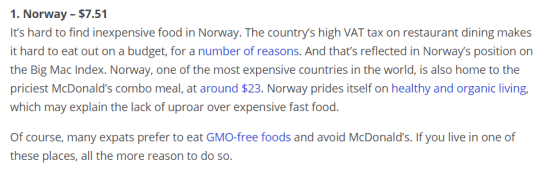
Friends holidayed in Norway recently and paid $10 for a cappuccino. For a welfare state greatly admired by our friends on the Left, the fact that food is very expensive is a big strike against Norway as a workers’ paradise.
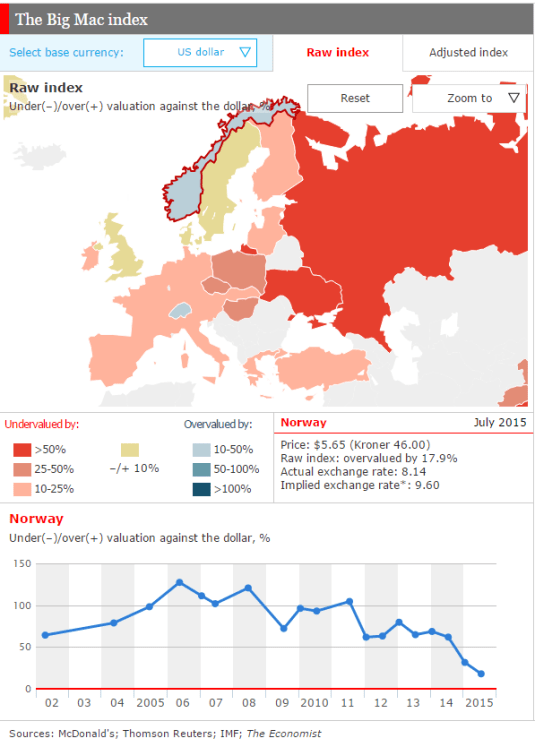
Source: Interactive currency-comparison tool: The Big Mac index | The Economist.
@BernieSanders are the rich getting richer & poor getting poorer or are just men getting their comeuppance?
16 Oct 2015 Leave a comment
in applied welfare economics, economic history, politics - USA Tags: 2016 presidential election, expressive voting, gender wage gap, Leftover Left, middle class stagnation, reversing gender gap, top 1%, Twitter left, wage stagnation
The Typical Male U.S. Worker Earned Less in 2014 Than in 1973: blogs.wsj.com/washwire/2015/… http://t.co/PmTmmfsfbE—
Demos Action (@DemosAction) September 21, 2015
For the first time ever, women are more likely to have bachelor's degrees than men. vox.com/2015/10/13/951… http://t.co/ffK7iiU2Kq—
Demos (@Demos_Org) October 14, 2015
@janlogie The dramatic closing of the gender pay gap at the 10th percentile in the US, UK, Australia and NZ since 1970 but not at the 90th percentile!
15 Oct 2015 4 Comments
in discrimination, economic history, gender, human capital, labour economics, politics - Australia, politics - New Zealand, politics - USA Tags: asymmetric marriage premium, compensating differentials, gender wage gap, marriage and divorce
It seems that the top 10% of men are so busy oppressing the top 10% of women that they forgot to keep up the violence inherent in the capitalist system against the bottom 10% of women. The gender pay gap at the bottom of the economic strata closed quite dramatically and consistently since 1970 or as far back as data was available in Australia, New Zealand, the UK and USA. Much of the closing of the gender pay gap for the low-paid was under the scourge of Reagan, Thatcher, Hawke and Keating and Rogernomics.
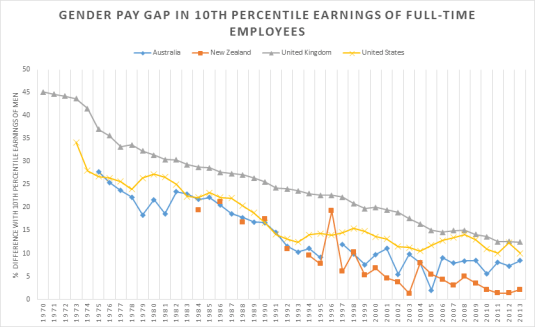
Source and Notes: OECD Employment Database. The gender gap plotted below is unadjusted. It is calculated as the difference between the 10th percentile earnings of men and the 10th percentile earnings of women relative to the 10th percentile earnings of men. Estimates of earnings used in the calculations refer to gross earnings of full-time wage and salary workers. However, this definition may slightly vary from one country to another.
By comparison to this dramatic liberation of women from the gender pay gap at the bottom, the gender pay gap for full-time employees has not really tapered down that much at the top of the income distribution and has been pretty flat for coming on 20 years. It seems the class war is over and has been won by women at the bottom but not at the top?
Younger, more educated women delay having families and can earn as much as their partners. bit.ly/1jw98Ky http://t.co/BaDIlBIBA2—
Ninja Economics (@NinjaEconomics) October 14, 2015
Rather than up the workers, the battle cry of the Posh Trots is up the managers, liberate them from insidious pay inequities imposed upon them by a vast sexist conspiracy of male managers.
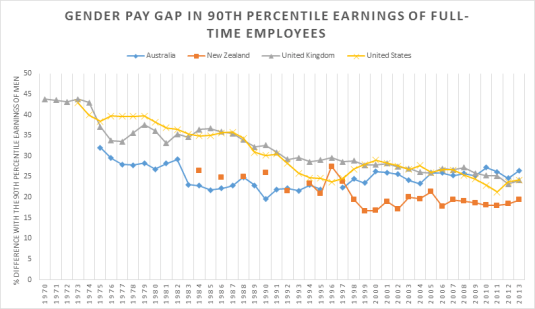
Source and Notes: OECD Employment Database. The gender gap plotted below is unadjusted. It is calculated as the difference between the 10th percentile earnings of men and the 10th percentile earnings of women relative to the 10th percentile earnings of men. Estimates of earnings used in the calculations refer to gross earnings of full-time wage and salary workers. However, this definition may slightly vary from one country to another.
This failure to close the gender pay gap at the top requires more investigation. The available of reliable contraceptives in the late 1960s led to an explosion of investment by women in long duration professional education and in careers where absences because of motherhood in their 20s and 30s was penalised in terms of human capital depreciation and promotional opportunities.

The reason for the endurance of the gender pay gap at the top of the income distribution is compensating differentials. Women at the top were able to have it all.

Professional women could invest in a career and a family and mix-and-match according to their own preferences for career and family and timing of births rather than the preferences of others who looked upon them as some sort of pathfinder for their gender. It is at the top of the income distribution where short absences from the workplace can has very large consequences for wages and promotion.

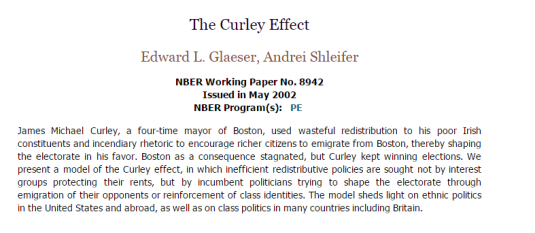
The economics of the Curly effect
14 Oct 2015 Leave a comment
in economic history, politics - USA, Public Choice
Why is #Italy’s productivity so much weaker
14 Oct 2015 Leave a comment
in economic history Tags: Eurosclerosis, Italy
Why is #Italy's productivity so much weaker than in the rest of Europe? V sharp divergence. ecb.europa.eu/press/key/date… http://t.co/pGFP5u6ACS—
Angel Ubide (@AngelUbide) May 22, 2015
Margaret Thatcher was born #OnThisDay in 1925.
14 Oct 2015 Leave a comment
in economic history Tags: British economy, British politics, Margaret Thatcher
Margaret Thatcher was born #OnThisDay in 1925. What Britain looked like under her tenure econ.trib.al/oWL5m7a http://t.co/TtFuexIFdM—
The Economist (@EconBritain) October 13, 2015
Why are we still calling them phones?
14 Oct 2015 Leave a comment
in economic history, economics of media and culture, entrepreneurship Tags: creative destruction, smart phones
Why are we still calling them phones? qz.com/509442 http://t.co/mIqCVnsyrY—
Quartz (@qz) September 26, 2015

50 years of creative destruction in desktops
13 Oct 2015 Leave a comment
in applied welfare economics, economic history, economics of media and culture, entrepreneurship, technological progress Tags: creative destruction, desktops, entrepreneurial alertness, innovation
Computers in 1964 vs. 2014: buff.ly/1NoBa3N http://t.co/4MFBCyk1D3—
HumanProgress.org (@humanprogress) June 28, 2015
Percentage of females employed part-time and USA, UK and Canada
13 Oct 2015 Leave a comment
in economic history, gender, labour supply
A lot more British women work part-time than in the USA or Canada. Is that good or bad?

Data extracted on 13 Oct 2015 01:59 UTC (GMT) from OECD.Stat


Recent Comments