Where's the beef? Meat consumption in America over time econ.st/1hsCmsn http://t.co/4qveycw4zO—
The Economist (@EconBizFin) October 09, 2015
Peak beef?
10 Oct 2015 Leave a comment
British, French, German and Italian asylum seeker intake since 1980
09 Oct 2015 Leave a comment
in economic history, population economics, war and peace
The Germans admitted so many asylum seekers in the early 1990s that I have had to reproduce the graph without Germany so some meaningful interpretation can be made of the three other countries.

Data extracted on 08 Oct 2015 09:06 UTC (GMT) from OECD.Stat.
The British started to admit a great many more refugees at the end of the 1990s compared to the already large number admitted at the beginning. Italy is only started offering shelter to a significant number of asylum seekers since the end of the 1990s. The French have been pretty consistently admitting reasonable numbers of asylum seekers and adjusting their quota upwards in a crisis.
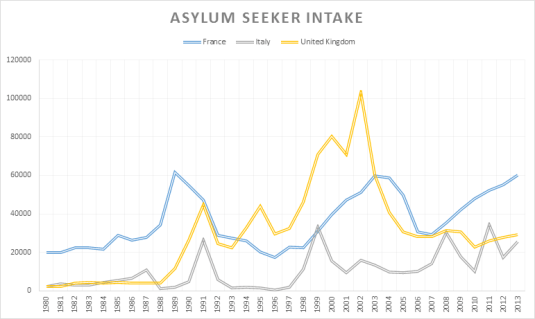
Data extracted on 08 Oct 2015 09:06 UTC (GMT) from OECD.Stat.
Scandinavian asylum seeker intake since 1980
09 Oct 2015 Leave a comment
in economic history, population economics, war and peace
Sweden took in so many asylum seekers in the early 1990s that I am reproducing the graph for the period after to give the data more meaning. Swedish generosity so dominates the rest of Scandinavia that it distorts any reading of the graph unless it is split into two.
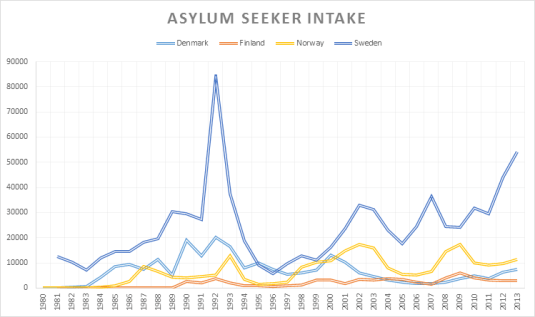
Data extracted on 08 Oct 2015 09:06 UTC (GMT) from OECD.Stat
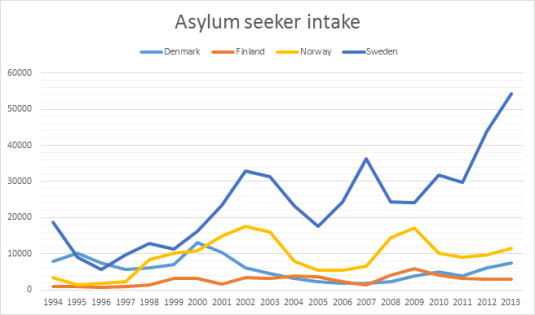
Data extracted on 08 Oct 2015 09:06 UTC (GMT) from OECD.Stat
@nzlabour @NZGreens @OxfamNZ @AmnestyNZ @johnkeyPM asylum seeker intake of Japan, S. Korea and New Zealand since 1987
09 Oct 2015 Leave a comment
in economic history, population economics, war and peace
When notoriously insular Japan and South Korea overtake New Zealand as a refuge for asylum seekers, the Left of New Zealand politics, which loves to lecture the rest of the world on peace and human rights, clearly dropped the ball as the self-appointed consciences of the nation. Being a nuclear free New Zealand is not a passport to moral superiority in the 21st century.
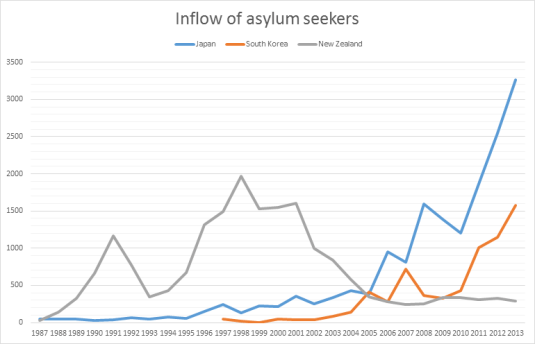
Source: Data extracted on 08 Oct 2015 09:06 UTC (GMT) from OECD.Stat.
The last time a large number of refugees were admitted to New Zealand was under the 1990s National Party government.
US, UK, Germany and New Zealand fertility rates since 1925
09 Oct 2015 Leave a comment
in economic history, population economics
New Zealand and the USA were much more serious about the post-war baby boom than were the British or Germans. The German fertility rates drop below replacement rates in the late 1960s with the British and Americans following them in in the 1970s. Only New Zealand still has a fertility rate of above replacement or thereabouts. German fertility has struggled to stay above replacement rates for coming on 100 years.

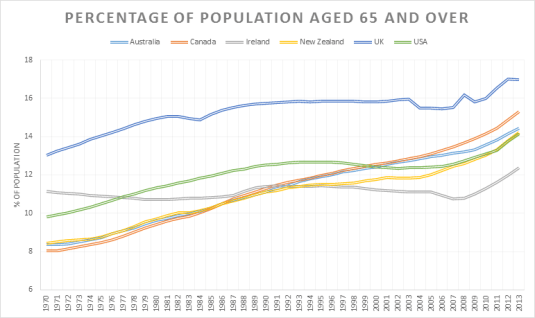
% of population aged 65 and over in English speaking countries since 1970
09 Oct 2015 Leave a comment
in economic history, population economics
Population ageing seemed to have passed the Irish by until the Global Financial Crisis. The British (in dark blue) started older but really did not have much of an ageing until this squiggly behaviour in the last 10 years in their population data. Canada simply got older. There is a long pause in ageing in the USA but ageing started again apace in the last 10 years. Population ageing in Australia (in light blue) and New Zealand was pretty consistent over the entire period since 1970. Australians and New Zealanders simply got older.
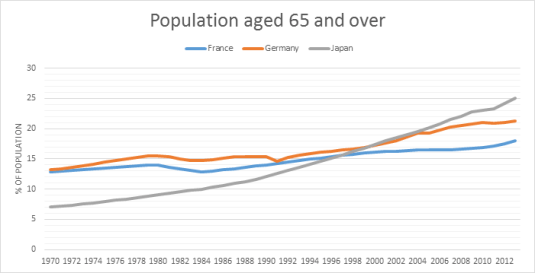
% of Japanese, German and French populations age 65 and over since 1970
09 Oct 2015 Leave a comment
in economic history, population economics
There are certainly rapid ageing in Japan but the Germans are doing their best to catch up with the French not far behind.
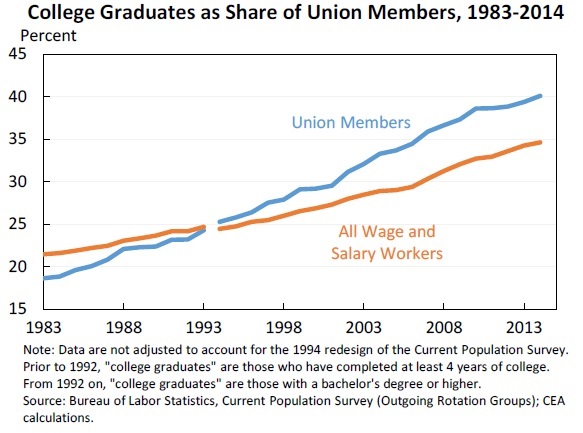
The withering away of unions as a working class movement @nzlabour @FairnessNZ
09 Oct 2015 Leave a comment
Creative destruction in car prices
09 Oct 2015 Leave a comment
in applied welfare economics, economic history, industrial organisation Tags: car prices, creative destruction, good old days
A century of progress: cars in 1913 vs. 2013. buff.ly/1OVS1iB #tech #wealth http://t.co/nzmW84la9R—
HumanProgress.org (@humanprogress) October 06, 2015
What will it take to finish the Last Mile in ending extreme poverty
09 Oct 2015 Leave a comment
in development economics, economic history, growth disasters, growth miracles, politics - Australia, politics - New Zealand, politics - USA, poverty and inequality Tags: capitalism and freedom, The Great Escape, The Great Fact
What will it take to finish the “Last Mile” in ending extreme #poverty? brook.gs/1LiFT8E http://t.co/YxSZ36VCSW—
Brookings (@BrookingsInst) October 07, 2015
US interest rates since 1871
09 Oct 2015 Leave a comment
in business cycles, economic history, macroeconomics, monetary economics Tags: interest rates, monetary policy
15% and more. The long-term view on U.S. Nominal Interest Rates
(from 1.usa.gov/1V2PhP1) http://t.co/52o992NFhJ—
Max Roser (@MaxCRoser) September 20, 2015
@NZNationalParty @nzlabour @NZGreens inflow of asylum seekers into #UK #Canada, #Australia and #NewZealand since 1980
08 Oct 2015 Leave a comment
in economic history, Economics of international refugee law, International law, politics - Australia, politics - New Zealand, population economics Tags: Australia, British politics, economics of migration, refugees
New Zealand’s intake of asylum seekers has been embarrassingly low. The left-wing parties in New Zealand should be ashamed of themselves given the way they wear their international consciences on their sleeves about New Zealand being above it all morally, nuclear free, and can lecture the rest about war, peace and compassion from on high.

Data extracted on 08 Oct 2015 09:06 UTC (GMT) from OECD.Stat; Dataset: International Migration Database.
The UK absorbed an immense number of asylum seekers in the 1990 as did Canada. The data stops in 2013.
Why did the Democrats become the favourites of the rich?
08 Oct 2015 Leave a comment
in economic history, politics - USA, Public Choice
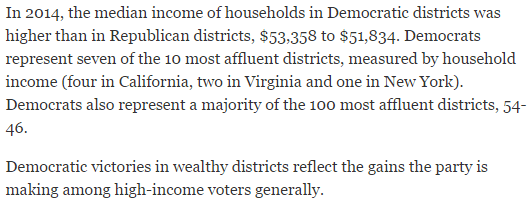
Thomas Edsall is one of the smartest op-ed writers at the New York Times. His latest op-ed is about how well-to-do people are contributing to and voting for the Democrats as much as the poor these days. The Democratic Party now holds the majority of the most affluent congressional districts in America.
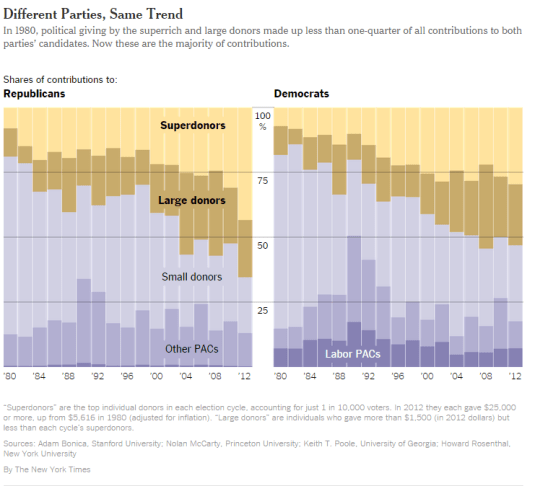
Source: How Did the Democrats Become Favorites of the Rich? – The New York Times.
The median income of Republican districts is slightly less than that of Democratic Party congressional districts. The Republicans are no longer the party of the well-off albeit by a whisker on average. Both the Democrats and the Republicans are doing their best as predicted by the Directors’ Law. They service the swinging voter who is a middle-class voter.
Source: How Did the Democrats Become Favorites of the Rich? – The New York Times.
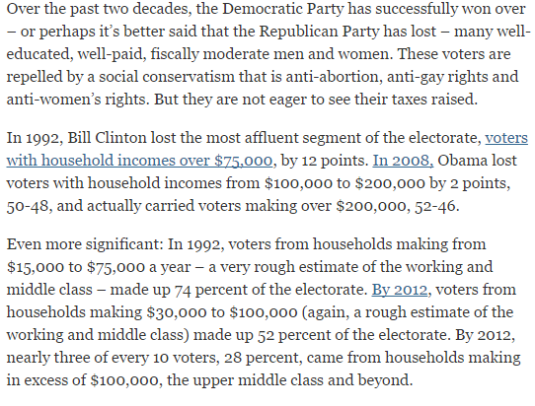
I first noticed this trend in in the best TV soapy of 2008. In the 2008 presidential primaries campaign, Hillary Clinton just talked all the time about the struggles of the middle class and will again in her 2016 campaign. Obama was no different.
A key reason for the withering away of the proletariat in Democratic Party campaign rhetoric is too many of the swinging voters are not in the working class and there are many more many members of the middle classes. One consequence of the withering away of the proletariat is parties that claim to represent the working class are representing a shrinking electorate. They must adapt or face permanent opposition.
Source: The Problem With Middle-Class Populism – The New York Times.
The Democrats do well among the college educated voters. Obama won this over Romney in 2012 by 10 percentage points. This may explain why the Democrats are slightly conflicting: they must win the working class vote as well as the college educated vote to win. The risk for the Democratic party of basing its support in the middle-class is this middle-class is fiscally conservative and rather unwilling to pay for any large-scale redistribution of wealth because it will come out of their very own pockets.
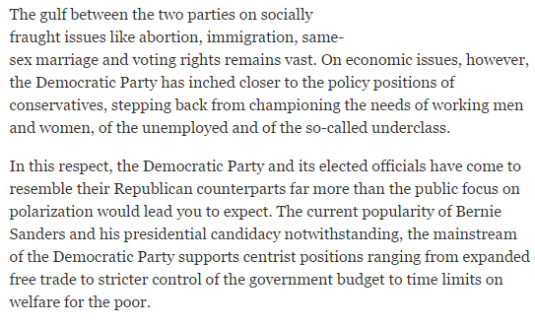
One reason that the Democratic Party and many parties on the centre-left moved into the politics of identity is that allows them to better target their policies towards people who might switch their vote to them all this at the expense of the welfare of the working class. By targeting race, gender, sexual orientation and ethnicity, the policies of the Democratic Party moved away from promoting the general welfare towards servicing their specific voting constituencies. The social liberalism of the Democratic Parties is part of this servicing of their constituencies.
Source: How Did the Democrats Become Favorites of the Rich? – The New York Times.
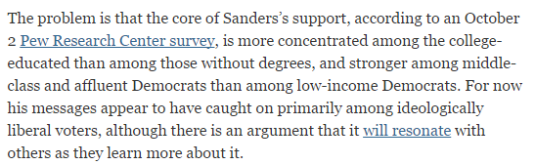
Do not get your hopes up with Bernie Sanders. He too is the favourite of the middle class and college students – expressive voters all. The working class and minorities do not actually have much time for him. Bernie Sanders has terrible polling among black Democratic voters and about 90% of blacks vote Democrat.
Source: How Did the Democrats Become Favorites of the Rich? – The New York Times
There is certainly a lot of straight median voter theorem in the Democratic Party being co-opted by the middle-class but there is more than that. There is the issue of smart political communication in the era of The Great Enrichment. Andrew Cherlin showed some insight into both the basics of political communication about identity and expressive politics when he observed that:
Politicians may prefer to call working-class families by the class position they aspire to rather than the one they hold.

@NZGreens @nzlabour @jamespshaw #TPA a brief history of trade policy
08 Oct 2015 Leave a comment
in economic history, international economic law, international economics, Public Choice Tags: Cato Institute, customs unions, Douglas Irwin, preferential trade agreements, regional trade agreements, TPA, TPPA, trade policy
Good grief, the architect of "the pivot to Asia" opposes TPP? In her book she praised the deal! http://t.co/9XDiv0btzM—
Ryan Lizza (@RyanLizza) October 07, 2015
Creative destruction in car prices
07 Oct 2015 Leave a comment
in applied welfare economics, economic history, entrepreneurship, politics - USA, technological progress, transport economics Tags: creative destruction
CHART: Since 1995 the CPI for new vehicles has been flat, while the CPI (and wages) increased 60%. What a bargain! http://t.co/DOdlQn8pcK—
Mark J. Perry (@Mark_J_Perry) July 01, 2015


Recent Comments