Malaria used to be common in the eastern USA, Continental Europe and northern Australia
26 Mar 2015 Leave a comment

Why, to many critics, Mother Teresa is still no saint – The Washington Post
26 Mar 2015 Leave a comment
Ways How You Would Have Spent Your Money as the 19th Century’s Top 1%
25 Mar 2015 Leave a comment
in economic history Tags: top 1%
 No cars
 still no cars
 No electricity


 coal, no electricity
 no TV
no TV
 no movies
 no DVDs


via 19 Ways How You Would Have Spent Your Money as the 19th Century’s 1 Percent – goodtips4wealth.com.
European residential electricity prices increasing faster than prices in United States
25 Mar 2015 Leave a comment
in applied welfare economics, economic history, energy economics, environmental economics, global warming Tags: energy prices

Why Portugal, Italy, Greece and Spain are called the PIGS
23 Mar 2015 Leave a comment
in economic growth, economic history, Euro crisis, macroeconomics

HT: Finn Kydland
Kabul, 1972
23 Mar 2015 Leave a comment
in economic history, economics of religion, politics - USA Tags: Afghanistan, Islam, women's rights
Life expectancy vis-a-vis the old age pension eligibility age has changed big time
23 Mar 2015 Leave a comment
London Smog 1959
23 Mar 2015 Leave a comment
in economic history, environmental economics, environmentalism Tags: London, London smog
Today’s Economic History: Robert Allen: Engels’s Pause (Brad DeLong’s Grasping Reality…)
23 Mar 2015 Leave a comment
in economic history, technological progress Tags: The Industrial Revolution
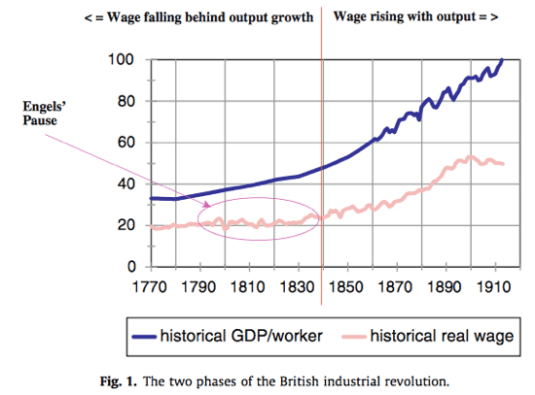
…In the first half of the 19th century, the real wage stagnated while output per worker expanded. The profit rate doubled and the share of profits in national income expanded at the expense of labour and land.
After the middle of the 19th century, real wages began to grow in line with productivity, and the profit rate and factor shares stabilized….
Technical progress was the prime mover behind the industrial revolution. Capital accumulation was a necessary complement.
The surge in inequality was intrinsic to the growth process: technical change increased the demand for capital and raised the profit rate and capital’s share. The rise in profits, in turn, sustained the industrial revolution by financing the necessary capital accumulation.
After the middle of the 19th century, accumulation had caught up with the requirements of technology and wages rose in line with productivity.
via Today’s Economic History: Robert Allen: Engels’s Pause (Brad DeLong’s Grasping Reality…).


Recent Comments