Ortelius' 1564 world map – by studying the coasts he had the idea of continental drift 300 years before it was proven pic.twitter.com/m8UrfEE9jh
— Europe's History (@EuropesHistory) January 22, 2015
Moscow, 1956
22 Jan 2015 Leave a comment
Where are the world’s tallest building?
21 Jan 2015 Leave a comment
in development economics, economic history, growth miracles Tags: Tallest buildings

Today Parliament commemorates 750th anniversary of first Parliament summoned by Simon De Montfort
21 Jan 2015 Leave a comment
in economic history, politics, Public Choice Tags: British parliament, UK politics
First McDonald’s in Moscow
20 Jan 2015 Leave a comment
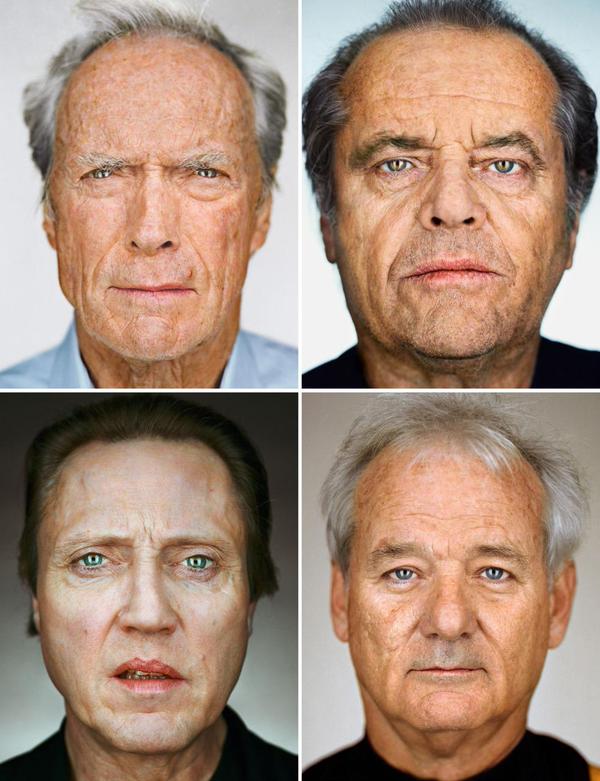
Four Legends by Martin Schoeller
20 Jan 2015 Leave a comment
in economic history, economics of media and culture, movies Tags: movies
Piketty and Capital Taxation in the 21st Century
20 Jan 2015 Leave a comment
in applied price theory, applied welfare economics, economic growth, economic history, income redistribution, macroeconomics, Public Choice, public economics, rentseeking Tags: Leftover Left, Thomas Piketty

“NZ up until the 1980s, was a fairly egalitarian country, apart from Maori and women”
18 Jan 2015 1 Comment
in applied welfare economics, economic history, gender, labour economics, Marxist economics
Max Rashbrooke is at it again in today’s Sunday Star Times – Wellington’s Sunday paper. He was painting pre-economic reform, pre-1984 New Zealand is a golden era of egalitarianism.
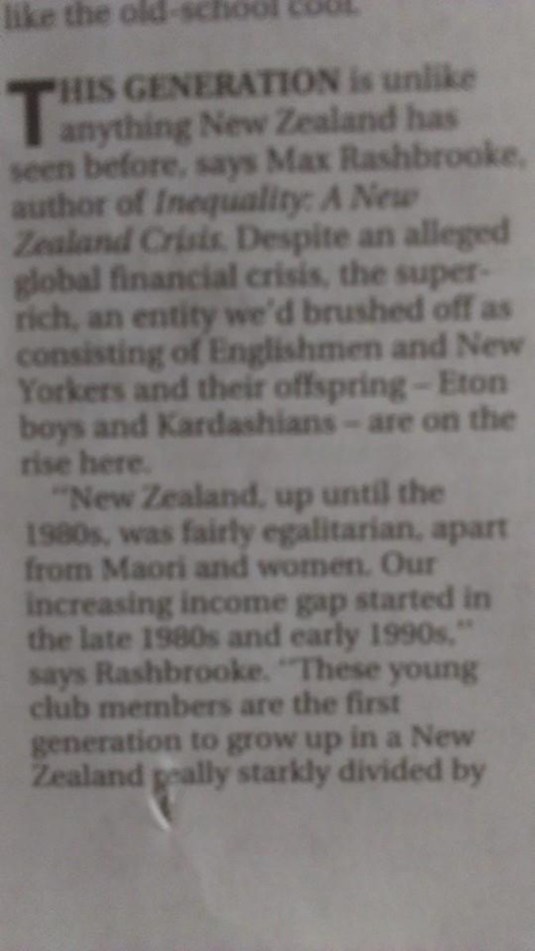
To do this, to paint pre-1984 New Zealand, pre-neoliberal New Zealand as a fairly egalitarian paradise, he only had to ignore up to two thirds of the population and the inequalities they suffered.
“New Zealand up until the 1980s was fairly egalitarian, apart from Maori and women, our increasing income gap started in the late 1980s and early 1990s,” says Rashbrooke. “These young club members are the first generation to grow up in a New Zealand really starkly divided by income.”
Racism and patriarchy can sit comfortably with a fairly egalitarian society if you are to believe the Left over Left.
As he implies in the paper today, captioned and quoted above, New Zealand in the 1980s was not fairly egalitarian for women, the majority of the population, and Māori, another 10% or so of the population.
This ignoring of racial and gender equality is very much in keeping with Max Rashbrooke’s boy’s own view of egalitarianism: women and ethnic minorities such as Māori and Pasifika don’t count in the greater scheme of the Left over Left when they whine and bitch about the Great Enrichment.
The mission in life of the Left over Left is desperately seeking poverty even if they drop out of the statistics most of the people who are no longer in poverty because of the Great Enrichment and the latest blessings of capitalism and freedom.
As shown in figure 1 below, between 1994 and 2010, real equivalised median New Zealand household income rose by 47%; for Māori, this rise was 68%; for Pasifika, the rise in real equivalised median household income was 77%.
Figure 1: Real equivalised median household income (before housing costs) by ethnicity, 1988 to 2013 ($2013)

Source: Bryan Perry, Household incomes in New Zealand: Trends in indicators of inequality and hardship 1982 to 2013. Ministry of Social Development (July 2014).
Median household income increases of nearly 50% in 16 years, and larger increases for ethnic minorities such as Māori and Pasifika should be celebrated rather than simply ignored because they are inconvenient to Left over Left sniping.

As is common with every member of the Left over Left that I run into these days, such as Max Rashbrooke,, their analysis has no gender analysis.
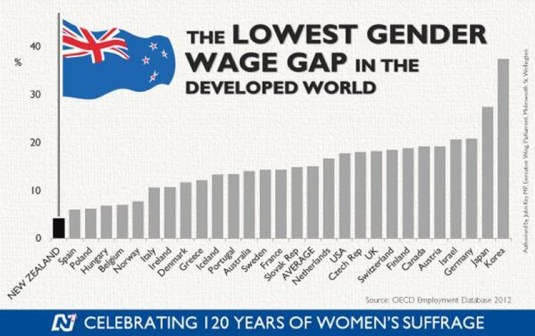
The Left over Left invariably fail to mention that New Zealand has the smallest gender wage gap of all the industrialised countries.
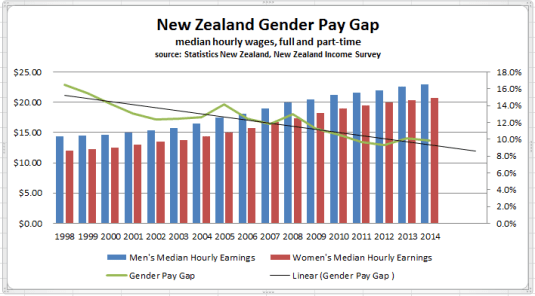
Sources: Ministry of Women’s Affairs and Statistics New Zealand: New Zealand Income Survey
Over the last more than two decades in New Zealand, there has been sustained income growth spread across all of New Zealand society contrary to hopes and dreams of the Left over Left.
Perry (2014) reviews the poverty and inequality data in New Zealand every year for the Ministry of Social Development. He concluded that:
Overall, there is no evidence of any sustained rise or fall in inequality in the last two decades. The level of household disposable income inequality in New Zealand is a little above the OECD median. The share of total income received by the top 1% of individuals is at the low end of the OECD rankings
Singapore Campaigns of the 70s/80s
17 Jan 2015 Leave a comment
in applied welfare economics, economic history, economics of regulation Tags: meddlesome preferences, nanny state, Singapore


 With intensive usage of media, campaigns are launched to achieve certain particular goals, usually in a political, social or commercial sense. Sometimes, a campaign represents an era, and some of its posters go on to become iconic representations that are even remembered after decades. One of the examples is the United States’ “I Want You For U.S. Army” poster in 1917.
 Campaigns are meant to have a long term impact. However, human errors, wrong judgement or a lack of foresight during the introduction of campaigns can sometimes lead to failures or even disasters to the country. In 1958, the new China launched the Four Pests Campaign in a bid to eliminate rats, flies, mosquitoes and sparrows. The sparrows were targeted because they ate the farmers’ grain seeds. In a short time, millions of Chinese were mobilised for the campaign. Sparrows, as well as other birds, were shot, with their nests…
View original post 3,146 more words


Recent Comments