Exactly when did Duke William II “The Conqueror” of Normandy become King of the English? Although he certainly became the De Facto King of the English when he defeated King Harold II Godwinson at the Battle of Hastings in October of 1066, it was not until his coronation on Christmas Day of that year did […]
Christmas Day 1066. William the Conqueror is crowned King of the English
Christmas Day 1066. William the Conqueror is crowned King of the English
26 Dec 2023 1 Comment
in economic history Tags: British history
#OTD Romania
25 Dec 2023 Leave a comment
in economic history, economics of crime, law and economics, liberalism, Marxist economics Tags: Romania

Corporate Taxation, Ireland, and Jealousy
24 Dec 2023 Leave a comment
in applied price theory, economic growth, economic history, macroeconomics, public economics Tags: Ireland, taxation and entrepreneurship, taxation and investment
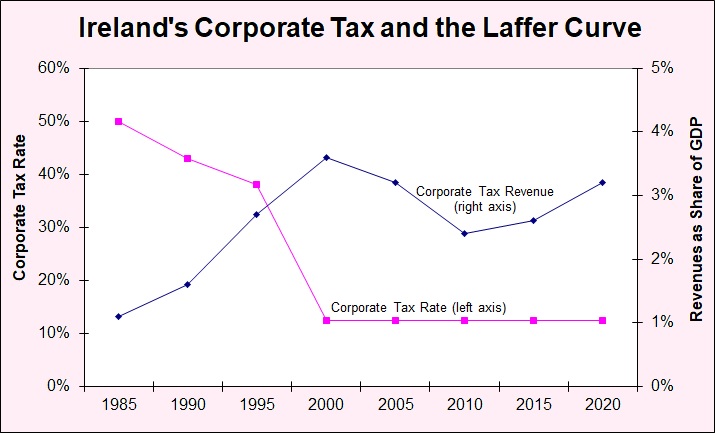
Two months ago, I wrote about a remarkable example of the Laffer Curve, involving Ireland’s low 12.5 percent corporate tax rate. According to the New York Times, Ireland was collecting so much corporate tax revenue that the government was having a hard time figuring out what to do with all the money (as you might […]
Corporate Taxation, Ireland, and Jealousy
FMI Public Speaker Series – Finn Kydland
23 Dec 2023 Leave a comment
in applied price theory, budget deficits, business cycles, comparative institutional analysis, development economics, economic growth, economic history, economics of bureaucracy, fiscal policy, global financial crisis (GFC), great depression, great recession, growth disasters, growth miracles, history of economic thought, human capital, income redistribution, labour economics, labour supply, macroeconomics, Public Choice, public economics, rentseeking
Finn E. Kydland Nobel Lecture at CERGE-EI
22 Dec 2023 Leave a comment
in applied price theory, budget deficits, business cycles, comparative institutional analysis, development economics, economic growth, economic history, economics of regulation, fiscal policy, global financial crisis (GFC), great depression, great recession, growth disasters, growth miracles, history of economic thought, human capital, income redistribution, labour economics, labour supply, macroeconomics, monetary economics, Public Choice, public economics
Unconvincing
21 Dec 2023 Leave a comment
in business cycles, economic history, global financial crisis (GFC), great recession, history of economic thought, inflation targeting, macroeconomics, monetary economics, politics - New Zealand Tags: monetary policy

The Herald ran an op-ed yesterday under the heading “Why the Government’s new Reserve Bank mandate may lead to worse outcomes”. It was written by Toby Moore who served as an economic adviser in Grant Robertson’s office while he was Minister of Finance (a fact the Herald chose not to disclose to its readers). I’m more […]
Unconvincing
Central Banking and the Real-Bills Doctrine
21 Dec 2023 Leave a comment
in economic history, financial economics, great depression, history of economic thought, macroeconomics, monetary economics Tags: monetary policy
Robert Hetzel, a distinguished historian of monetary theory and of monetary institutions, deployed his expertise in both fields in his recent The Federal Reserve: A New History. Hetzel’s theoretical point departure is that the creation of the Federal Reserve System in 1913 effectively replaced the pre-World War I gold standard, in which the value […]
Central Banking and the Real-Bills Doctrine
Hawtrey on the Interwar Gold Standard
21 Dec 2023 Leave a comment
in business cycles, economic history, great depression, history of economic thought, macroeconomics, monetary economics
I just got a copy of Ralph Hawtrey’s Trade Depression and the Way Out (1933 edition, an expanded version of the first, 1931, edition published three days before England left the gold standard). Just flipping through the pages, I found the following tidbit on p. 9. The banking system of the world, as it was […]
Hawtrey on the Interwar Gold Standard
From Now To 2100 Emission Reduction Policy Costs Greatly Exceed Any Net Benefit from Averted Warming
20 Dec 2023 Leave a comment
in applied price theory, applied welfare economics, development economics, econometerics, economic history, energy economics, environmental economics, global warming, growth disasters, growth miracles Tags: climate alarmism
The benefits of not meeting Paris Accord emissions-reduction targets outweigh the costs associated even with worst-case-scenario global warming throughout the 21st century.
From Now To 2100 Emission Reduction Policy Costs Greatly Exceed Any Net Benefit from Averted Warming
Monetary policy turning points
18 Dec 2023 Leave a comment
in business cycles, economic growth, economic history, economics of bureaucracy, global financial crisis (GFC), great recession, history of economic thought, inflation targeting, macroeconomics, monetary economics, politics - New Zealand, Public Choice Tags: monetary policy

When the Reserve Bank MPC came out late last month with its last words on monetary policy before its extended summer break, my post then was headed “Really?“. It was a commentary on the disjunction between the Reserve Bank’s inflation forecasts on the one hand, that showed quarterly inflation collapsing (not really too strong a word […]
Monetary policy turning points
Claudia Goldin: “What’s ‘Greedy Work’ and Why Is It a Problem?” | People…
18 Dec 2023 Leave a comment
in applied price theory, discrimination, economic history, gender, history of economic thought, human capital, labour economics, labour supply, minimum wage, occupational choice Tags: gender wage gap, sex discrimination
Number of oil spills decreased
18 Dec 2023 Leave a comment
in economic history, energy economics, environmental economics Tags: oil spills
The Piketty-Saez-Zucman response to Auten and Splinter
17 Dec 2023 Leave a comment
in applied price theory, econometerics, economic history, entrepreneurship, financial economics, income redistribution, labour economics, politics - USA, poverty and inequality, Public Choice, public economics Tags: top 1%
A number of you have asked me what I think of their response. The first thing I noticed is that Auten and Splinter make several major criticisms of PSZ, and yet PSZ respond to only one of them. On the others they are mysteriously silent. The second thing I noticed is that PSZ have been […]
The Piketty-Saez-Zucman response to Auten and Splinter
Dr Lawrie Knight: Fact Checking Waitangi Tribunal Finding
16 Dec 2023 Leave a comment
in constitutional political economy, economic history, law and economics, politics - New Zealand, property rights, Public Choice Tags: constitutional law
Evidence that Northern ,Māori ,knew they were ceding sovereignty to the Crown when they signed the Treaty of Waitangi – fact checking the Waitangi Tribunal 2014 findings and the 2023 findings released on the 8th of December 2023. The Waitangi Tribunal has stated in its 2014 inquiry into Te Paparahi o Te Raki, that the…
Dr Lawrie Knight: Fact Checking Waitangi Tribunal Finding
GDP per capita growth
16 Dec 2023 Leave a comment
in business cycles, economic growth, economic history, inflation targeting, macroeconomics, monetary economics

The quarterly GDP data were out on Thursday. Quite how one reads them probably depends on bit on where your focus lies. To the extent that the focus is on squeezing out inflation then any data that points to excess demand dissipating a bit faster is mostly a good and welcome thing. The sooner inflation is back to […]
GDP per capita growth


Recent Comments