How much more will you earn by going to university? It depends hugely on which country you're from http://t.co/7RMnUTM8nj—
paulkirby (@paul1kirby) September 11, 2015
Higher education is a dog of an investment in #NewZealand
14 Sep 2015 Leave a comment
in economics of education, human capital, labour economics, labour supply, occupational choice, politics - New Zealand Tags: College premium, education premium, graduate premium
Long-term evidence of the college premium
12 Sep 2015 Leave a comment
in economics of education Tags: College premium, education premium, graduate premium
Always exceptions but BA+ earn more on average than everyone else. seii.mit.edu/wp-content/upl… @anamfores http://t.co/gtO69MetqB—
S Dynarski (@dynarski) September 09, 2015
Mises on feminism
12 Sep 2015 Leave a comment
in constitutional political economy, discrimination, economics of education, gender, labour economics, labour supply, liberalism, occupational choice, Public Choice, rentseeking Tags: economics of fertility, economics of the family, engines of liberation, female labour force participation, feminism, women's liberation
Trends in the British gender wage gap by age band
10 Sep 2015 Leave a comment
in discrimination, economic history, economics of education, gender, human capital, labour economics, labour supply Tags: British economy, gender wage gap

Maybe teaching quality does matter
05 Sep 2015 Leave a comment
in economics of education, human capital, politics - USA Tags: economics of teachers
Human capital accumulation and economic growth
01 Sep 2015 Leave a comment
in economic growth, economics of education, human capital, labour economics, macroeconomics Tags: educational attainment, endogenous growth theory, human capital, knowledge capital
Low numeracy skills across the OECD
30 Aug 2015 Leave a comment
in economics of education, human capital, labour economics, labour supply, occupational choice Tags: literacy and numeracy, PISA, reading and writing

Scientific Retractions are on the rise
25 Aug 2015 Leave a comment
in economics of crime, economics of education, law and economics Tags: conjecture and refutation, scientific fraud
Scientific Retractions are on the Rise, and That May Be a Good Thing
priceonomics.com/scientific-ret… http://t.co/jMrC8R0EI1—
Priceonomics (@priceonomics) June 24, 2015
Over-qualification rates in jobs in the USA, UK and Canada
19 Aug 2015 2 Comments
in economics of bureaucracy, economics of education, human capital, job search and matching, labour economics, labour supply, occupational choice, politics - USA, Public Choice Tags: British economy, Canada, compensating differentials, job shopping, offsetting behaviour, on-the-job training, search and matching, The fatal conceit, The pretense to knowledge
In the UK, foreign-born are much more likely to be over qualified than native born highly educated not in education with less difference between men and women. More men than women are overqualified for their jobs in the UK. Over qualification is less of a problem in the UK than in the USA and Canada.
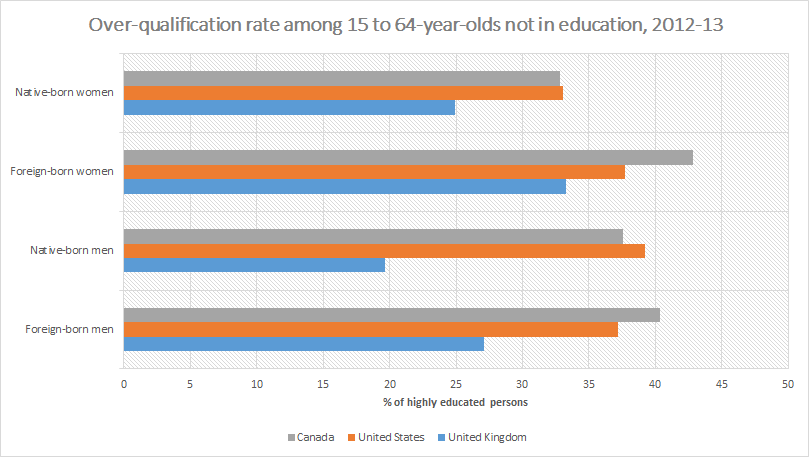
Source: OECD (2015) Indicators of Immigrant Integration 2015: Settling In.
In the USA and Canada, there are few differences between native and foreign born men in over-qualification rates. Foreign-born women tend to be more over-qualified than native born women in the USA and more so in Canada. Many more workers are overqualified for their jobs in the USA and Canada as compared to the UK.
There are large differences in the percentage of people with tertiary degrees and the education premium between these three countries that are outside the scope of this blog post. These trends may explain differences in the degree of educational mismatch.
It goes without saying that the concept of over-qualification and over-education based mismatch in the labour market is ambiguous, if not misleading and a false construct.
To begin with, under human capital theories of labour market and job matching, what appears to be over-schooling substitutes for other components of human capital, such as training, experience and innate ability. Not surprisingly, over-schooling is more prominent among younger workers because they substitute schooling for on-the-job training. A younger worker of greater ability may start in a job below his ability level because he or she expects a higher probability to be promoted because of greater natural abilities. Sicherman and Galor (1990) found that:
overeducated workers are more likely to move to a higher-level occupation than workers with the required level of schooling
Investment in education is a form of signalling. Workers invest so much education that they appear to be overqualified in the eyes of officious bureaucrats. The reason for this apparent overinvestment is signalling superior quality as a candidate. Signalling seems to be an efficient way of sorting and sifting among candidates of different ability. The fact that signalling survives in market competition suggests that alternative measure ways of measuring candidate quality that a more reliable net of costs are yet to be discovered.
A thoroughly disheartening chart if you're a graduate in the UK i100.io/mpDbJAl http://t.co/mv9izA0mbc—
i100 (@thei100) August 20, 2015
Highly educated workers, like any other worker, must search for suitable job matches. Not surprisingly, the first 5 to 10 years in the workforce are spent in half a dozen jobs as people seek out the most suitable match in terms of occupation, industry and employer. Some of these job seekers who are highly educated will take less suitable jobs while they search on-the-job for better matches. Nothing is free or instantly available in life including a good job match.
A more obvious reason for over qualification is some people like attending university and other forms of education for the sheer pleasure of it.
Anyone who encounters the words over-qualified and over-educated should immediately recall concepts such as the pretence to knowledge, the fatal conceit, and bureaucratic busybodies. As Edwin Leuven and Hessel Oosterbeek said recently:
The over-education/mismatch literature has for too long led a separate life of modern labour economics and the economics of education.
We conclude that the conceptional measurement of over-education has not been resolved, omitted variable bias and measurement error are too serious to be ignored, and that substantive economic questions have not been rigorously addressed.
Gender politics on college campuses
14 Aug 2015 Leave a comment
in discrimination, economics of education, gender, labour economics Tags: fainting couch feminism, male privilege, meddlesome preferences, micro-aggressions, nanny state, safe spaces, trigger warnings
Is there a gender gap in the Dunning-Kruger effect?
10 Aug 2015 Leave a comment
in applied price theory, economics of education, economics of media and culture, gender, human capital, labour economics, personnel economics Tags: cognitive psychology, Dunning-Kruger effect, economics of personality traits, reversing gender gap
Great scientists know what they don't know. 1st step to learning. Female economists winning. blogs.lse.ac.uk/impactofsocial… http://t.co/xcfCvMNU3U—
S Dynarski (@dynarski) July 03, 2015
The number of children not going to school globally has halved in 10 years
08 Aug 2015 Leave a comment
in development economics, economic history, economics of education, growth disasters, growth miracles Tags: educational attainment, schooling, The Great Fact
"55 million children remained out of school in 2012" New blog on #MDG2 – blogs.worldbank.org/opendata/mdg2-… #opendata #WDI2015 http://t.co/6uYQE1RNSG—
World Bank Data (@worldbankdata) May 20, 2015
An under-emphasised fact in education policy
07 Aug 2015 Leave a comment
in economics of education Tags: IQ
 Utopia, you are standing in it!
Recent Comments