Dramatic increase in education across all demographic groups over the past 100 years bit.ly/16XYZun http://t.co/0Ew0OxDzlx—
Catherine Mulbrandon (@VisualEcon) August 27, 2013
The education explosion in the 20th century
06 Aug 2015 Leave a comment
in economic history, economics of education, human capital, labour economics, occupational choice Tags: age of human capital, educational attainment
The discovery process in student athlete wages
04 Aug 2015 Leave a comment
in economics of education, entrepreneurship, human capital, labour economics, labour supply, sports economics Tags: entrepreneurial alertness, on-the-job training, superstar wages, superstars


FiveThirtyEightSports has a great piece about how much college quarterbacks are really worth in terms of market value. I’m neutral-but-leaning-against on the issue of paying college athletes, but the piece begins with University of Iowa Athletic Director Gary Barta giving a very bad reason to oppose it: it’s too complicated to figure out how much they should be paid. He’s right given how he’s conceiving the issue, he’s just not conceiving the issue in the right way.
Wages are not determined by a person or group of people independently evaluating what a job is “really” worth. That’s what markets do, i.e. that’s what innumerable decisions over time by innumerable anonymous consumers operating within the price system do. The failure to understand how the price system works in allocating resources by preferences is not unique to Barta. Very few people understand it, and lamentably even people who do understand it often…
View original post 619 more words
Linguistic distance among languages of Europe 2015
01 Aug 2015 Leave a comment
in economics of education Tags: economics of languages, network goods
Interesting!
Lexical distance among languages of Europe 2015(Source: bit.ly/1ENUPaB ) http://t.co/PMDZhclnuM—
Max Roser (@MaxCRoser) June 28, 2015
Graduate premium in starting wages
31 Jul 2015 Leave a comment
in economics of education, human capital, labour economics, labour supply Tags: College premium, graduate premium
Why next to no gender wage gap for under 45s in New Zealand?
28 Jul 2015 Leave a comment
in discrimination, economics of education, gender, human capital, labour economics, labour supply, occupational choice, politics - New Zealand Tags: gender wage gap
Figure 1: unadjusted median pay per hour by gender and age group, New Zealand, 2014

Source: New Zealand Income Survey 2014 via Human Rights Commission: Tracking Equality at Work.
More evidence on the rise and rise of the working super rich – the top income earners are top wage earners now
28 Jul 2015 Leave a comment
in economic history, economics of education, entrepreneurship, financial economics, human capital, labour supply, occupational choice, politics - USA Tags: creative destruction, entrepreneurial alertness, top 1%, top income earners, top wage earners
Page 47 from "An Illustrated Guide to Income" more economic #dataviz at: bit.ly/10QWgyR http://t.co/d1dhSYKWDC—
Catherine Mulbrandon (@VisualEcon) June 03, 2013
The gender wage gap by educational attainment
28 Jul 2015 Leave a comment
in discrimination, economics of education, gender, human capital, labour economics, occupational choice Tags: College premium, education premium, gender wage gap
Men's and Women's Earnings by Education (Ph'Ds are the most equal) bit.ly/153m9jZ http://t.co/IPfT15Qwiz—
Catherine Mulbrandon (@VisualEcon) September 03, 2013
Murray Rothbard on the falling popularity of Pope Francis
25 Jul 2015 Leave a comment
in applied price theory, applied welfare economics, comparative institutional analysis, constitutional political economy, economic history, economics of bureaucracy, economics of education, economics of regulation, economics of religion, energy economics, environmental economics, income redistribution, industrial organisation, international economics, Murray Rothbard, politics - Australia, politics - New Zealand, politics - USA, Public Choice, rentseeking, survivor principle Tags: antiforeign bias, antimarket bias, Catholic social thought, climate alarmism, expressive voting, global warming, makework bias, Pope Francis, rational ignorance, rational irrationality, voter demographics


Unemployment rates by education in the USA
21 Jul 2015 Leave a comment
in business cycles, economics of education, global financial crisis (GFC), great recession, human capital, job search and matching, labour economics, labour supply, macroeconomics, unemployment Tags: education premium, labour market demographics
June jobless rate for people 25+ with
B.A. or more 2.5%
High school diploma 5.4%
No H.S. 8.2%
on.wsj.com/1LG1B6z http://t.co/luUUuw9h1V—
Sudeep Reddy (@Reddy) July 02, 2015
Research papers decoded
17 Jul 2015 Leave a comment
in economics of education, economics of media and culture Tags: academic bias, academic jargon, conjecture and refutation
Capitalism and The Great Fact in China
17 Jul 2015 Leave a comment
in applied price theory, applied welfare economics, comparative institutional analysis, development economics, economic history, economics of education, economics of regulation, entrepreneurship, environmental economics, growth disasters, growth miracles, history of economic thought, industrial organisation, Marxist economics, Public Choice Tags: capitalism and freedom, China, fall of communism, Leftover Left, transitional economies
As China grew freer economically, its poverty rate fell. buff.ly/1KohOxS http://t.co/OpaxOzNdNs—
HumanProgress.org (@humanprogress) June 29, 2015
Low performers in maths by gender, USA, UK, Japan, Canada, Australia and New Zealand
17 Jul 2015 Leave a comment
in discrimination, economics of education, gender, human capital, labour economics Tags: cognitive psychology, educational psychology, lost boys, PISA, Psychology, reversing gender gap
Figure 1: % of students achieving a proficiency level below 2 in maths by gender, USA, UK, New Zealand, Japan, Canada and Australia, 2012
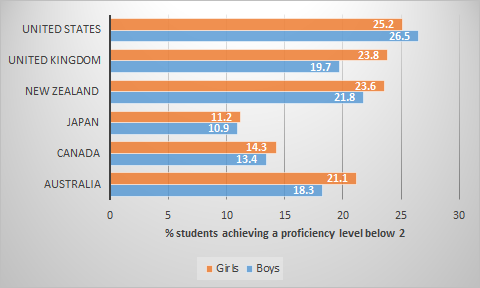
Source: OECD StatExtract.
What group has by far the lowest jobless rate?
17 Jul 2015 Leave a comment
in economics of education, human capital, job search and matching, labour economics, labour supply, occupational choice, unemployment Tags: College premium, compensating differentials, graduate premium, labour demographics
What group has by far the lowest jobless rate? College grads on.wsj.com/1Mtk8l9 http://t.co/27ft9qYjvz—
WSJ Central Banks (@WSJCentralBanks) June 05, 2015
Share of university degrees conferred to U.S. women since 1970
16 Jul 2015 Leave a comment
in economic history, economics of education, human capital, labour economics, occupational choice, politics - USA Tags: lost boys, reversing gender gap
Share of university degrees conferred to U.S. women since 1970 (via @MaxCRoser) http://t.co/FUGrM7WbJd—
Claire Lehmann (@clairlemon) July 09, 2015
Low performers in science by gender, USA, UK, Japan, Canada, Australia and New Zealand
16 Jul 2015 Leave a comment
in discrimination, economics of education, gender, labour economics, labour supply Tags: cognitive psychology, educational psychology, lost boys, PISA, Psychology, reversing gender gap
Figure 1: % of students achieving a proficiency level below 2 in science by gender, USA, UK, New Zealand, Japan, Canada and Australia, 2012

Source: OECD StatExtract.
 Utopia, you are standing in it!
Recent Comments