Marc Wilson, David Seymour, MP and should students harden up

Professor Marc Wilson is most upset by David Seymour’s suggestion that students who are under stress should harden up. Seymour was misquoted, but that is not so important for the purpose of today. What Wilson said in a rambling op-ed more about his gripes at student loans than student mental health was:

So, if David Seymour did advise students and, by extension anyone, experiencing the burdens of stress-related mental health issues to “harden up”, I think that’s reprehensible. There might have been a time when university was all about carousing the week long at taxpayers’ expense, and cramming at the end of the year, but that time has long gone.

One of the purposes of undergraduate study is to work out if you have chosen the right vocation. In the very beginning of the first year of medicine, new students are confronted with blood and dead bodies and all sorts of things that are not for the squeamish.

Another thing that is not for any prospective medical student is an inability to cope with stress. Doctors have lives in their hands and have to manage that calmly. New police officers are in the same position. They have to cope with a lot of death and misery. They need to learn quickly whether they can even hope to do so.

Doctors must cope with tremendous stress and still succeed. My father was a doctor. He was a changed man when he retired such was the burden of stress lifted from his shoulders. My brother and sister-in-law are also doctors as is a nephew. My late sister was a nurse. I have a nephew who is a police constable.

Some years ago I saw a program about the sports preferences of doctors. Those doctors that like extreme sports happened to work in emergency departments of hospitals. Those doctors who were somewhat overweight and rather disinterested in sport especially dangerous sports ended up as paediatricians.

I always remember an old flat mate of mine in Canberra whose father was a surgeon. He had no illusions about what was required of surgeons. They had to have tremendous arrogance and someone else to tell them what to do. If you are going to open up someone with a knife you must have tremendous self-confidence and ability to cope with stress. It is helpful if you actually know what you are doing as well but the key thing is a steady hand and cool head.

Many professions are high stress occupations. Anyone choosing to enter a high stress profession must find out soon whether they can cope with the demands of other people’s lives in their hands.

You do students no favours by sheltering him from the fact that they have chosen a higher stress occupation. If a medical student cannot cope with exam stress, you do worry about their ability to cope with someone’s life in their hands. That will be every day when they do their residency in emergency departments in their first year after leaving university. Better find out quickly. New lawyers work long hours too.

In my first year at university, I used to look at the first year medical students and worry that my life will be in some of their hands should I show up at a Tasmanian emergency room in about six years or so.

Personality traits including conscientiousness and emotional stability have important influences on occupational choice:

High Openness is strongly over-represented in creative, theoretical fields such as writing, the arts, and pure science, and under-represented in practical, detail-oriented fields such as business, police work, and manual labour. (Myers and McCaulley 1985, pp.246-8).

High Extraversion is over-represented in people-oriented fields like sales and business, and under-represented in fields like accounting and library work. (Myers and McCaulley 1985, pp.244-6). High Agreeableness is over-represented in “caring” fields like teaching, nursing, religion, and counselling, and under-represented in pure science, engineering, and law. (Briggs Myers and McCaulley 1985, pp.248-50). Individuals studying or working in fields atypical for their personality are also markedly more likely to drop out or switch occupations. (Briggs Myers and Myers 1993)…

Neuroticism indexes the propensity to experience negative emotions like anxiety, anger, and depression. Persons low in Neuroticism rarely experience such feelings, while persons high in Neuroticism experience them frequently. Neuroticism is also associated with hard-to-control cravings for food, drugs, and other forms of consumption with immediate benefits but long-run costs. (Costa and Widiger 1994; Costa and McCrae 1992)

Much of my diabetes management is about quite frankly hardening up. Do not give in to the temptation of sweet things. Moderate your diet; get some more exercise. It is about acquiring skills and inner strength you previously did not have but for the diagnosis of diabetes. I lost 18 kg as a result.

Why are Asian females so good at maths?

The key difference between what poor people and everyone else eat

When I was a lad, the poor were thin. Indeed, I can remember the names of my two classmates from high school who were just a little bit chubby. I will not mention names.

Roland Fryer On Why Good Schools Matter @greencatherine @dbseymour @ThomasHaig @PPTAWeb

Roland Fryer believes “high-quality education is the new civil rights battleground”. He is an extraordinary man who was carrying a gun and selling drugs at 14 and an assistant professor of economics at Harvard at the age of 27. He is fearless as a researcher.

Source: Roland Fryer On Why Good Schools Matter – Forbes

James Heckman on improving schools @greencatherine @dbseymour @ThomasHaig @PPTAWeb

Source:  James J. Heckman The American Family in Black and White: A Post-Racial Strategy for Improving Skills to Promote Equality, 2011.

Source: Promoting Social Mobility | Boston Review

Higher education is a dog of an investment in #NewZealand

Long-term evidence of the college premium

Mises on feminism

Trends in the British gender wage gap by age band

Education policy and kittens

image

Image

Maybe teaching quality does matter

Human capital accumulation and economic growth

Low numeracy skills across the OECD

https://www.facebook.com/theOECD/photos/a.10150177273897461.304209.73290362460/10152794003922461/?type=1


image

Scientific Retractions are on the rise

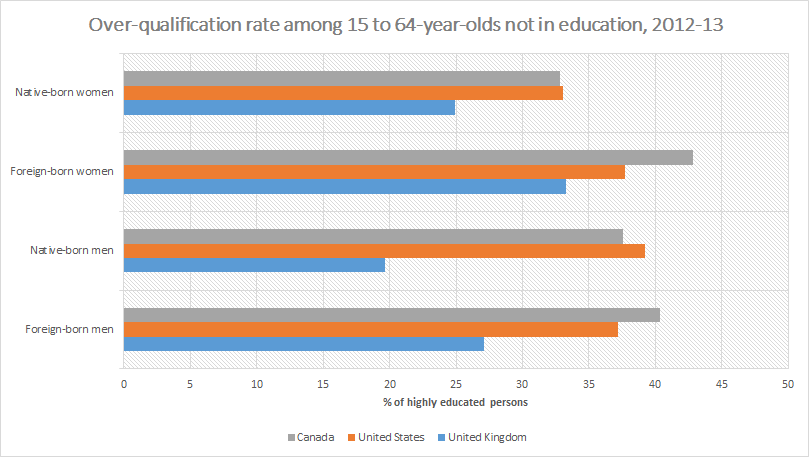
Over-qualification rates in jobs in the USA, UK and Canada

In the UK, foreign-born are much more likely to be over qualified than native born highly educated not in education with less difference between men and women. More men than women are overqualified for their jobs in the UK. Over qualification is less of a problem in the UK than in the USA and Canada.

image

Source: OECD (2015) Indicators of Immigrant Integration 2015: Settling In.

In the USA and Canada, there are few differences between native and foreign born men in over-qualification rates. Foreign-born women tend to be more over-qualified than native born women in the USA  and more so in Canada. Many more workers are overqualified for their jobs in the USA and Canada as compared to the UK.

There are large differences in the percentage of people with tertiary degrees and the education premium between these three countries that are outside the scope of this blog post. These trends may explain differences in the degree of educational mismatch.

It goes without saying that the concept of over-qualification and over-education based mismatch in the labour market is ambiguous, if not misleading and a false construct.

To begin with, under human capital theories of labour market and job matching, what appears to be over-schooling substitutes for other components of human capital, such as training, experience and innate ability. Not surprisingly,  over-schooling is more prominent among younger workers because they substitute schooling for on-the-job training. A younger worker of greater ability may start in a job below his ability level  because he or she  expects a higher probability to be promoted because of greater natural abilities. Sicherman and Galor (1990) found that:

overeducated workers are more likely to move to a higher-level occupation than workers with the required level of schooling

Investment in education is a form of signalling. Workers invest so much education that they appear to be overqualified  in the eyes of officious bureaucrats. The reason for this apparent overinvestment  is signalling superior quality as a candidate. Signalling seems to be an efficient way of sorting and sifting among candidates of different ability. The fact that signalling survives in market competition suggests that alternative measure ways of measuring candidate quality  that a more reliable net of costs are yet to be discovered.

Highly educated workers, like any other worker, must search for suitable job matches. Not surprisingly, the first 5 to 10 years in the workforce are spent in half a dozen jobs as people seek out the most suitable match in terms of occupation, industry and employer. Some of these job seekers who are highly educated will take less suitable jobs while they search on-the-job for better matches. Nothing is free or instantly available in life including a good job match.

A more obvious reason for over qualification is some people like attending university and other forms of education for the sheer pleasure of it.

Anyone who encounters the words over-qualified and over-educated should immediately recall concepts such as the pretence to knowledge, the fatal conceit, and bureaucratic busybodies. As Edwin Leuven and Hessel Oosterbeek said recently:

The over-education/mismatch literature has for too long led a separate life of modern labour economics and the economics of education.

We conclude that the conceptional measurement of over-education has not been resolved, omitted variable bias and measurement error are too serious to be ignored, and that substantive economic questions have not been rigorously addressed.

Previous Older Entries Next Newer Entries

David Andolfatto

Celebrating humanity's flourishing through the spread of capitalism and the rule of law

Monetary Non-Neutrality

Celebrating humanity's flourishing through the spread of capitalism and the rule of law

Reason Magazine

Celebrating humanity's flourishing through the spread of capitalism and the rule of law

Coyote Blog

Celebrating humanity's flourishing through the spread of capitalism and the rule of law

Thoughts from the North

Celebrating humanity's flourishing through the spread of capitalism and the rule of law

Fardels Bear

A History of the Alt-Right

Vincent Geloso

Econ Prof at George Mason University, Economic Historian, Québécois

Bassett, Brash & Hide

Celebrating humanity's flourishing through the spread of capitalism and the rule of law

Truth on the Market

Scholarly commentary on law, economics, and more

The Undercover Historian

Beatrice Cherrier's blog

Matua Kahurangi

Celebrating humanity's flourishing through the spread of capitalism and the rule of law

Temple of Sociology

Celebrating humanity's flourishing through the spread of capitalism and the rule of law

Velvet Glove, Iron Fist

Celebrating humanity's flourishing through the spread of capitalism and the rule of law

Why Evolution Is True

Why Evolution is True is a blog written by Jerry Coyne, centered on evolution and biology but also dealing with diverse topics like politics, culture, and cats.

NoTricksZone

Celebrating humanity's flourishing through the spread of capitalism and the rule of law

Homepaddock

A rural perspective with a blue tint by Ele Ludemann

Kiwiblog

DPF's Kiwiblog - Fomenting Happy Mischief since 2003

The Dangerous Economist

Celebrating humanity's flourishing through the spread of capitalism and the rule of law

Watts Up With That?

The world's most viewed site on global warming and climate change

The Logical Place

Tim Harding's writings on rationality, informal logic and skepticism

Doc's Books

A window into Doc Freiberger's library

The Risk-Monger

Let's examine hard decisions!

Uneasy Money

Commentary on monetary policy in the spirit of R. G. Hawtrey

Barrie Saunders

Thoughts on public policy and the media

Liberty Scott

Celebrating humanity's flourishing through the spread of capitalism and the rule of law

Point of Order

Politics and the economy

James Bowden's Blog

A blog (primarily) on Canadian and Commonwealth political history and institutions

Science Matters

Reading between the lines, and underneath the hype.

Peter Winsley

Economics, and such stuff as dreams are made on

A Venerable Puzzle

"The British constitution has always been puzzling, and always will be." --Queen Elizabeth II

The Antiplanner

Celebrating humanity's flourishing through the spread of capitalism and the rule of law

Bet On It

Celebrating humanity's flourishing through the spread of capitalism and the rule of law

History of Sorts

WORLD WAR II, MUSIC, HISTORY, HOLOCAUST

Roger Pielke Jr.

Undisciplined scholar, recovering academic

Offsetting Behaviour

Celebrating humanity's flourishing through the spread of capitalism and the rule of law

JONATHAN TURLEY

Res ipsa loquitur - The thing itself speaks

Conversable Economist

In Hume’s spirit, I will attempt to serve as an ambassador from my world of economics, and help in “finding topics of conversation fit for the entertainment of rational creatures.”

The Victorian Commons

Researching the House of Commons, 1832-1868

The History of Parliament

Articles and research from the History of Parliament Trust

Books & Boots

Reflections on books and art

Legal History Miscellany

Posts on the History of Law, Crime, and Justice

Sex, Drugs and Economics

Celebrating humanity's flourishing through the spread of capitalism and the rule of law

European Royal History

Exploring the Monarchs of Europe

Tallbloke's Talkshop

Cutting edge science you can dice with

Marginal REVOLUTION

Small Steps Toward A Much Better World

NOT A LOT OF PEOPLE KNOW THAT

“We do not believe any group of men adequate enough or wise enough to operate without scrutiny or without criticism. We know that the only way to avoid error is to detect it, that the only way to detect it is to be free to inquire. We know that in secrecy error undetected will flourish and subvert”. - J Robert Oppenheimer.