I played it in each class I taught. A former colleague taught it to me many years ago. As far as I know, I use the game invented by Edward Chamberlin and refined by Vernon Smith. Click here to see the Lessons From the Supply and Demand Game. Or just read it all here. Part…
The Supply And Demand Game
The Supply And Demand Game
12 Jul 2026 Leave a comment
in applied price theory, economics of information, history of economic thought Tags: experimental economics
Artificial Intelligence, Natural Ignorance
07 Jun 2026 Leave a comment
in economics of information, economics of media and culture, economics of regulation, entrepreneurship, financial economics, history of economic thought, industrial organisation, market efficiency, politics - USA, regulation, survivor principle Tags: creative destruction

Everyone in Washington seems to agree that artificial intelligence must be governed. The only real dispute is who gets the steering wheel. Congress? Federal agencies? State legislatures? Some newly minted task force with a long acronym and a taste for reporting requirements? That debate is already too narrow. President Donald Trump’s recent executive order on…
Artificial Intelligence, Natural Ignorance
Economics is Counter-Emotional, Not Counter-Intuitive
30 Apr 2026 Leave a comment
in applied price theory, comparative institutional analysis, constitutional political economy, economics of education, economics of information, history of economic thought, Public Choice
A few months ago, a high school econ student asked me to zoom with his class. I’m working against a tight deadline for Blockade, so I was inclined to decline. But the student’s list of questions was so ambitious that I decided to make the time. See for yourself:Here is the plan:- 5 minutes -WELCOME…
Economics is Counter-Emotional, Not Counter-Intuitive
Sky News issues on-air correction about Lebanon death toll
28 Apr 2026 Leave a comment
in defence economics, economics of information, economics of media and culture, laws of war, war and peace Tags: Israel, Lebanon, media bias, Middle-East politics, regressive left, war against terror
Two weeks ago, we complained to Sky News editors about an April 11 interview with Israel’s UN Ambassador Danny Danon by presenter Yalda Hakim,… The post Sky News issues on-air correction about Lebanon death toll appeared first on CAMERA UK.
Sky News issues on-air correction about Lebanon death toll
The Australian government has ‘subscription traps’ in its sights
26 Apr 2026 Leave a comment
in applied price theory, economics of information, industrial organisation
As I noted in a post last week, firms are increasingly selling subscriptions rather than products because consumer inertia can make them substantially more profitable. Once a customer starts a subscription, they tend not to cancel the subscription as soon as they should, simply because it requires some thought and attention (as well as a…
The Australian government has ‘subscription traps’ in its sights
The Fatal Conceit of Cheap Drugs
07 Apr 2026 1 Comment
in applied price theory, Austrian economics, economics of information, economics of regulation, health economics, law and economics, politics - USA, property rights Tags: copyrights and patents, intellectual property

The U.S. Supreme Court agreed to hear Hikma v. Amarin to answer a narrow question. It may end up saying far more about how policymakers misunderstand pharmaceutical markets. On its face, the case is narrow. It asks whether a generic drug manufacturer can face liability for inducing patent infringement based on how it markets a…
The Fatal Conceit of Cheap Drugs
Martin Cruz Smith reviews
01 Apr 2026 Leave a comment
in defence economics, economics of education, economics of information, economics of media and culture
Martin Cruz Smith (1942 to 2025) was a prolific author of mystery and suspense fiction, publishing over 30 novels. He was best known for his 11-book series featuring Russian investigator Arkady Renko, who was introduced in 1981 with ‘Gorky Park’ and last appeared in ‘Hotel Ukraine’. ‘Gorky Park’ was made into a successful Hollywood movie […]
Martin Cruz Smith reviews
Wake-up Call: Survey Shows Majority Of Germans Now Favor Postponing Climate Targets!
16 Mar 2026 1 Comment
in economics of climate change, economics of information, economics of media and culture, energy economics, environmental economics, environmentalism, global warming Tags: Germany
According to the survey, 53 percent of Germans are in favor of pushing back the target for climate neutrality from 2045 to 2050. This shift would align Germany with the general European Union timeline and end the current “special path” (Sonderweg) of an accelerated exit.
Wake-up Call: Survey Shows Majority Of Germans Now Favor Postponing Climate Targets!
The bizarre world of Advertising
26 Feb 2026 Leave a comment
in economic history, economics of information, economics of media and culture, history of economic thought, industrial organisation

It is not often I am speechless but that is exactly what I was when I saw some of these advertisements and products from days of yore. You would not get away with it by today’s standards. Vintage newspaper ad for heroin Who doesn’t like a bit of cocaine on their candy. Stay fit and […]
The bizarre world of Advertising
Polls are snapshots, not predictions: how to read them critically this election year
12 Feb 2026 1 Comment
in econometerics, economics of education, economics of information, politics - New Zealand
With nine months to go, how much can opinion polls tell us about the general election on November 7? Short answer: not much. Based solely on polls, no one could have predicted the past three elections this early in the year they were held. Trends shifted over the subsequent months, and events (especially COVID in 2020) […]
Polls are snapshots, not predictions: how to read them critically this election year
Adam Smith And Joseph Campbell On The Dangers Of “The Man Of System”
23 Dec 2025 Leave a comment
in Adam Smith, applied price theory, comparative institutional analysis, economics of information, economics of regulation, history of economic thought
Here is a passage from The Theory of Moral Sentiments by Smith (author of the book The Wealth of Nations in 1776 that started economics) at the Library of Economics and Liberty. Smith emphasizes the arrogance and conceit of those who think they can arrange society any way they want. In a separate passage, Smith…
Adam Smith And Joseph Campbell On The Dangers Of “The Man Of System”
My first AI op-ed summary
21 Dec 2025 Leave a comment
in applied price theory, discrimination, economics of education, economics of information, entrepreneurship, gender, human capital, labour economics, labour supply, politics - New Zealand Tags: gender wage gap
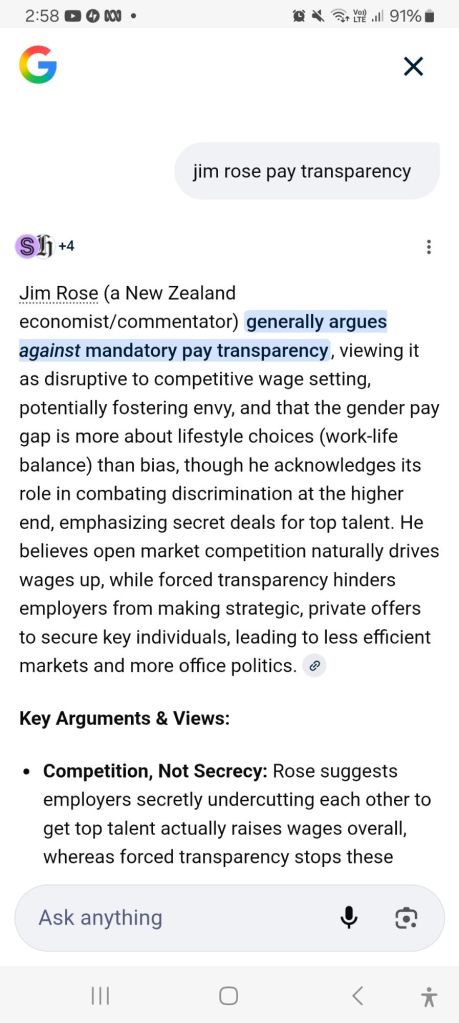
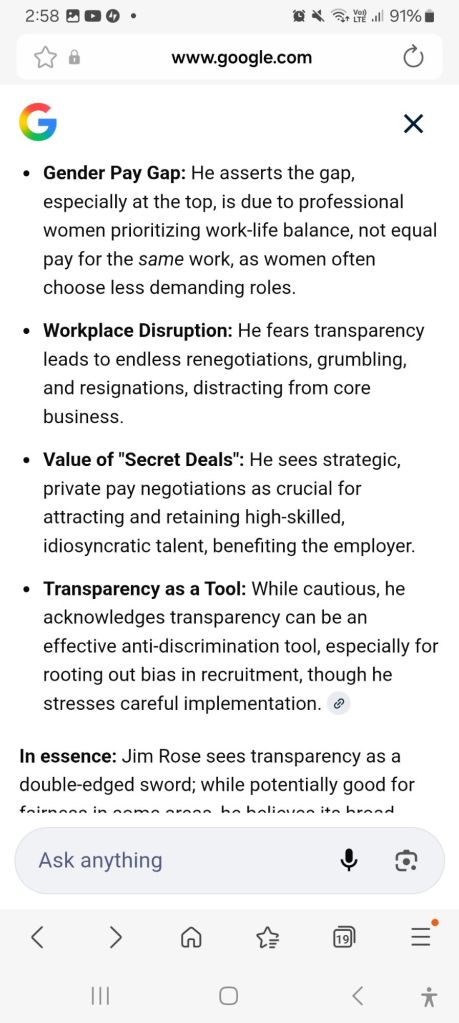

“AI is everywhere but in the productivity statistics…”
15 Dec 2025 Leave a comment
in applied price theory, econometerics, economic history, economics of information, entrepreneurship, history of economic thought, industrial organisation Tags: creative destruction
These people are saying it is there too. Though I am not quite sure what they (or anyone, for that matter) mean by AI: First, we argue that AI can already be seen in productivity statistics for the United States. The production and use effects of software and software R&D (alone) contributed (a) 50 percent…
“AI is everywhere but in the productivity statistics…”
Media bias in New Zealand yet again
08 Dec 2025 Leave a comment
in economics of information, economics of media and culture, industrial organisation, politics - New Zealand, survivor principle Tags: media bias
Chris McVeigh writes – If you took a double at the TAB, with the Pope getting married as one leg and Radio New Zealand admitting to a smidgen of left wing partiality as the other, you could be forgiven for thinking that the smart money would be on the Vatican gig bringing home the bacon […]
Media bias in New Zealand yet again
Who Won the Socialist Calculation Debate (with Peter Boettke) 2/17/25
29 Nov 2025 Leave a comment
in applied price theory, Austrian economics, comparative institutional analysis, development economics, economic history, economics of information, entrepreneurship, F.A. Hayek, history of economic thought, industrial organisation, law and economics, Ludwig von Mises, market efficiency, property rights, survivor principle, Thomas Sowell


Recent Comments