By Paul Homewood We have just escaped the Climate and Nature Bill by the skin of the teeth, but it seems the Germans have not been so lucky. Benny Peiser sent me an essay (translated) by Robert von Loewenstern, which tells about a new law, the “Energy Efficiency Act”, which was passed in 2023. […]
New German Law Mandates Energy Consumption Cuts
New German Law Mandates Energy Consumption Cuts
23 Feb 2025 Leave a comment
in economics of climate change, economics of regulation, energy economics, environmental economics, environmentalism, global warming, liberalism, Marxist economics Tags: Germany
The Accumulation of Regulation
21 Feb 2025 1 Comment
in applied price theory, economics of bureaucracy, economics of regulation, labour economics, labour supply, law and economics, politics - USA, property rights, Public Choice, regulation Tags: employment law
Like many who do business in California, I often complain about the regulatory burden (free at last!) People will ask, “So what one regulation would you get rid of?” The problem is that this is a really hard question to answer because in most cases it is not any one regulation in particular, but the…
The Accumulation of Regulation
Trump Officially Ends Biden-Era War On American Appliances
17 Feb 2025 1 Comment
in applied price theory, economics of climate change, economics of regulation, energy economics, environmental economics, environmentalism, global warming, liberalism, politics - USA Tags: 2024 presidential election, climate activists, climate alarmism
“In recent years, burdensome and ideologically motivated regulations have impeded the development of these resources, limited the generation of reliable and affordable electricity, reduced job creation, and inflicted high energy costs upon our citizens,” Trump stated in the executive order. “These high energy costs devastate American consumers by driving up the cost of transportation, heating, utilities, farming, and manufacturing, while weakening our national security.”
Trump Officially Ends Biden-Era War On American Appliances
EPA’s infamous 2009 “endangerment finding” re. so-called greenhouse gases to be reviewed
16 Feb 2025 Leave a comment
in economics of bureaucracy, economics of climate change, economics of regulation, energy economics, environmental economics, environmentalism, global warming, law and economics, politics - USA, Public Choice Tags: climate alarmism

By order of POTUS the ridiculous ‘finding’ that the vital trace gas carbon dioxide is some sort of hazard to humanity is about to be reviewed. It may well struggle for survival. – – – Source: Climate fact check January 2025. CFACT says: We will close out this month by noting that President Trump has […]
EPA’s infamous 2009 “endangerment finding” re. so-called greenhouse gases to be reviewed
Why the RMA must go
13 Feb 2025 Leave a comment
in economics of bureaucracy, economics of regulation, environmental economics, environmentalism, politics - New Zealand, Public Choice, urban economics
Stuff reports: The small town of Wānaka will not have a McDonald’s restaurant after a resource consent application was declined. Independent commissioners released their decision on the proposed McDonald’s restaurant on Wednesday. They said the adverse effects of the proposed restaurant on the environment would be more than minor on the approach to Wānaka, the landscape character […]
Why the RMA must go
The long road to housing affordability
11 Feb 2025 Leave a comment
in applied price theory, economics of bureaucracy, economics of regulation, income redistribution, law and economics, politics - New Zealand, property rights, Public Choice, rentseeking, transport economics, urban economics Tags: housing affordability, land supply, zoning
There is much work yet to be done in New Zealand to improve housing affordability, despite recent declines in valuations. Eric Crampton writes – It wasn’t that long ago that New Zealand’s housing market made international news because of its insanity. In 2016, The Guardian tagged Auckland as the “hottest property market in the world” […]
The long road to housing affordability
By 2025 we were supposed to have closed the gap
05 Feb 2025 Leave a comment
in economic growth, economics of regulation, entrepreneurship, human capital, industrial organisation, labour economics, labour supply, macroeconomics, politics - New Zealand, poverty and inequality
Don Brash and Michael Reddell write – When Don was young and Michael’s parents were young, New Zealand had among the very highest material standards of living in the world. It really was, in the old line, one of the very best places to bring up children. But no longer. For 75 years now, with […]
By 2025 we were supposed to have closed the gap
Property, liberty, transparency: the principled basis for the Regulatory Standards Bill
04 Feb 2025 Leave a comment
in Adam Smith, applied price theory, economics of bureaucracy, economics of regulation, law and economics, politics - New Zealand, property rights, Public Choice, rentseeking
Bryce Wilkinson writes – If you believe some of its critics, the pending Regulatory Standards Bill is a demonic measure to end New Zealand society as we know it. This is beyond false; it is ridiculous. In fact, it is a modest transparency measure. It will better inform the public about laws and regulations likely […]
Property, liberty, transparency: the principled basis for the Regulatory Standards Bill
Mocking European Statism
04 Feb 2025 1 Comment
in applied price theory, Austrian economics, comparative institutional analysis, economic growth, economics of bureaucracy, economics of regulation, entrepreneurship, environmental economics, financial economics, industrial organisation, international economics, labour economics, labour supply, law and economics, liberalism, macroeconomics, Marxist economics, property rights, Public Choice, public economics, rentseeking, survivor principle, theory of the firm Tags: employment law, European Union
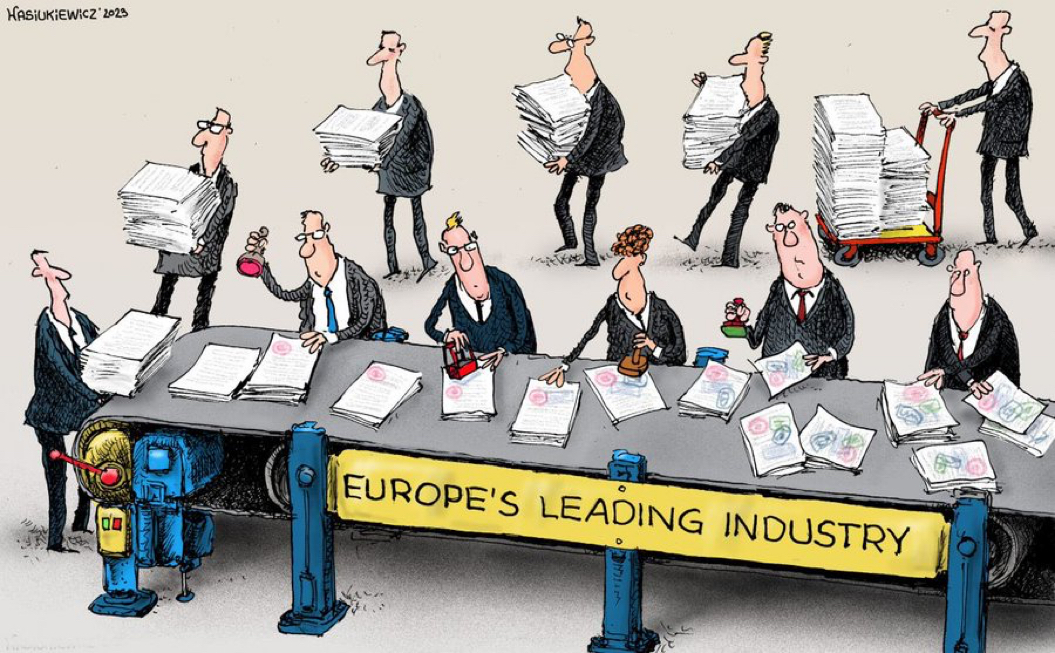
I have a special page for humor involving Europe, but I have not added to it since sharing some Brexit humor in 2016. Let’s being the process of catching up with some amusing cartoons and memes mocking our government-loving cousins on the other side of the Atlantic Ocean. I’ve made the serious point that bureaucrats […]
Mocking European Statism
Going for growth…..perhaps
04 Feb 2025 Leave a comment
in applied price theory, comparative institutional analysis, economic growth, economic history, economics of regulation, entrepreneurship, macroeconomics, politics - New Zealand

The Prime Minister’s speech 10 days or so ago kicked off a flurry of commentary. No one much anywhere near the mainstream (ie excluding Greens supporters) questioned the rhetoric. New Zealand has done woefully poorly on productivity for a long time and we really need better outcomes, and the sorts of policy frameworks that would […]
Going for growth…..perhaps
How are Mexico and Turkey right now like the USA in the 1920s? (Prohibition is causing deaths from drug & alcohol poisoning)
03 Feb 2025 Leave a comment
in applied price theory, economic history, economics of regulation, health economics Tags: economics of prohibition
The picture below is of a few paragraphs from the book The Economics of Public Issues, which I often used as a supplemental textbook when I was teaching. Now for modern day Mexico. See How Mexican Cartels Test Fentanyl on Vulnerable People and Animals: A global crackdown on fentanyl has led cartels to innovate production methods…
How are Mexico and Turkey right now like the USA in the 1920s? (Prohibition is causing deaths from drug & alcohol poisoning)
Reviewing Covid experiences and policies
01 Feb 2025 Leave a comment
in applied price theory, applied welfare economics, comparative institutional analysis, economic growth, economics of bureaucracy, economics of regulation, health economics, macroeconomics, politics - New Zealand, Public Choice Tags: economics of pandemics

Michael Reddell writes – I’ve spent the last week writing a fairly substantial review of a recent book (“Australia’s Pandemic Exceptionalism: How we crushed the curve but lost the race”) by a couple of Australian academic economists on Australia’s pandemic policies and experiences. For all its limitations, there isn’t anything similar in New Zealand. What […]
Reviewing Covid experiences and policies
Trump Admin Moves To Toss Out Biden’s Fuel Economy Rules
31 Jan 2025 Leave a comment
in economics of climate change, economics of regulation, energy economics, environmental economics, environmentalism, global warming, politics - USA, transport economics Tags: 2024 presidential election
Newly-confirmed Department of Transportation (DOT) Secretary Sean Duffy is already moving to overturn the Biden-Harris administration’s stringent fuel economy standards for vehicles.
Trump Admin Moves To Toss Out Biden’s Fuel Economy Rules
When politicians campaign on competition, be very worried
31 Jan 2025 Leave a comment
in applied price theory, applied welfare economics, Armen Alchian, Austrian economics, comparative institutional analysis, economics of information, economics of regulation, entrepreneurship, experimental economics, history of economic thought, law and economics, politics - New Zealand, property rights Tags: competition law
Targeting big existing businesses may be tempting to politicians, but ensuring market openness will do more good Eric Crampton writes – It’s fair to say that economists like competition. It’s also fair to say that when politicians start talking about competition, economists ought to get a little bit nervous.
When politicians campaign on competition, be very worried
Reviewing Covid experiences and policies
30 Jan 2025 Leave a comment
in applied price theory, applied welfare economics, economic history, economics of bureaucracy, economics of regulation, fiscal policy, health and safety, health economics, labour economics, labour supply, law and economics, macroeconomics, politics - Australia, politics - New Zealand, property rights, Public Choice Tags: economics of pandemics

I’ve spent the last week writing a fairly substantial review of a recent book (“Australia’s Pandemic Exceptionalism: How we crushed the curve but lost the race”) by a couple of Australian academic economists on Australia’s pandemic policies and experiences. For all its limitations, there isn’t anything similar in New Zealand. What we do have is […]
Reviewing Covid experiences and policies
 Utopia, you are standing in it!
Recent Comments