Most politicians don’t want to know about this
06 May 2015 Leave a comment
in applied price theory, applied welfare economics, economics of religion, Public Choice Tags: expressive voting, rational ignorance, rational irrationality
The ethnic groups of the Middle East
05 May 2015 Leave a comment
in economic history, economics of media and culture, economics of religion Tags: Middle-East politics

Christianity used to be Europe-based religion
03 May 2015 Leave a comment
in economic history, economics of religion Tags: Christianity
Share of all Christians living in
Europe
1910 66%
2050 16%SS Africa
1910 1%
2050 38%pewresearch.org/fact-tank/2015… http://t.co/yZWG9X25Qz—
Conrad Hackett (@conradhackett) April 26, 2015
This is how fast America changed its mind on the biggest social issues
30 Apr 2015 Leave a comment
in economic history, economics of media and culture, economics of regulation, economics of religion, political change, politics - USA Tags: expressive voting, preference falsification
This is how fast America changed its mind on the biggest social issues bloom.bg/1DIk6PQ http://t.co/RjAiw0y2dV—
Bloomberg Business (@business) April 27, 2015
Public’s Views on Human Evolution
29 Apr 2015 Leave a comment
in economics of media and culture, economics of religion Tags: evolution, science awareness


The Sunni-Shia divide
17 Apr 2015 Leave a comment
in economics of religion Tags: Middle-East politics

Sharia law, arbitration law and family law
16 Apr 2015 Leave a comment
in economics of religion, law and economics, politics - Australia, property rights Tags: economics of contracts, family law, rule of law, Sharia law
Sharia law is part of a general issue of private arbitration in religious courts. There are rabbinical courts doing private arbitration among Orthodox Jews in the UK. There is a famous paper about extra-legal enforcement of contracts among Orthodox Jews in the diamond trade.
Success in the industry requires enforcing executory agreements that are beyond the reach of public courts, and Jewish diamond merchants enforce such contracts with a reputation mechanism supported by a distinctive set of industry, family, and community institutions. An industry arbitration system publicizes promises that are not kept. Intergenerational legacies induce merchants to deal honestly through their very last transaction, so that their children may inherit valuable livelihoods. And ultraorthodox Jews, for whom participation in their communities is paramount, provide important value-added services to the industry without posing the threat of theft and flight.
The British law society copped a lot of flak for issuing practice notes explaining how to write wills that were compliant with Islamic family law.
In any case, any will is always subject to laws about providing for the family and for dependent children and can be overridden on those grounds, no matter how they are written.
Peter Sellers left each of his adult children £750 because he wanted to disinherit them. Under the case law at that time, if you left your children nothing, the courts somehow persuaded themselves that you had forgotten to provide for them so they amended the will. By Sellers leaving them this small sum of money, he made it clear that he wanted the limit how much he gave his children.
In the UK, rulings handed down by the Muslim Arbitration Tribunal can be legally binding. This is because the Arbitration Act 1996 allows almost any body to act as a dispute resolution service if both parties agreed to be bound by its decision.
There is a bill before the House of Lords amending the Arbitration Act to ensure that the evidence of men and women are weighed equally and penalties to apply to any body purporting to have the powers of a court of law.
The UK parliament also passed a Forced Marriages Act a few years ago. This law included penalties for people who threaten self-harm if someone didn’t go through with an arranged marriage.
Double Standards in Evaluating Violence by Self-Identified Christians and Muslims
14 Apr 2015 Leave a comment
in economics of crime, economics of religion, politics - USA
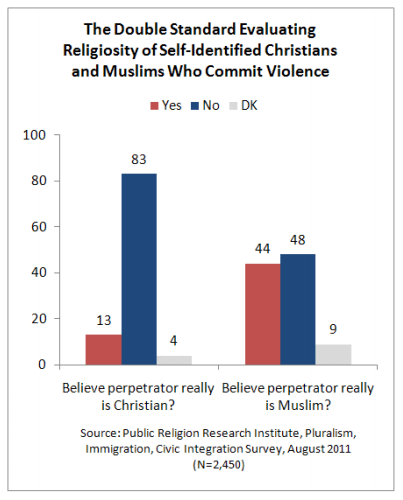
There are no large differences between Republicans (10 percent), Democrats (17 percent) and independents (14 percent) in views of whether a self-identified Christian who commits acts of violence in the name of Christianity is really Christian. However, there are significant partisan differences in views about whether a self-identified Muslim who commits acts of violence in the name of Islam is really Muslim. A majority (55 percent) of Republicans say that such a person is Muslim, compared about 4-in-10 Democrats (40 percent) and independents (39 percent). Majorities of Democrats (51 percent) and independents (53 percent) disagree that a self-identified Muslim who commits acts of violence is really Muslim.
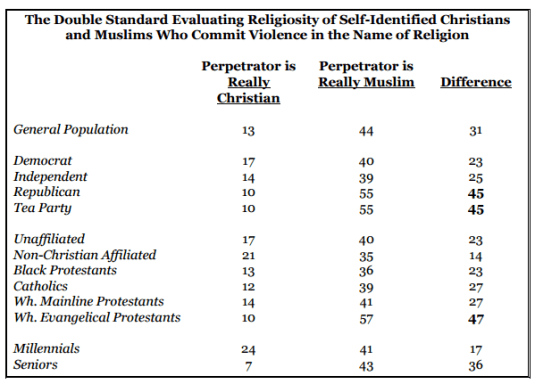
White evangelical Protestants stand out strongly from other major religious groups in evaluating the religiosity of a self-identified Muslim who commits violence. Only roughly 4-in-10 white mainline Protestants (41 percent), Catholics (39 percent), black Protestants (36 percent), and non-Christian religiously affiliated Americans (35 percent) say a self-proclaimed Muslims who commits acts of violence in the name of Islam is really Muslim. In contrast, nearly 6-in-10 (57 percent) white evangelical Protestants believe that self-identified Muslims who commit acts of violence in the name of Islam are really Muslim.
The impact of religion on fertility rates
05 Apr 2015 Leave a comment
in economics of religion, population economics Tags: economics of fertility, family demographics
People with no religion have about 1 child less per woman than the religiously affiliated
researchgate.net/publication/27… http://t.co/mqGVk7GpyH—
Conrad Hackett (@conradhackett) April 05, 2015
The evolution of the Gospels
05 Apr 2015 Leave a comment
in economics of religion Tags: atheism, The Gospels
Voltaire on the power of religion
05 Apr 2015 Leave a comment
in economics of religion Tags: atheism, Voltaire
 Utopia, you are standing in it!
Recent Comments