US Shale map http://t.co/yO1bkeq2mK—
Charts and Maps (@ChartsandMaps) May 21, 2015
US Shale map
08 Jul 2015 Leave a comment
in energy economics Tags: Oil prices, shale oil
Richer is greener: environmentalists are Environmental Kuznets Curve deniers
07 Jul 2015 Leave a comment
in applied price theory, applied welfare economics, development economics, economic growth, economic history, energy economics, environmental economics, growth disasters, growth miracles, health and safety, industrial organisation, international economics, labour economics, law and economics, liberalism, property rights, public economics Tags: healthier is wealthier, Japan, Kuznets environmental curve, richer is greener, richer is safer
The Kuznets environmental curve describes an empirical regularity between environmental quality and economic growth. Outdoor water, air and other pollution first worse and then improves as a country first experiences economic growth and development.

While many pollutants exhibit this pattern in the Kuznets environmental curve, peak pollution levels occur at different income levels for different pollutants, countries and time periods. John Tierney explains:
In dozens of studies, researchers identified Kuznets curves for a variety of environmental problems.
There are exceptions to the trend, especially in countries with inept governments and poor systems of property rights, but in general, richer is eventually greener.
As incomes go up, people often focus first on cleaning up their drinking water, and then later on air pollutants like sulphur dioxide.
As their wealth grows, people consume more energy, but they move to more efficient and cleaner sources — from wood to coal and oil, and then to natural gas and nuclear power, progressively emitting less carbon per unit of energy.
When I was living in Japan in the mid 1990s, they just completed a period of rapid operation of the Kuznets environmental curve. I was told by my professors at Graduate School that in the 1960s, cities and prefectures welcomed polluting industries because of the better paid jobs they offered. At that time, shipping companies used like to go to Tokyo because the pollution in Tokyo Bay was so bad that it would clean all the barnacles off their ships. That made them sail faster.

Japanese incomes and wages doubled over the course of the 1960s. The Japanese voter was now prepared to support stricter pollution standards and environmental controls.
Life expectancy is at an all time high: buff.ly/1ICraAi http://t.co/jgRqKy8LfQ—
HumanProgress.org (@humanprogress) June 28, 2015
In the early 1970s, the ruling LDP stole the long-standing environmental policies of their opponents in a big crack down on pollution because the country could now afforded them.
Poverty has plummeted in East Asia and the world. buff.ly/1NtIDyY http://t.co/SsY3sf3kyH—
HumanProgress.org (@humanprogress) July 01, 2015
Plenty of developing countries are democracies now. Their people could demand through the ballot box higher environmental standards and clean tap water but they don’t because of its cost to economic development.
These 4 nations are 50% of mankind. That's 3.5 billion people who are living longer. buff.ly/1Kle6mU #health http://t.co/949oqisMsL—
HumanProgress.org (@humanprogress) June 30, 2015
The environmental movement lives in a state of denial regarding the relationship between economic growth and environmental quality.
OECD Better Life Index correlates with GDP
But US lower than poorer countries
& NZL higher than richer countries http://t.co/yrTCnO1B0l—
Max Roser (@MaxCRoser) June 26, 2015
Matt Ridley on the Pope and The Great Fact
06 Jul 2015 Leave a comment
in applied price theory, applied welfare economics, development economics, economic history, economics of regulation, energy economics, entrepreneurship, environmental economics, financial economics, growth disasters, growth miracles, health economics, history of economic thought, human capital, industrial organisation, labour economics, liberalism, survivor principle Tags: doomsday prophecies, Matt Ridley doomsday prophets, Papal economics, The Great Enrichment, The Great Escape, The Great Fact
See which way the data points for yourself, like @mattwridley. buff.ly/1HsZxgx #health #progress http://t.co/B3KbUJOn05—
HumanProgress.org (@humanprogress) June 30, 2015
Oil forecasting is hard
05 Jul 2015 Leave a comment
in energy economics, macroeconomics Tags: forecasting errors, Oil prices, peak oil
Oil forecasting is hard, EIA edition bloombergview.com/articles/2015-… http://t.co/J2mvpKYrsc—
Justin Fox (@foxjust) April 16, 2015
Solar and wind power – forever just round the corner
05 Jul 2015 Leave a comment
in energy economics, environmental economics, global warming, politics - Australia, politics - New Zealand, politics - USA Tags: Big Solar, Big Wind, creative destruction, green rent seeking, renewable energy, solar power, wind power
The media history of climate change scares
03 Jul 2015 Leave a comment
in economic history, economics of media and culture, energy economics, entrepreneurship, environmental economics, global warming, industrial organisation, politics - Australia, politics - New Zealand, politics - USA, rentseeking, survivor principle Tags: climate alarmism, global cooling, global warming, media bias
America at night
03 Jul 2015 Leave a comment
in energy economics Tags: maps
Light pollution in the US http://t.co/ze0yBhJmT2—
Amazing Maps (@Amazing_Maps) March 24, 2015
Where lies the future of carbon emissions?
28 Jun 2015 Leave a comment
in energy economics, environmental economics, global warming Tags: climate alarmism, global warming
The world at night
22 Jun 2015 Leave a comment
in economics of media and culture, energy economics Tags: maps
Light Pollution Around the World – brilliantmaps.com/light-pollutio… http://t.co/r2w1Zoics8—
Brilliant Maps (@BrilliantMaps) March 23, 2015
How Al Gore spins global warming
21 Jun 2015 Leave a comment
in energy economics, environmental economics, global warming, politics - USA, rentseeking Tags: Al Gore, climate alarmism, global warming, green rent seeking
Oil was really cheap in the 1990s
17 Jun 2015 Leave a comment
in economic history, energy economics Tags: Oil prices
Oil prices could be cheaper – David Zervos read.bi/1CI2fby http://t.co/93Z5LtsYB7—
BI Chart of the Day (@chartoftheday) March 08, 2015
Solar power versus economic development
11 Jun 2015 Leave a comment
in development economics, energy economics, environmental economics, environmentalism, global warming, growth disasters, growth miracles Tags: renewable energy, solar power

What it would take for the US to run on 100% renewable energy
10 Jun 2015 Leave a comment
in energy economics, environmental economics, global warming, politics - USA Tags: expressive voting, geothermal power, hydroelectric power, rational ignorance, rational irrationality, renewable energy, solar power, tidal power, wind power
/cdn0.vox-cdn.com/uploads/chorus_asset/file/3768834/jacobson-us-renewables-2015.png)
Household energy price inflation in New Zealand
09 Jun 2015 Leave a comment
in energy economics, politics - New Zealand Tags: child poverty, consumer price index, CPI inflation, energy prices, family poverty, fuel poverty, power prices
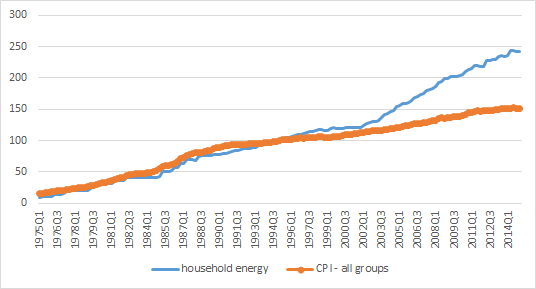
Energy prices seem to have been roaring ahead of consumer prices since the first quarter of 2001. Maybe that is a major contributor to fuel poverty in New Zealand and material deprivation among more poor households in the winter. What gives?
Figure 1: ratio of household energy price index to consumer price index – all groups, March quarter 1995 – March quarter 2015, base = 1995

Source: Statistics New Zealand Infoshare.
Figure 2: Household energy price index and consumer price index – all groups, March quarter 1975 – March quarter 2015, base = 1995
Source: Statistics New Zealand Infoshare.
Australia at night
08 Jun 2015 Leave a comment
in economics of media and culture, energy economics Tags: Australia, maps
Notice the light pollution in Java (top left) compared to Australia – brilliantmaps.com/light-pollutio… http://t.co/f8nZodQhrB—
Brilliant Maps (@BrilliantMaps) March 22, 2015


Recent Comments