“The news of BlackRock’s departure from NZAM should be music to the ears of every American consumer,” Will Hild, executive director of conservative nonprofit Consumers’ Research, told the Daily Caller News Foundation. “NZAM is an illegitimate cartel of asset managers pushing harmful and costly net zero policies across the entire economy. The activities of NZAM and its members raise prices on Americans everywhere from the gas pump to the grocery store.”
‘A Huge Win’: Woke ‘Cartel’ Of Financial Giants Dealt Death Blow 11 Days Before Trump Takes Office
‘A Huge Win’: Woke ‘Cartel’ Of Financial Giants Dealt Death Blow 11 Days Before Trump Takes Office
13 Jan 2025 Leave a comment
in applied price theory, economics of climate change, energy economics, entrepreneurship, environmental economics, environmentalism, financial economics, global warming, politics - USA, Public Choice, rentseeking Tags: efficient markets hypothesis
Some Links
12 Jan 2025 Leave a comment
in applied price theory, budget deficits, development economics, economic growth, economic history, economics of regulation, entrepreneurship, fiscal policy, global financial crisis (GFC), great recession, growth disasters, growth miracles, human capital, income redistribution, industrial organisation, international economics, job search and matching, labour economics, labour supply, macroeconomics, monetary economics, poverty and inequality, Public Choice, rentseeking, survivor principle, unemployment
TweetGMU Econ alum Holly Jean Soto busts the myth of “greedflation.” Scott Lincicome identifies an interesting contrast between the facts and opinion about China. George Will decries the spinelessness of the modern U.S. Congress. A slice: The incoming president will be able, on a whim, to unilaterally discombobulate international commerce — and the domestic economy…
Some Links
Mr. Haltiwanger and the Austrians
11 Jan 2025 1 Comment
in applied price theory, Austrian economics, economic history, entrepreneurship, history of economic thought, Israel Kirzner
In November, I chided Austrian economists for neglecting the John Haltiwanger’s empirical work on creative destruction:Around 2000, I discovered that John Haltiwanger, a very mainstream economist, had a pile of empirical evidence vindicating the importance of Schumpeterian creative destruction. That pile is now a mountain. At the time, I tried to get Austrians to start…
Mr. Haltiwanger and the Austrians
Meta dismantles misinformation industry
09 Jan 2025 Leave a comment
in economics of information, entrepreneurship, industrial organisation, law and economics, liberalism, politics - Australia, politics - New Zealand, politics - USA, property rights, Public Choice, survivor principle Tags: 2024 presidential election, free speech, political correctness, regressive left
Mark Zuckerberg announced: In recent years we’ve developed increasingly complex systems to manage content across our platforms, partly in response to societal and political pressure to moderate content. This approach has gone too far. As well-intentioned as many of these efforts have been, they have expanded over time to the point where we are making […]
Meta dismantles misinformation industry
A Reading deal that doesn’t cost ratepayers
08 Jan 2025 Leave a comment
in economics of bureaucracy, entrepreneurship, industrial organisation, law and economics, politics - New Zealand, property rights, Public Choice, rentseeking, survivor principle
NewstalkZb reports: The derelict Reading Cinema complex on Wellington’s Courtenay Place has finally been sold, with a local developer snapping up the 1.5-hectare plot. The property was at the centre of a controversial deal between Wellington City Council and Reading International last year, after the council tried to buy the land under the quake-prone building […]
A Reading deal that doesn’t cost ratepayers
Meta Culpa: Zuckerberg Joins Musk in the Global Fight for Free Speech
08 Jan 2025 Leave a comment
in economics of information, economics of regulation, entrepreneurship, law and economics, liberalism, politics - USA Tags: creative destruction, free speech, political correctness, regressive left

Below is my column in Fox.com on the potentially historic change in policy at Meta to restore free speech protections. As one of the longest and loudest critics of the company over its censorship history, it is admittedly hard to trust. However, an alliance of Mark Zuckerberg with Elon Musk could prove the most important […]
Meta Culpa: Zuckerberg Joins Musk in the Global Fight for Free Speech
Quotation of the Day…
07 Jan 2025 Leave a comment
in applied price theory, entrepreneurship, human capital, income redistribution, labour economics, labour supply, occupational choice, poverty and inequality, Public Choice, Thomas Sowell
Tweet… is from page 496 of the 2011 revised and enlarged edition of Thomas Sowell’s 2009 book Intellectuals and Society (original emphasis): Another common tactic and flaw in the arguments of the intelligentsia is eternalizing the transient. Thus statistical trends in the share of the nation’s income going to “the rich” (however defined) and “the…
Quotation of the Day…
Some Links
06 Jan 2025 Leave a comment
in applied price theory, economics of bureaucracy, economics of regulation, entrepreneurship, income redistribution, industrial organisation, politics - USA, Public Choice, rentseeking, survivor principle
TweetScott Lincicome decries Biden’s abuse of national security to block Nippon Steel’s acquisition of U.S. Steel. Two slices: Today, President Joe Biden blocked Nippon Steel’s proposed acquisition of US Steel on the grounds that “there is credible evidence” the Japanese steelmaker “might take action that threatens to impair the national security of the United States.” What…
Some Links
ESG ‘vibe’ check: ‘Stock market investors are pulling a record amount of cash out of climate funds’ – ‘The main driver of the exodus is bad vibes’
31 Dec 2024 Leave a comment
in energy economics, entrepreneurship, environmental economics, financial economics, global warming Tags: climate activists
Stock market investors are pulling a record amount of cash out of climate funds, even though many have not underperformed.
ESG ‘vibe’ check: ‘Stock market investors are pulling a record amount of cash out of climate funds’ – ‘The main driver of the exodus is bad vibes’
Creative destruction
29 Dec 2024 Leave a comment
in economic history, entrepreneurship Tags: creative destruction

Scandinavian Governments Are Greedy, not Socialist
27 Dec 2024 Leave a comment
in applied price theory, economic growth, entrepreneurship, fiscal policy, human capital, income redistribution, labour economics, labour supply, liberalism, macroeconomics, Marxist economics, politics - USA, poverty and inequality, Public Choice, public economics Tags: Denmark, Norway, social insurance, Sweden, taxation and entrepreneurship, taxation and investment, taxation and labour supply
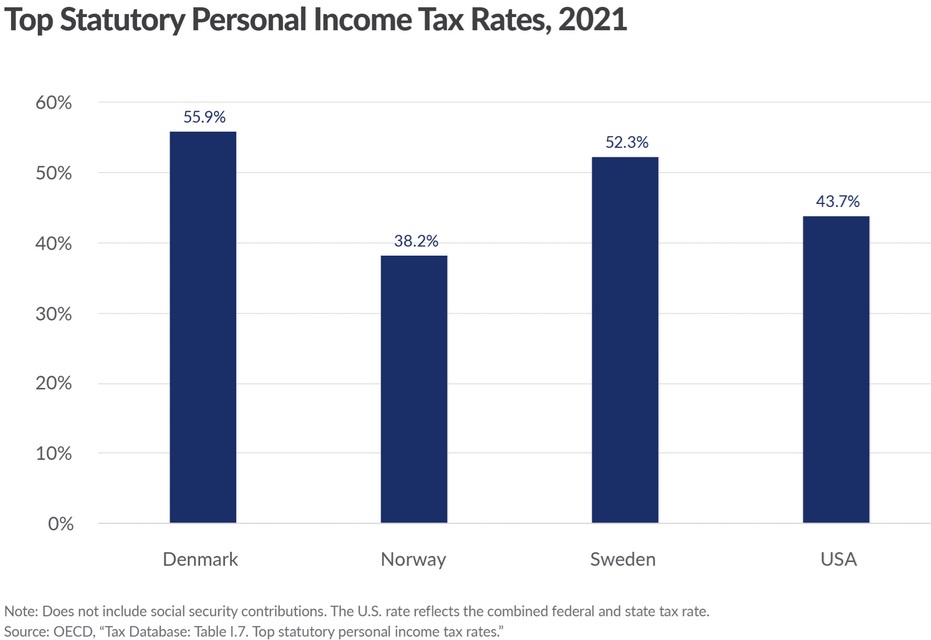
Scandinavian nations are not socialist, at least if we’re using the technical definition (government ownership, central planning, and price controls). But those countries do have big welfare states. And that means stifling tax burdens. And those harsh taxes don’t just apply to rich taxpayers. Lower-income and middle-class people also get pillaged. I’ve already explained that punitive value-added […]
Scandinavian Governments Are Greedy, not Socialist
Bye and Bye: Washington State Moves To Toward a “Wealth Tax” As the Wealthy Move to Leave the State
26 Dec 2024 Leave a comment
in applied price theory, entrepreneurship, financial economics, fiscal policy, income redistribution, macroeconomics, Marxist economics, politics - USA, Public Choice, public economics Tags: regressive left, taxation and entrepreneurship, taxation and investment, taxation and savings, wealth tax

Washington State’s unofficial state motto has long been “Al-ki” which means either “bye and bye” or “by and by” in Chinook. The former meaning now seems official as Gov. Jay Inslee pushed for a “wealth tax.” Wealthy citizens are already saying bye to the state in anticipation of what one Democratic billionaire recently called a […]
Bye and Bye: Washington State Moves To Toward a “Wealth Tax” As the Wealthy Move to Leave the State
Nuclear Waste could be the game-changer to Unlimited Electricity
25 Dec 2024 Leave a comment
in energy economics, entrepreneurship Tags: nuclear energy
Today, nuclear waste is the key to Unlimited Electricity, as that “so-called nuclear waste”, the slightly used nuclear fuel (SUNF), still has 97% of its electricity potential yet to be realized.
Nuclear Waste could be the game-changer to Unlimited Electricity
Some Simple Economics of the Google Antitrust Case
17 Dec 2024 1 Comment
in applied price theory, economics of information, entrepreneurship, industrial organisation, law and economics, politics - USA, Public Choice, survivor principle, theory of the firm Tags: competition law
The case is straightforward: Google pays firms like Apple billions of dollars to make its search engine the default. (N.B. I would rephrase this as Apple charges Google billions of dollars to make its search engine the default–a phrasing which matters if you want to understand what is really going on. But set that aside […]
Some Simple Economics of the Google Antitrust Case
Call in the Bailiffs: How the NZ Government’s Green Investment Fund Turned Itself Into an Unpleasant Predatory Lender and Debt Collection Agency.
16 Dec 2024 1 Comment
in applied price theory, comparative institutional analysis, energy economics, entrepreneurship, environmental economics, law and economics, politics - New Zealand, property rights Tags: solar power
The just resigned Chair of the NZ Green Investment Fund (NZGIF) and Chancellor of Auckland University, Cecilia Tarrant, previously worked at Morgan Stanley Bank in New York, starting in 1997 and finishing in 2009. She’s a very nice person, a lawyer by training, and Structured Products expert, in particular on Mortgage Backed Securities. The collapse of…
Call in the Bailiffs: How the NZ Government’s Green Investment Fund Turned Itself Into an Unpleasant Predatory Lender and Debt Collection Agency.
 Utopia, you are standing in it!
Recent Comments