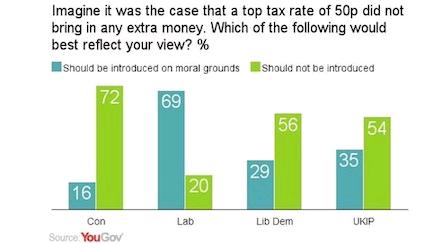
When a government taxes a certain level of income or inheritance at a rate of 70 or 80 percent, the primary goal is obviously not to raise additional revenue (because these very high brackets never yield much).
It is rather to put an end to such incomes and large estates, which lawmakers have for one reason or another come to regard as socially unacceptable and economically unproductive…
Piketty’s method of doing economics involves frequent grand proclamations about "social justice" and economic "evolutions," but he offers no analyses of the dynamics of individual decision-making, often referred to as "microeconomics," that should be central to the issues he raises…
Revealingly, Piketty writes of income and wealth as being claimed or "distributed," never as being earned or produced. The resulting statistics are too aggregated—too big-picture—to reveal what is happening to individuals on the ground…
He imagines that such aggregates interact in robotic fashion through a logic of their own, unmoved by individual human initiative, creativity, or choice…
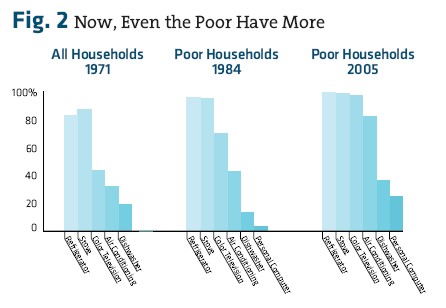
If we follow the advice of Adam Smith and examine people’s ability to consume, we discover that nearly everyone in market economies is growing richer…
THE U.S. IS THEbête noir of Piketty and other progressives obsessed with monetary inequality.
But middle-class Americans take for granted their air-conditioned homes, cars, and workplaces—along with their smartphones, safe air travel, and pills for ailments ranging from hypertension to erectile dysfunction…
At the end of World War II, when monetary income and wealth inequalities were narrower than they’ve been at any time in the past century, these goods and services were either available to no one or affordable only by the very rich.
So regardless of how many more dollars today’s plutocrats have accumulated and stashed into their portfolios, the elite’s accumulation of riches has not prevented the living standards of ordinary people from rising spectacularly…
Piketty’s disregard for basic economic reasoning blinds him to the all-important market forces at work on the ground—market forces that, if left unencumbered by government, produce growing prosperity for all. Yet, he would happily encumber these forces with confiscatory taxes.
The bronze winner is happy as Larry looking at all those losers that won nothing.
The silver medal winners came second. At least they know that their mum will remember their great day when they almost made it. A 1924 silver medal winner was still brooding about it in his 80s.
“I will do anything that is basically covered by the law to reduce Berkshire’s tax rate,” Buffett told an audience in Omaha, Nebraska this weekend. “For example, on wind energy, we get a tax credit if we build a lot of wind farms. That’s the only reason to build them. They don’t make sense without the tax credit.”
Buffett has invested billions into wind power to get federal subsidies.
Remember this, firms are only likely to collude in certain market environments.
Brozen and Posner suggest the following pre-conditions to collusion
market concentration on the supply side;
no fringe of small sellers;
high transport costs from neighbouring markets;
small variations in production costs between firms;
readily available information on prices;
inelastic demand at the competitive price;
low pre-collusion industry profits;
long lags on new entry;
many buyers (otherwise selective discounting to big buyers will be too tempting while monitoring adherence to the agreement will be difficult);
no significant product differentiation;
large suppliers selling at the same level in the distribution chain;
a simple price, credit and distribution structure;
price competition is more important than other forms of competition;
demand is static or declining over time; and
stagnant technological innovation and product redesign.
Stable collusive arrangements are thus likely to be rare; the absence of any of the conditions will tend to undermine the potential for successful collusion.
The French are poorer that the 3rd poorest American state: Arkansas. TheEU-15as a whole would qualify to be the 49th poorest American state.
The rich in Europe are poor by American standards. The poor in the USA are middle class by European standards. The European middle class has smaller houses, few cars and few consumers durables that the average poor in the USA.
Media conspiracy theories suggest someone is in control; that dark, all-powerful cabals of men in cultish robes control the world. The truth is no one is in control. What about 57 channels, nothing on!
Newspapers, TV and cable, are not a monopoly. A monopoly is a single seller of as product with a legal right to bar new entry. It is an exclusive right to sell something.
At best, newspapers, TV and cable, are a large and unwieldy cartel under pressure from costs and new entry. The Internet makes electronic news competition global.
There are many different Australian news outlets and media types, three national networks, plus many cable news networks and 9 media owners. That is more than enough to destabilise any cartel.
Why is the mass media special? A supply-side model of media ownership suggesting that media outlets weigh the rewards of bias—political influence or personal pleasure—against the cost of bias—lost circulation from providing faulty news.
The mass media is a big business, and they increase readership and revenue by presenting factual and informative news.
The most likely to turn-off are women, and women vote to the Left more often than do men. The media is perhaps pandering to this centre-left marginal buyer.
A news cartel is like any other cartel. All cartels break-down and only some get back together.
Cartels contain seeds of their own destruction. Cartel members are reducing their output below their existing potential production capacity, and once the market price increases, each member of the cartel has the capacity to raise output relatively easily.
All cartels must decide how to allocate the reduction of output that follows the price increases across members with different costs structures and spare capacity.:
The tendency is for cartel members to cheat on their production quotas, increasing supply to meet market demand and lowering their price.
Most cartel agreements are unstable and at the slightest incentive they will quickly disband, and returning the market to competitive conditions.
One sign of a cartel that was developed by Aaron Director is periods of stable prices, despite cost fluctuations, followed by sudden price changes when the cartel collapses or decide to increase prices.
For a news cartel, this means toeing the line and then periods of truth, and then a sudden return to the party line when the cartel starts-up again.
The exercise of collective market power will not be stable unless sellers agree on prices and production shares; on how to divide the profits; on how to enforce the agreement; on how to deal with cheating; and on how to prevent new entry.
A cartel is in the unenviable position of having to satisfy everyone, for one dissatisfied producer can bring about the feared price competition and the disintegration of the cartel.
Thus a successful cartel must follow a policy of continual compromise. Little wonder that John. S McGee wrote that:
The history of cartels is the history of double crossing
Meetings are by definition a concession to a deficient organization.
For one either meets or one works. One can not do both at the same time…
There will always be more than enough meetings…Every meeting generates a host of little follow-up meetings—some formal, some informal, but both stretching out for hours.
Meetings, therefore, need to be purposefully directed.
An undirected meeting is not just a nuisance; it is a danger.
But above all, meetings have to be the exception rather than the rule.
An organization where everybody meets all the time is an organization in which no one gets anything done.
Wherever a time log shows the fatty degeneration of meetings—whenever, for instance people in an organization find themselves in meetings a quarter of their time or more—there is time-wasting malorganization.
Drucker also said:
The senior financial executive of a large organization knew perfectly well that the meetings in his office wasted a lot of time.
This man asked all of his direct subordinates to every meeting, whatever the topic.
As a result, the meetings were far too large.
And because every participant felt that he had to show interest, everybody asked at least one question—most of them irrelevant. As a result, the meetings stretched on endlessly.
But the senior executive had not known, until he asked, that his subordinates too considered the meetings a waste of their time.
Aware of the great importance everyone in the organization placed on status and on being "in the know", he feared that the uninvited men would feel slighted and left out.
Now, however, he satisfies the status needs of his subordinates in a different manner.
He sends out a printed form which reads:
"I have asked [Messrs Smith, Jones and Robinson] to meet with me [Wednesday at 3] in [the fourth floor conference room] to discuss [next year’s capital appropriations budget].
Please come if you think that you need the information or want to take part in the discussion.
But you will in any event receive right away a full summary of the discussion and of any decisions reached, together with a request for your comments".
Where formerly a dozen people came and stayed all afternoon, three men and a secretary to take the notes now get the matter over within an hour or so. And no one feels left out.
In the beginning, mobile phones were just a walkie-talkie. iPhones have the same capabilities of 13 distinct electronics gadgets worth more than $3,000 in a 1991.
An iPhone incorporates a computer, CD player, phone, and video camera, among other items.
In 1991, a gigabyte of hard disk storage cost around $10,000. Today, it costs around four cents.
Back in 1991, a gigabyte of flash memory, which is what the iPhone uses, would have cost something like $45,000, or more. (Today, it’s around 55 cents ($0.55).)
The mid-level iPhone 5S has 32 GB of flash memory. Thirty-two GB, multiplied by $45,000, equals $1.44 million.
The iPhone used 20,500 millions of instructions per second which in 1991 would have cost around $620,000.
In 1991, a mobile phone used the AMPS analog wireless network to deliver kilobit voice connections.
A 1.44 megabit T1 line from the telephone company cost around $1,000 per month.
Today’s LTE mobile network is delivering speeds in the 15 Mbps range.
Safe to say, the iPhone’s communication capacity is at least 10,000 times that of a 1991 mobile phone.
The 1991 cost of mobile communication was something like $100 per kilobit per second.
Fifteen thousand Kbps (15 Mbps), multiplied by $100, is $1.5 million.
Considering only memory, processing, and broadband communications power, duplicating the iPhone back in 1991 would have (very roughly) cost: $1.44 million + $620,000 + $1.5 million = $3.56 million.
This doesn’t even account for the MEMS motion detectors, the camera, the iOS operating system, the brilliant display, or the endless worlds of the Internet and apps to which the iPhone connects us.
Limiting the number of TV stations has unusual effects on media slant and muckraking.
Tyler Cowen argues that competition by itself is not a powerful force for media accuracy.
In the traditional conception of the demand for news, audiences read, watch, and listen to the news in order to get information. The quality of news is its accuracy.
But when there are many media outlets, competition results in a common slanting of news towards reader biases in the audience niche each network are serving. The market is very good are serving up what the customer wants.
Competition forces news outlets to cater to their customer’s niche preferences.
Realised profit is the criterion by which the market process selects survivors: those who realise positive profits survive; those who suffer losses disappear.
Positive profits accrue to those news outlets who are better than their competitors. These lesser rivals will exhaust their retained earnings and fail to attract further new investor support.
On topics where reader beliefs diverge on politically divisive issues, media outlets profit from segmenting the market and slanting reports to the biases of their niche audiences.
There is less bland truth-telling and more of the polemics that each market niche wants.
This means that left-wing and right-wing media outlets will hound the political enemies of their readers to cater to the preferences of their audience niche.
The clearest illustration of infotainment is the Lewinsky affair:
The left wing press presented information designed to excuse Clinton’s sins; and
The right wing press dug out details pointing to his culpability.
When there are only a few media outlets, the networks instead go for the median viewer/reader and offer more sedate and less scandal driven coverage.
More media competition increases the chances of the muckraking that brings down ministers and governments.
Both political parties used television licensing and the threat of cable TV to manipulate Murdoch, Packer and the other press barons. They were victims of Fred McChesney’s concept of rent extraction:
Rent extraction is the politician’s pastime of threatening harmful legislation to extract political support and contributions from well-heeled private institutions.
Payments to politicians are often made not for political favours, but to avoid political disfavour, that is, as part of a system of political extortion or rent extraction.
Rent extraction is money for nothing – money paid in exchange for politicians’ inaction.
The politician is paid, not for rent creation, but for withholding legislative and regulatory action that would destroy existing private rents.
McChesney establishes the conditions under which of rent creation or extraction will occur. The relative attractiveness of the two strategies depends on the elasticities of demand and supply.
If demand is relatively inelastic, rent creation will occur; and
If supply is relatively inelastic, rent extraction will occur.
The existence of an organization or a large established firm lowers transaction costs for the politicians negotiating and collecting donations and support, making rent expropriation threats easier.
It is hard to extort rents from those with little in the way of organisation. A cost of being an established lobbying organisation or a large firm with high fixed costs is a greater potential for rent extraction.
The print and electronic media are ripe for rent extraction because of their immobile assets and heavy regulation.
Investors in heavily regulated capital intensive industries such as the mass media, digital and print, do not bite the hand the feeds them.
Little wonder that the media barons were honoured supplicants to whomever is in power in Canberra. They are soon Labor’s business mates whenever Labor was in power.
Threatening to allow cable TV was the big stick in every Australian government’s hand until the 1990s to extract support or at least subservience from the media.
Rupert Murdoch has unashamedly backed political winners, only to dump them when he was convinced that they were washed up or that his newspapers might be left stranded on the losing side of politics.
Murdoch’s see-sawing political stances are entirely pragmatic. He has always been prepared to back winners just before they win, and to shift allegiances on non-ideological grounds.
Throughout the history of the world, the average person on earth has been extremely poor: subsisting on the modern equivalent of $3 per day.
This was true until 1800, at which point average wages—and standards of living—began to rise dramatically.
Prof. Deirdre McCloskey explains how this tremendous increase in wealth came about.
In the past 30 years alone, the number of people in the world living on less than $3 per day has been halved.
The cause of the economic growth we have witnessed in the past 200 years may surprise you.
It’s not exploitation, or investment. Innovation—new ideas, new inventions, materials, machinery, organizational structures—has fueled this economic boom.
Prof. McCloskey explains how changes in Holland and England in the 1600s and 1700s opened the door for innovation to take off—starting the growth that continues to benefit us today.
SuperEntrepreneurs founded half the largest new firms created since the end of the Second World War
There is a strong correlation between high rates of SuperEntrepreneurship in a country and low tax rates
a low regulatory burden and high rates of philanthropy both correlate strongly with high rates of SuperEntrepreneurship
Active government and supranational programmes to encourage entrepreneurship – such as the EU’s Lisbon Strategy – have largely failed.
Yet governments can encourage entrepreneurialism by lowering taxes (particularly capital gains taxes which have a particularly high impact on entrepreneurialism while raising relatively insignificant revenues); by reducing regulations; and by vigorously enforcing property rights.
High rates of self-employment and innovative entrepreneurship are both important for the economy.
Yet policy makers should recognise that they are not synonymous and should not assume policies which encourage self-employment necessarily promote entrepreneurship.
Policy makers should use a definition of entrepreneurship which is based on innovation.
SuperEntrepreneurs examined about 1,000 self-made men and women who have earned at least $1 billion dollars and who appeared in Forbes magazine list of the world’s richest people between 1996 and 2010.
Hong Kong has the most, with around three SuperEntrepreneurs per million inhabitants, followed by Israel, the US, Switzerland and Singapore.
The US is roughly four times more super-entrepreneurial than Western Europe and three times more super-entrepreneurial than Japan.
Super-entrepreneurs tend to be well-educated – 84% have a university degree.
Many started their own company but there is no clear relationship between self-employment and successful entrepreneurship
Today’s super-rich are self-made rich because they produce new and better products and services that people wanted and are willing to pay for.
John Rawls was alive to the importance of incentives in a just and prosperous society.
With his emphasis on fair distributions of income, Rawls’ initial appeal was to the Left. Left-wing thinkers then started to dislike his acceptance of capitalism and his tolerance of large discrepancies in income and wealth.
Rawls excluded envy when we are behind his veil of ignorance designed the social contract about how the society will be organised. He believed that principles of justice should not be affected by individual inclinations, which are mere accidents.
Rawls also argued that the liberties and political status of equal citizens encourage self-respect even when one is less well off than others; and background institutions (including a competitive economy) make it likely that excessive inequalities will not be the rule. He supposes that
the main psychological root of our liability to envy is a lack of self-confidence in our own worth combined with a sense of impotence
Then there is the old Russian joke that tells the story of a peasant with one cow who hates his neighbour because he has two. A sorcerer offers to grant the envious farmer a single wish any thing he wants: “Shoot my neighbour’s cow!” he demands.
Why Evolution is True is a blog written by Jerry Coyne, centered on evolution and biology but also dealing with diverse topics like politics, culture, and cats.
In Hume’s spirit, I will attempt to serve as an ambassador from my world of economics, and help in “finding topics of conversation fit for the entertainment of rational creatures.”
“We do not believe any group of men adequate enough or wise enough to operate without scrutiny or without criticism. We know that the only way to avoid error is to detect it, that the only way to detect it is to be free to inquire. We know that in secrecy error undetected will flourish and subvert”. - J Robert Oppenheimer.
Recent Comments