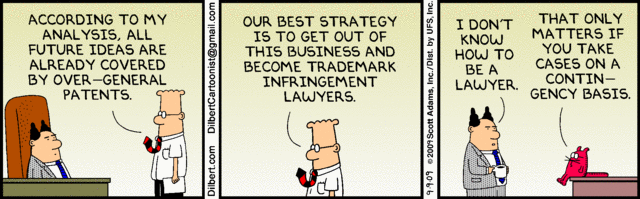
Economists, using charts or high-speed computer models, can accurately forecast the future

crystal_ball-551x700

Many studies, formal and informal, have been made of the record of forecasting by economists, and it has been consistently abysmal.

Forecasters often complain that they can do well enough as long as current trends continue; what they have difficulty in doing is catching changes in trend. But of course there is no trick in extrapolating current trends into the near future.

You don’t need sophisticated computer models for that; you can do it better and far more cheaply by using a ruler.

The real trick is precisely to forecast when and how trends will change, and forecasters have been notoriously bad at that. No economist forecast the depth of the 1981–82 depression, and none predicted the strength of the 1983 boom.

The next time you are swayed by the jargon or seeming expertise of the economic forecaster, ask yourself this question: If he can really predict the future so well, why is he wasting his time putting out newsletters or doing consulting when he himself could be making trillions of dollars in the stock and commodity markets?

Murray Rothbard

Murray Penthouse.jpg

Machiavelli’s theory of entrepreneurship

Niccolò Machiavelli

Entrepreneurs are simply those who understand that there is little difference between obstacle and opportunity and are able to turn both to their advantage.

Economic Theory and the Meaning of Competition

As it is, it is one of the great paradoxes of economic science that every act of competition on the part of a businessman is evidence, in economic theory, of some degree of monopoly power, while the concepts of monopoly and perfect competition have this important common feature: both are situations in which the possibility of any competitive behaviour has been ruled out by definition

Paul J McNulty, Economic Theory and the Meaning of Competition

HT: spontaneousorder.blogspot

A Brief History of the Efficient Markets Hypothesis by Eugene Fama

Video

Corporate life spans| Uneasy Money

S&P500_churn

via Further Thoughts on Capital and Inequality | Uneasy Money.

Image

"Pot Is the New Pizza" in Washington State – Hit & Run

Evan Cox left pizza delivery and now employs 50 people in Washington state in his pot delivery company:

Although it is legal to buy marijuana in Washington state, the person who delivers it could be guilty of a felony. That hasn’t stopped Winterlife from attracting competitors.

Mr Cox has registered as a business with the city and state, but he cannot open a bank account, thanks to federal rules.

In April, he paid $167,000 in sales tax to the Washington State Department of Revenue—in cash.

via Door-to-Door Dope Delivery: "Pot Is the New Pizza" in Washington State – Hit & Run : Reason.com.

Two charts about the future of newspapers

adrev-600x423

google v newspapers.pptx

via Two charts that tell you everything you need to know about the future of newspapers — Tech News and Analysis.

The Peak Whale Oil Theory | Coyote Blog

As the US Population reaches toward the astronomical total of 40 million persons, we are reaching the limits of the number of people this earth can support.  If one were to extrapolate current population growth rates, this country in a hundred years could have over 250 million people in it!  Now of course, that figure is impossible – the farmland of this country couldn’t possibly support even half this number.  But it is interesting to consider the environmental consequences.

Take the issue of transportation.  Currently there are over 11 million horses in this country, the feeding and care of which constitute a significant part of our economy.  A population of 250 million would imply the need for nearly 70 million horses in this country, and this is even before one considers the fact that “horse intensity”, or the average number of horses per family, has been increasing steadily over the last several decades.

It is not unreasonable, therefore, to assume that so many people might need 100 million horses to fulfil all their transportation needs.  There is just no way this admittedly bountiful nation could support 100 million horses.  The disposal of their manure alone would create an environmental problem of unprecedented magnitude.

Or, take the case of illuminant.  As the population grows, the demand for illuminant should grow at least as quickly.  However, whale catches and therefore whale oil supply has levelled off of late, such that many are talking about the “peak whale” phenomena, which refers to the theory that whale oil production may have already passed its peak.  250 million people would use up the entire supply of the world’s whales four or five times over, leaving none for poorer nations of the world.

via The Peak Whale Theory | Coyote Blog.

The real beauty of this free-market price system is that it brings about its own kind of sustainability

This is not so much sustainability in the use of particular resources — for particular goods fall in and out of favour according to supply and demand factors — but sustainability of high economic growth and high standards of living in the economically developed, capitalist economies.

Take, as an example, the transition in the market for interior illumination: tallow candles were replaced by whale-oil lamps, which were replaced by kerosene lamps, which were replaced by incandescent bulbs powered by electricity.

There was no social or political pressure needed to accomplish this evolution; there was no “peak whale oil” movement, no kerosene conservationists, no sustainability crusade of yore. All it took was a functional price system, combined with the ever-present entrepreneurial drive for profits under a competitive, free-market order.

Tyler A. Watts

The NSA has its uses

Image

Cancelling a digital subscription to The Australian is a complicated process

I had to call Sydney from New Zealand via telephone to cancel my online subscription.

Their online My Account has no cancel button nor any instructions on how to cancel the account.

When you try and send them a message through their online enquiry form, they tell you to phone number in Sydney.

Got that off my chest now.

Why governments cannot pick winners

The salary of one top hedge fund manager exceeds the entire payroll of any of the government departments in New Zealand.

To get on the list of top 25 hedge fund manager you must earn at least $300 million a year. The best of these earned $3 billion last year.

Anyone who was any good at picking the share market would certainly not accept government wages.

Government employees have neither the aptitude nor the taste for risk that betting it all every day and losing everything perhaps requires.

The market process picks unusual winners

What World Bank consultant would risk his fee and return business on advising Egypt to specialise in the export of toilets to Italy? But Egypt’s largest single manufacturing export is toilets to Italy where it captured 93% of the market.

Kenya has a booming export business in cut flowers for men to buy for their wives. Kenya has 40% of the European markets for cut flowers. Nigeria has 84% of the Norwegian market for floating docks. The Philippines has 71% of the global market for electronic integrated circuits.

What development expert would have picked these winners? They’re far too far away from the conventional wisdom and the safe bets that are behind picking winners in government circles.

Picking winners by governments requires heroic assumptions not only about the information politicians and bureaucrats have about the present and their ability to predict the future, but also about their motivations and their ability to resist capture by special interests. The Economist explains:

None of these studies addresses a deeper problem with the way industrial policy tends to develop over time.

Earlier efforts have tended to degenerate into rent-seeking, lobbying and cosy deals between incumbent firms and bureaucrats, stifling innovation and the process of creative destruction.

The problem, of course, is that … industrial policy requires disinterested, benevolent policymakers who can do it well. Unfortunately, they do not yet have a recipe for how such policymakers can be created.

Policy is made by real people with political and personal motivations. What they come up with is unlikely to be as well designed as the ones in the models.

The Social Possibilities of Economic Chivalry (1907)

Alfred Marshall.jpg

A Government could print a good edition of Shakespeare’s works, but it could not get them written…

I am not urging that municipalities should avoid all such undertakings without exception. For, indeed, when a large use of rights of way, especially in public streets, is necessary, it is doubtless generally best to retain the ownership, if not also the management, of the inevitable monopoly in public hands.

I am only urging that every new extension of Governmental work in branches of production which need ceaseless creation and initiative is to be regarded as prima facie anti-social, because it retards the growth of that knowledge and those ideas which are incomparably the most important form of collective wealth.

The mismeasurement of prosperity

The average quality of goods: new goods and improved versions of older goods can provide variety and entirely new products and services previously unavailable at any price.

Measurement of the impact of new goods is ‘pretty much guesswork at present’ and ‘some very large gains in consumer welfare’ may be missed (Moulton 1996, p. 173).

An important bias affecting the measurement of prosperity is greater longevity.


The life expectancy of males at birth improved by 5.9 years between 1970-72 and 1995-97, and by another 3.6 years by 2005-2007 (Statistics New Zealand 2009a). Life expectancy of males at birth increased by a mere 1.3 years from 1950-52 to 1970-72!

Becker et al. (2005) estimated that the six year increase in New Zealand life expectancy between 1965 and 1995 amplified the 34.3 per cent increase in New Zealand GDP per capita to the income equivalent of a 47.3 per cent rise. Becker et al. (2005) estimated that the 73.5 per cent rise in Australian GDP per capita between 1965 and 1995 was enhanced to 95.5 per cent after adjustment for the seven year increase in life expectancy.

Reality television programmes are common-place using the large differences in even 20th century living standards as their theme. The latest niche targeting younger audiences is programmes about the technological backwardness of the 1970s and even the 1980s.

Previous Older Entries Next Newer Entries

Bassett, Brash & Hide

Celebrating humanity's flourishing through the spread of capitalism and the rule of law

Truth on the Market

Scholarly commentary on law, economics, and more

The Undercover Historian

Beatrice Cherrier's blog

Matua Kahurangi

Celebrating humanity's flourishing through the spread of capitalism and the rule of law

Temple of Sociology

Celebrating humanity's flourishing through the spread of capitalism and the rule of law

Velvet Glove, Iron Fist

Celebrating humanity's flourishing through the spread of capitalism and the rule of law

Why Evolution Is True

Why Evolution is True is a blog written by Jerry Coyne, centered on evolution and biology but also dealing with diverse topics like politics, culture, and cats.

Down to Earth Kiwi

Celebrating humanity's flourishing through the spread of capitalism and the rule of law

NoTricksZone

Celebrating humanity's flourishing through the spread of capitalism and the rule of law

Homepaddock

A rural perspective with a blue tint by Ele Ludemann

Kiwiblog

DPF's Kiwiblog - Fomenting Happy Mischief since 2003

The Dangerous Economist

Celebrating humanity's flourishing through the spread of capitalism and the rule of law

Watts Up With That?

The world's most viewed site on global warming and climate change

The Logical Place

Tim Harding's writings on rationality, informal logic and skepticism

Doc's Books

A window into Doc Freiberger's library

The Risk-Monger

Let's examine hard decisions!

Uneasy Money

Commentary on monetary policy in the spirit of R. G. Hawtrey

Barrie Saunders

Thoughts on public policy and the media

Liberty Scott

Celebrating humanity's flourishing through the spread of capitalism and the rule of law

Point of Order

Politics and the economy

James Bowden's Blog

A blog (primarily) on Canadian and Commonwealth political history and institutions

Science Matters

Reading between the lines, and underneath the hype.

Peter Winsley

Economics, and such stuff as dreams are made on

A Venerable Puzzle

"The British constitution has always been puzzling, and always will be." --Queen Elizabeth II

The Antiplanner

Celebrating humanity's flourishing through the spread of capitalism and the rule of law

Bet On It

Celebrating humanity's flourishing through the spread of capitalism and the rule of law

History of Sorts

WORLD WAR II, MUSIC, HISTORY, HOLOCAUST

Roger Pielke Jr.

Undisciplined scholar, recovering academic

Offsetting Behaviour

Celebrating humanity's flourishing through the spread of capitalism and the rule of law

JONATHAN TURLEY

Res ipsa loquitur - The thing itself speaks

Conversable Economist

In Hume’s spirit, I will attempt to serve as an ambassador from my world of economics, and help in “finding topics of conversation fit for the entertainment of rational creatures.”

The Victorian Commons

Researching the House of Commons, 1832-1868

The History of Parliament

Articles and research from the History of Parliament Trust

Books & Boots

Reflections on books and art

Legal History Miscellany

Posts on the History of Law, Crime, and Justice

Sex, Drugs and Economics

Celebrating humanity's flourishing through the spread of capitalism and the rule of law

European Royal History

Exploring the Monarchs of Europe

Tallbloke's Talkshop

Cutting edge science you can dice with

Marginal REVOLUTION

Small Steps Toward A Much Better World

NOT A LOT OF PEOPLE KNOW THAT

“We do not believe any group of men adequate enough or wise enough to operate without scrutiny or without criticism. We know that the only way to avoid error is to detect it, that the only way to detect it is to be free to inquire. We know that in secrecy error undetected will flourish and subvert”. - J Robert Oppenheimer.

STOP THESE THINGS

The truth about the great wind power fraud - we're not here to debate the wind industry, we're here to destroy it.

Lindsay Mitchell

Celebrating humanity's flourishing through the spread of capitalism and the rule of law

Alt-M

Celebrating humanity's flourishing through the spread of capitalism and the rule of law

croaking cassandra

Economics, public policy, monetary policy, financial regulation, with a New Zealand perspective

The Grumpy Economist

Celebrating humanity's flourishing through the spread of capitalism and the rule of law

International Liberty

Restraining Government in America and Around the World