
This Greenpeace Stunt May Have Irreparably Damaged Peru’s Nazca Site
12 Dec 2014 Leave a comment
in economics of crime, environmental economics, global warming Tags: climate alarmism, eco-vandals, ecotourism, Greenpeace, vandalism


no one, not even presidents and cabinet ministers, was allowed where the activists had gone without authorisation and anyone who received permission must wear special shoes.
The Nazca lines are huge figures depicting living creatures, stylised plants and imaginary figures scratched on the surface of the ground between 1,500 and 2,000 years ago. They are believed to have had ritual functions related to astronomy.
via This Greenpeace Stunt May Have Irreparably Damaged Peru’s Nazca Site
What would you spend $200 million on?
11 Dec 2014 Leave a comment
in development economics, environmental economics, global warming Tags: climate alarmism, green rent seeking, overseas development assistance
Anti-science Left alert: climate alarmists routinely reject the IPCC consensus
10 Dec 2014 Leave a comment
in environmental economics, global warming Tags: Anti-Science left, climate alarmists, conjecture and refutation, global warming, IPCC
Anti-science Left alert: Biotech and global warming
09 Dec 2014 Leave a comment
in environmental economics, global warming, health economics Tags: Anti-Science left, biotechnology, climate alarmism, GMOs, Quacks
Climate Change Denial Bingo!
06 Dec 2014 Leave a comment
in environmental economics, global warming Tags: climate alarmism, global warming

Climate alarmism and the low cost of the green economy
06 Dec 2014 Leave a comment
in environmental economics, global warming, Marxist economics Tags: climate alarmism, green rent seeking, low carbon economy, Robert Murphy
On the beneficial effects of climate change
05 Dec 2014 Leave a comment
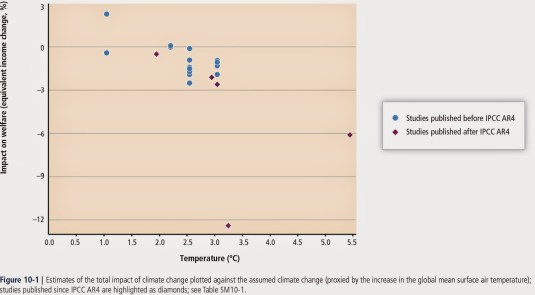
The above figure is as it appears in the final, published version of Chapter 10 of the Contribution of Working Group II to the Fifth Assessment Report of the Intergovernmental Panel on Climate Change.
via Richard Tol.
We’ve got 5 years (now 1 hour left) to save world says Australia’s chief scientist Professor Penny Sackett, 4th December 2009 | Herald Sun
04 Dec 2014 Leave a comment

On the unsustainability of wind power – noise pollution edition
03 Dec 2014 Leave a comment
in energy economics, environmental economics, global warming, law and economics Tags: noise pollution, wind power
Three days to save the world from climate change, if Australia’s chief scientist is to believed?!
01 Dec 2014 Leave a comment
in environmental economics, global warming, politics - Australia Tags: climate alarmism, global warming, green rent seeking
A Revealing Cartoon |Ideas
30 Nov 2014 Leave a comment
in economics of information, economics of media and culture, environmental economics, global warming Tags: climate alarmism, economics of advertising, global warming

But it apparently does not occur to them that, for someone not persuaded of their policies, the same argument applies to them, that, from the standpoint of the people they want to convince, the cartoon is a reason to be more skeptical of their views, not less.
via Ideas.

Treat scientific advice on global warming like advice from your doctor
28 Nov 2014 Leave a comment
in applied price theory, applied welfare economics, environmental economics, global warming Tags: climate alarmism, cost benefit analysis, evidence-based policy, global warming

1. Physicians may not agree on the medical condition causing the symptoms the patient presents.
2. Even if physicians agree on their diagnoses, they often do not agree on the efficacy of alternative responses — for example, surgery or medical management for lower-back pain.
3. The reason patients seek advice and treatment is that they expect physicians to have vastly superior knowledge about the proper diagnosis and efficacy of treatment.
4. Medicine proceeds on the basis of double blind trials and other small field experiments. Control and treatment groups are used before any treatment is applied widely.
5. Medicine is not perfect as was the case with the misdiagnosis of the causes of stomach ulcers.
6. The lag between cause and effect are short as would be the case if you rejected emergency treatment after a car accident or cancer treatment.
7. Medicine tests the efficacy of invasive treatments, weighs side-effects and encourages adaptation and prevention.
8. The staying power of self-interest in medicine is well-known: much higher rates of surgery when there is fee for service and much lower rates of surgery if the patient is a doctor or his partner. The efforts of the medical profession to suppress competition is well-known.


Recent Comments