
Via The-Galileo-Movement and dailymail.co.uk
Celebrating humanity's flourishing through the spread of capitalism and the rule of law
01 Aug 2014 Leave a comment
in environmental economics, environmentalism, global warming Tags: carbon credits, global warming, unintended consequence
Via The-Galileo-Movement and dailymail.co.uk
01 Aug 2014 Leave a comment
in economics of climate change, energy economics, environmental economics, environmentalism, global warming Tags: bootleggers and baptists, global warming, green rent seeking, solar power, wind power

Paul Joskow pointed out that these costs do not take account of the costs of intermittency: wind power is not generated on a calm day, nor solar power at night. Conventional power plants must be kept on standby. Electricity demand also varies during the day in ways that the supply from wind and solar generation may not match.
HT: The Economist via Sinclair Davidson
26 Jul 2014 Leave a comment
in economics of regulation, environmental economics, global warming, Public Choice, rentseeking Tags: bootleggers and baptists, Bruce Yandle, environmental interest groups, global warming, green rent seeking, Todd Zywicki
Bootleggers, Baptists, and the Global Warming Battle By Bruce Yandle and Stuart Buck:
The theory’s name is meant to evoke 19th century laws banning alcohol sales.
Yandle and Buck argue that during the battle over the Kyoto Protocol, he “Baptist” environmental groups provided moral support while “bootlegger” corporations and nations worked in the background to seek economic advantages over their rivals.

BAPTISTS? THE POLITICAL ECONOMY OF POLITICAL ENVIRONMENTAL INTEREST GROUPS By Todd J. Zywicki who specifies three testable implications of a public interest model of the activities of environmental interest groups:
(1) a desire to base policy on the best-available science;
(2) a willingness to engage in deliberation and compromise to balance environmental protection against other compelling social and economic interests; and,
(3) a willingness to consider alternative regulatory strategies that can deliver environmental protection at lower-cost than traditional command-and-control regulation.
Zywicki concludes that It has been argued that environmental regulation can be best understood as the product of an unlikely alliance of “Baptists and Bootleggers” – public-interested environmental activist groups and private-interested firms and industries seeking to use regulation for competitive advantage.
19 Jul 2014 Leave a comment
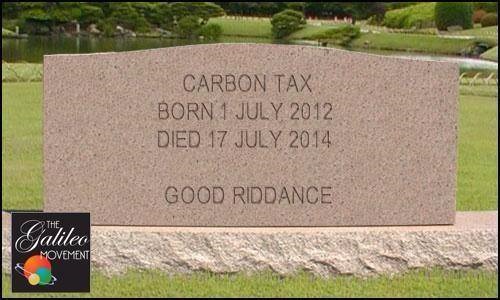
in environmental economics, global warming, politics - Australia Tags: carbon tax, expressive voting
17 Jul 2014 Leave a comment
15 Jul 2014 Leave a comment
in economics of climate change, environmental economics, environmentalism, global warming Tags: an inconvenient truth, global warming

HT: aei-ideas.org
08 Jul 2014 Leave a comment
in environmentalism, global warming Tags: global cooling, global warming, Little ice age, Medieval warming period

The second IPCC report, in 1996, showed a 1,000-year graph demonstrating that temperature in the Middle Ages was warmer than today.
The 2001 report contained a new graph showing no medieval warm period. The technique they overweighed was one which the UN’s 1996 report had said was unsafe: measurement of tree-rings from bristlecone pines.
Scores of scientific papers show that the medieval warm period was real, global and up to 3C warmer than now.
29 Jun 2014 Leave a comment
in environmental economics, global warming Tags: cap and trade, carbon tax, emissions trading, global warming, rent seeking

25 Jun 2014 Leave a comment
in environmental economics, environmentalism, global warming Tags: global warming, Little ice age, Medieval warm period, River Thames frost fairs


This painting, dated 1684, by Abraham Hondius depicts one of many frost fairs on the River Thames during the Little Ice Age. River Thames frost fairs were held on its tideway in some winters between the 17th century and early 19th century.
22 Jun 2014 Leave a comment
in economics of climate change, environmental economics, global warming Tags: climate change, hiatus in global warming, IPCC

Ross McKitrick noted this week that the IPCC still uses the word unequivocal to describe the evidence, but has let a new word slip into its lexicon : hiatus – the global warming hiatus since 1998.

How times have changed. Up until now, to mention this hiatus was to be a climate denier – pure wickedness: to be anti-science and a paid lackey or wannabe paid lackey of Big Oil.

Has the IPCC become a climate denier? Trends change. Differentiating a break in trend from fluctuations around a trend is never easy.

I have not seen a statement of when this hiatus becomes a break in trend. Nor have I seen an estimate of when a return of warming, in what year in the 2020s or 2030s or whenever, will a return in warming make recent trends in global temperatures statistically significant evidence of global warming.
Celebrating humanity's flourishing through the spread of capitalism and the rule of law
Celebrating humanity's flourishing through the spread of capitalism and the rule of law
Celebrating humanity's flourishing through the spread of capitalism and the rule of law
Celebrating humanity's flourishing through the spread of capitalism and the rule of law
Celebrating humanity's flourishing through the spread of capitalism and the rule of law
Celebrating humanity's flourishing through the spread of capitalism and the rule of law
Celebrating humanity's flourishing through the spread of capitalism and the rule of law
Celebrating humanity's flourishing through the spread of capitalism and the rule of law
Celebrating humanity's flourishing through the spread of capitalism and the rule of law
Celebrating humanity's flourishing through the spread of capitalism and the rule of law
Celebrating humanity's flourishing through the spread of capitalism and the rule of law
Celebrating humanity's flourishing through the spread of capitalism and the rule of law
A History of the Alt-Right
Econ Prof at George Mason University, Economic Historian, Québécois
Celebrating humanity's flourishing through the spread of capitalism and the rule of law
Scholarly commentary on law, economics, and more
Beatrice Cherrier's blog
Celebrating humanity's flourishing through the spread of capitalism and the rule of law
Celebrating humanity's flourishing through the spread of capitalism and the rule of law
Celebrating humanity's flourishing through the spread of capitalism and the rule of law
Why Evolution is True is a blog written by Jerry Coyne, centered on evolution and biology but also dealing with diverse topics like politics, culture, and cats.
Celebrating humanity's flourishing through the spread of capitalism and the rule of law
A rural perspective with a blue tint by Ele Ludemann
DPF's Kiwiblog - Fomenting Happy Mischief since 2003
Celebrating humanity's flourishing through the spread of capitalism and the rule of law
The world's most viewed site on global warming and climate change
Tim Harding's writings on rationality, informal logic and skepticism
A window into Doc Freiberger's library
Let's examine hard decisions!
Commentary on monetary policy in the spirit of R. G. Hawtrey
Thoughts on public policy and the media
Celebrating humanity's flourishing through the spread of capitalism and the rule of law
Politics and the economy
A blog (primarily) on Canadian and Commonwealth political history and institutions
Reading between the lines, and underneath the hype.
Economics, and such stuff as dreams are made on
"The British constitution has always been puzzling, and always will be." --Queen Elizabeth II
Celebrating humanity's flourishing through the spread of capitalism and the rule of law
Celebrating humanity's flourishing through the spread of capitalism and the rule of law
WORLD WAR II, MUSIC, HISTORY, HOLOCAUST
Undisciplined scholar, recovering academic
Celebrating humanity's flourishing through the spread of capitalism and the rule of law
Res ipsa loquitur - The thing itself speaks
In Hume’s spirit, I will attempt to serve as an ambassador from my world of economics, and help in “finding topics of conversation fit for the entertainment of rational creatures.”
Researching the House of Commons, 1832-1868
Reflections on books and art




Recent Comments