
Source: International freight transport services | Productivity Commission of New Zealand.

Source: International freight transport services | Productivity Commission of New Zealand.

Celebrating humanity's flourishing through the spread of capitalism and the rule of law
24 May 2016 Leave a comment
in environmental economics, industrial organisation, politics - New Zealand, survivor principle, transport economics Tags: celebrity technologies, New Zealand Greens
Source: International freight transport services | Productivity Commission of New Zealand.
Source: International freight transport services | Productivity Commission of New Zealand.
24 May 2016 Leave a comment
in energy economics, environmental economics, global warming, politics - New Zealand, transport economics Tags: celebrity technologies, coastal shipping, New Zealand Greens
Of the 4.2 billion million tons of annual coastal shipping in New Zealand, 2.32 million tons of that is petroleum products. The majority of coastal shipping is petroleum products redistributed from the one refinery in New Zealand to the rest of the country. You can’t double that which the Greens wanted to because it is already at its upper limit.

Source: Coastal shipping and modal freight choice | NZ Transport Agency.
24 May 2016 Leave a comment
in environmental economics, global warming, politics - New Zealand, transport economics, urban economics Tags: celebrity technologies, New Zealand Greens
The Greens today announced a policy to double the amounts of cargo moved by train and shipping. It seems to have forgotten that most cargo moved by ship is bulk cargoes such as cars. Nothing can change the fact that once the ship is unloaded, the cars have to go by truck to the car yard.
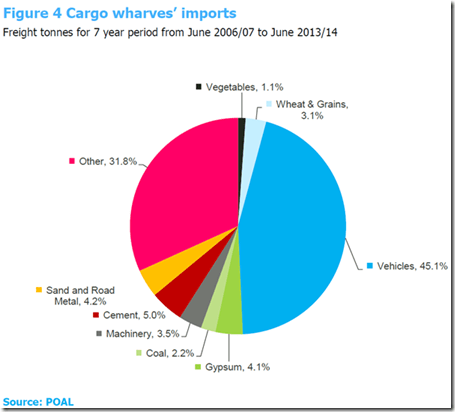
Source: New Zealand Institute of Economic Research. Port study 2 Final report NZIER report to Auckland Council (3 February 2015).
24 May 2016 Leave a comment
in development economics, economics, economics of religion, energy economics, entrepreneurship, environmental economics Tags: The Great Enrichment
20 May 2016 Leave a comment
in applied price theory, applied welfare economics, comparative institutional analysis, constitutional political economy, economics of media and culture, economics of regulation, entrepreneurship, environmental economics, industrial organisation, liberalism Tags: offsetting behaviour, The fatal conceit, The pretence to knowledge
18 May 2016 Leave a comment
in applied price theory, energy economics, environmental economics, global warming Tags: electric cars, rational irrationality
17 May 2016 Leave a comment
in applied price theory, applied welfare economics, environmental economics, industrial organisation, privatisation, survivor principle Tags: economics of national parks
17 May 2016 Leave a comment
in applied price theory, comparative institutional analysis, economics of regulation, environmental economics, fisheries economics, industrial organisation, international economics, law and economics, privatisation, property rights Tags: common property, economics of fisheries, individual transferable quotas, tragedy of the commons
16 May 2016 Leave a comment
in comparative institutional analysis, constitutional political economy, economics of crime, energy economics, environmental economics, global warming, law and economics, politics - New Zealand, Public Choice, Rawls and Nozick, rentseeking Tags: climate activists, climate alarmism, law and order, non-violent direct action, peaceful protest, reactionary left
In a letter to the editor today in the Dominion Post defending a climate change protest that closed a branch of the ANZ bank, one of the participants Jimmy Green said
Of course our intention wasn’t to intimidate individuals – our intention was to intimidate ANZ into shifting its investments after the bank ignored us asking.
This honesty about the willingness to intimidate to advance a political agenda shows that climate protesters are engaging in plain thuggery. Peaceful protest has its role in any democracy.
What these thuggish protesters forgot about is how we resolve our differences in a democracy. That is by trying to persuade each other and elections. Let the people decide.
These protesters are keen to pass laws to save the environment but they’re more than happy to break laws they disagree with. I wonder if they extend that same courtesy to others they regard as less enlightened than them? They expect others to obey the laws for which they successfully lobbied.
Why do these climate action protesters think they can break laws that others secured through lawful, peaceful democratic action? Is some direct action more equal than others? Why do these climate action protesters think their vote counts more than mine?
John Rawls makes the point that the purpose of civil disobedience is not to impose your will upon others but through your protest to implore others to reconsider their position and change the law or policy you are disputing.
Rawls argues that civil disobedience is never covert or secretive; it is only ever committed in public, openly, and with fair notice to legal authorities. Openness and publicity, even at the cost of having one’s protest frustrated, offers ways for the protesters to show their willingness to deal fairly with authorities.
Rawls argues: for a public, non-violent, conscientious yet political act contrary to law being done (usually) with the aim of bringing about a change in the law or policies of the government; that appeals to the sense of justice of the majority; which may be direct or indirect; within the bounds of fidelity to the law; whose protesters are willing to accept punishment; and although civil disobedience involves breaking the law, it is for moral rather than selfish reasons, and the willingness to accept arrest is proof of the integrity of the act of peaceful protest.
Rawls argues, and too many forget, that civil disobedience and dissent more generally contribute to the democratic exchange of ideas by forcing the dominant opinion to defend their views.
The civil disobedient is attempting to appeal to the “sense of justice” of the majority and their willingness to accept arrest is proof of the integrity of the act as a contribution to democratic persuasion not intimidation says Rawls:
…any interference with the civil liberties of others tends to obscure the civilly disobedient quality of one’s act.
Rawls argues that the use or threat of violence is incompatible with a reasoned appeal to fellow citizens to move them to change a law. The protest actions are not a means of coercing or frightening others into conforming to one’s wishes.
The intimidation by the protesters at the ANZ bank and their promise to do it again as shown in the adjacent tweet is a breach of the principles of a just society. These climate change protesters blockading an ANZ bank branch were attempting to coerce and frighten others into conforming with their political views. That ‘might does not make right’ is fundamental to democracy and the rule of law. As United States Supreme Court Justice Antonin Scalia said
The virtue of a democratic system [with a constitutionally guaranteed right to free speech] is that it readily enables the people, over time, to be persuaded that what they took for granted is not so and to change their laws accordingly.
When the climate protesters lose at the ballot box, they always claim it is rigged by the corporate interests. This is just sore losers.
How the left-wing and liberal visions of democracy are different nymag.com/daily/intellig… http://t.co/Qk5vS9SaV4—
Jonathan Chait (@jonathanchait) August 13, 2015
The great strength of democracy is a small group of concerned and thoughtful citizens can band together and change things by mounting single issue campaigns or joining a political party and running for office and winning elections or influencing who wins.
Yesterday’s majority of the vote sooner or later and often sooner than they expect will break off into different minorities on the next big issue of the day. These newly formed minorities will use that same ability to band together as a minority to block vote to protect what they think is important and advance agendas they think are to be wider benefit despite the opinion of the current majority to the contrary. All reforms start as a minority viewpoint.
Indeed, it is a strength of democracy – small groups of concerned citizens banding together – is what is holding up legislating in many areas. It is not that minorities are powerless and individuals are voiceless. It is exactly the opposite.
Parliaments elected by proportional representation such as in New Zealand, and in Australian upper houses reinforces the ability of small groups of citizens to band together to win a seat.
Nothing stirs up the impassioned (and most other people as well) more than depriving them of their right to support or oppose what is important to them through political campaigns and at an election. The losing side, we all end up on the losing side at one time or another, are much more likely to accept an outcome if they had their say and simply lost the vote at the election or in Parliament. Scalia warned of, for example, the risks of the courts moving in advance of the popular will, and thereby poisoning the democratic process
We might have let the People decide. But that the majority will not do. Some will rejoice in today’s decision, and some will despair at it; that is the nature of a controversy that matters so much to so many. But the Court has cheated both sides, robbing the winners of an honest victory, and the losers of the peace that comes from a fair defeat. We owed both of them better. I dissent.
These climate change protesters want to rob the winners of their honest democratic victory over the balance between oil and coal exploration and other energy options. They are also robbing themselves of a fair defeat.
A fair defeat flows from laws and policies secured through normal democratic means knowing that one day you may be in a majority. Only by respecting the will of the majority when you are in the minority do you have any right to expect future minorities to respect your honest democratic victories as the majority of some future day. Democratic majorities of patched together through give-and-take and the reality that even the most important policies may be reversed in the future.

Climate change protesters should respect the political process because democracy alone can produce compromises satisfying a sufficient mass of the electorate on deeply felt issues so as to not poison the remainder of the democratic process. The losing side, we all end up on the losing side at one time or another, are much more likely to accept an outcome if they had their say and simply lost the vote at the election or in Parliament.
13 May 2016 Leave a comment
in energy economics, environmental economics Tags: endangered specie, expressive voting, green hypocrisy, killer green technologies, Left-wing hypocrisy, rational irrationality, wind power
13 May 2016 Leave a comment
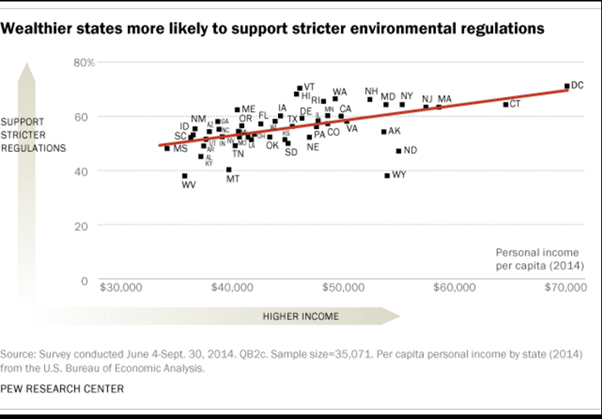
in economics of regulation, environmental economics, Public Choice Tags: expressive voting, rational irrationality, voter demographics
09 May 2016 Leave a comment
in applied price theory, applied welfare economics, Austrian economics, comparative institutional analysis, constitutional political economy, development economics, economics of regulation, environmental economics, history of economic thought, industrial organisation, international economics, law and economics, property rights Tags: star trek
09 May 2016 Leave a comment
in energy economics, environmental economics, global warming, labour economics, labour supply, occupational choice Tags: Big Wind, green rent seeking, renewable energy, wind power
Doubling from 4,400 to 9,000 does not exactly strike me as an explosion in wind technician employment.

Source: Wind Turbine Technicians : Occupational Outlook Handbook: : U.S. Bureau of Labor Statistics.
Yet still this occupation is expected to be the fastest-growing occupation in the USA in the next 10 years.
08 May 2016 Leave a comment
in applied price theory, applied welfare economics, Austrian economics, comparative institutional analysis, constitutional political economy, economics of regulation, environmental economics, history of economic thought, industrial organisation, law and economics, property rights, Ronald Coase Tags: Coase theorem
Celebrating humanity's flourishing through the spread of capitalism and the rule of law
Celebrating humanity's flourishing through the spread of capitalism and the rule of law
Celebrating humanity's flourishing through the spread of capitalism and the rule of law
Celebrating humanity's flourishing through the spread of capitalism and the rule of law
Celebrating humanity's flourishing through the spread of capitalism and the rule of law
Celebrating humanity's flourishing through the spread of capitalism and the rule of law
Celebrating humanity's flourishing through the spread of capitalism and the rule of law
Celebrating humanity's flourishing through the spread of capitalism and the rule of law
Celebrating humanity's flourishing through the spread of capitalism and the rule of law
Celebrating humanity's flourishing through the spread of capitalism and the rule of law
Celebrating humanity's flourishing through the spread of capitalism and the rule of law
Celebrating humanity's flourishing through the spread of capitalism and the rule of law
A History of the Alt-Right
Econ Prof at George Mason University, Economic Historian, Québécois
Celebrating humanity's flourishing through the spread of capitalism and the rule of law
Scholarly commentary on law, economics, and more
Beatrice Cherrier's blog
Celebrating humanity's flourishing through the spread of capitalism and the rule of law
Celebrating humanity's flourishing through the spread of capitalism and the rule of law
Celebrating humanity's flourishing through the spread of capitalism and the rule of law
Why Evolution is True is a blog written by Jerry Coyne, centered on evolution and biology but also dealing with diverse topics like politics, culture, and cats.
Celebrating humanity's flourishing through the spread of capitalism and the rule of law
A rural perspective with a blue tint by Ele Ludemann
DPF's Kiwiblog - Fomenting Happy Mischief since 2003
Celebrating humanity's flourishing through the spread of capitalism and the rule of law
The world's most viewed site on global warming and climate change
Tim Harding's writings on rationality, informal logic and skepticism
A window into Doc Freiberger's library
Let's examine hard decisions!
Commentary on monetary policy in the spirit of R. G. Hawtrey
Thoughts on public policy and the media
Celebrating humanity's flourishing through the spread of capitalism and the rule of law
Politics and the economy
A blog (primarily) on Canadian and Commonwealth political history and institutions
Reading between the lines, and underneath the hype.
Economics, and such stuff as dreams are made on
"The British constitution has always been puzzling, and always will be." --Queen Elizabeth II
Celebrating humanity's flourishing through the spread of capitalism and the rule of law
Celebrating humanity's flourishing through the spread of capitalism and the rule of law
WORLD WAR II, MUSIC, HISTORY, HOLOCAUST
Undisciplined scholar, recovering academic
Celebrating humanity's flourishing through the spread of capitalism and the rule of law
Res ipsa loquitur - The thing itself speaks
In Hume’s spirit, I will attempt to serve as an ambassador from my world of economics, and help in “finding topics of conversation fit for the entertainment of rational creatures.”
Researching the House of Commons, 1832-1868
Reflections on books and art


Recent Comments