Further evidence from the legacy media that climate alarmism is on the way out?
16 Mar 2015 Leave a comment
in economics of information, economics of media and culture, environmental economics, global warming Tags: climate alarmism, expressive voting, global warming, rational ignorance, rational irrationality
What did the IPCC say on global warming and hurricanes in the Pacific?
16 Mar 2015 2 Comments
in environmental economics, global warming Tags: climate alarmists, green rentseeking, hurricanes
Maybe the future is not solar and wind, so those mass layoffs of climate alarmists are cancelled
16 Mar 2015 Leave a comment
in energy economics, environmental economics, politics - Australia, politics - New Zealand, politics - USA Tags: Big Solar, Big Wind, climate alarmists, green rentseeking, solar power, wind power


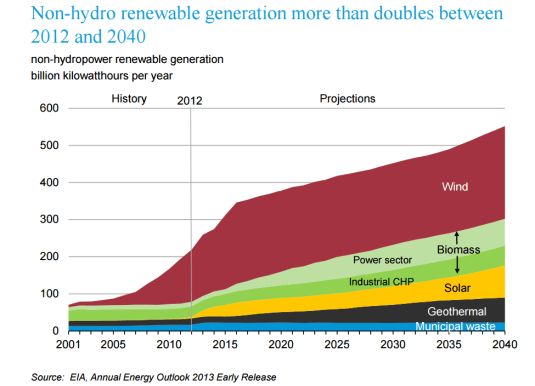
via eia.gov
The relationship between energy use & GDP
Technology is getting much more efficient
(Source bit.ly/1Anl8AJ) http://t.co/7zYDhXv2lu—
Max Roser (@MaxCRoser) March 15, 2015
Ed Miliband’s crimes against the climate continue
15 Mar 2015 Leave a comment
in energy economics, environmental economics
Frankly, how can you sign up to action on climate change while freezing the energy bills of households?

HT: Ed Miliband targets energy firms with proposed price-cut powers for Ofgem | Business | The Guardian.
RT if you think this summarises the Anti-Science Left
15 Mar 2015 Leave a comment
in economics of information, economics of media and culture, economics of regulation, environmental economics, global warming, health economics, politics - Australia, politics - New Zealand, politics - USA Tags: Anti-Science left, conjecture and refutation, expressive voting, Green Left, progressive left, rational ignorance, rational irrationality
Many more birds to be incinerated as solar energy becomes cost competitive; climate alarmists face mass layoffs
13 Mar 2015 Leave a comment
in energy economics, environmental economics, global warming Tags: climate alarmism, creative destruction, global warming, killer green technologies, solar power

Unsubsidized rooftop solar electricity costs anywhere between $0.13 and $0.23/kWh today, well below retail price of electricity in many markets globally.
The economics of solar have improved significantly due to the reduction in solar panel costs, financing costs and balance of system costs. We expect solar system costs to decrease 5-15% annually over the next 3+ years which could result in grid parity within ~50% of the target markets.
If global electricity prices were to increase at 3% per year and cost reduction occurred at 5-15% CAGR, solar would achieve grid parity in an additional ~30% of target markets globally. We believe the cumulative incremental total available market for solar is currently around ~140GW/year and could potentially increase to ~260GW/year over the next 5 years as solar achieves grid parity in more markets globally and electric capacity needs increase…
solar system costs have declined at ~15% CAGR over the past 8 years and we expect 40% cost reduction over the next 4-5 years as a solar module costs continue to decline, panel efficiencies gradually improve, balance of system costs decline due to scale and competition, global financing costs decline due to development of new business models and customer acquisition costs decline as a result of increasing customer awareness and more seamless technology adoption enabled by storage solutions…
oil represents only about 5% of global electricity production and in some of the important solar markets such as US, China, oil based electricity generation is less than 5% of the total. Moreover, the cost of oil based electricity generation even at $50 oil prices is the 7-9c/kWh range and as shown in the note, the marginal cost is higher than solar in many regions worldwide. Bottom line is that oil prices do not have a material impact on solar demand.

About the only losers from this creative destruction in energy production, aside from the tens of thousands of public officials, academics and NGO employees who jobs and research grants depend up climate alarmism, are the birds that happen to fly past these solar power stations and are incinerated.

via Deutsche Bank’s 2015 solar outlook: accelerating investment and cost competitiveness – Deutsche Bank Responsibility and Deutsche Bank report: Solar grid parity in a low oil price era – Deutsche Bank Responsibility.
Richard Lindzen on back when periods of warming were climate optima
12 Mar 2015 1 Comment
in economic history, economics of bureaucracy, environmental economics, global warming, Public Choice, rentseeking Tags: Anti-Science left, climate alarmism, green rent seeking, Richard Lindzen

JS Mill on the importance of never saying that the science is settled
12 Mar 2015 Leave a comment
in economics of media and culture, environmental economics, liberalism Tags: climate alarmism, critical discussion, John Stuart Mill, The philosophy of science
Red Ed has given up on fighting climate change and introducing a carbon tax
11 Mar 2015 Leave a comment
in energy economics, environmental economics, global warming, public economics Tags: carbon tax, climate alarmism, expressive voting, left-wing popularism, rational ignorance, rational irrationality, UK politics
I am starting to warm to Red Ed. His freeze on energy bills rules out any carbon tax was he cannot introduce a carbon tax while freezing energy bills.
Environmental and Urban Economics: The Drought Causes War Hypothesis: Evidence from Syria
09 Mar 2015 Leave a comment
in applied price theory, environmental economics, global warming, politics - USA, war and peace Tags: Syria, water markets

I am an economist so permit me to make one Econ 101 point.
As drought conditions unfolded in Syria, did water prices rise? Is water metered and paid for in Syria? How do farmers and residential water customers access water?
If there had been a market signal of increased scarcity, water prices would have gone up and rational households and firms would reduce their consumption.
In the presence of such well functioning water markets, no “excess conflict” would have resulted. Capitalist markets thus can diffuse violence as increasingly scarce resources are allocated efficiently and water consumers are incentivized to invest in strategies and actions to reduce their water demand.
So, to repeat my point; if the PNAS authors are correct then it is the synergistic effect between increased drought conditions and the absence of water markets that caused the problem. If the nation had well functioning water markets, then I would strongly predict that there would be no extra violence.
via Environmental and Urban Economics: The Drought Causes War Hypothesis: Evidence from Syria.
Follow the money – The Global Landscape of Climate Finance 2014 CPI Report Climate Policy Initiative
09 Mar 2015 Leave a comment
in environmental economics, global warming, Public Choice, rentseeking Tags: bootleggers and baptists, climate alarmism, global warming, green rent seeking
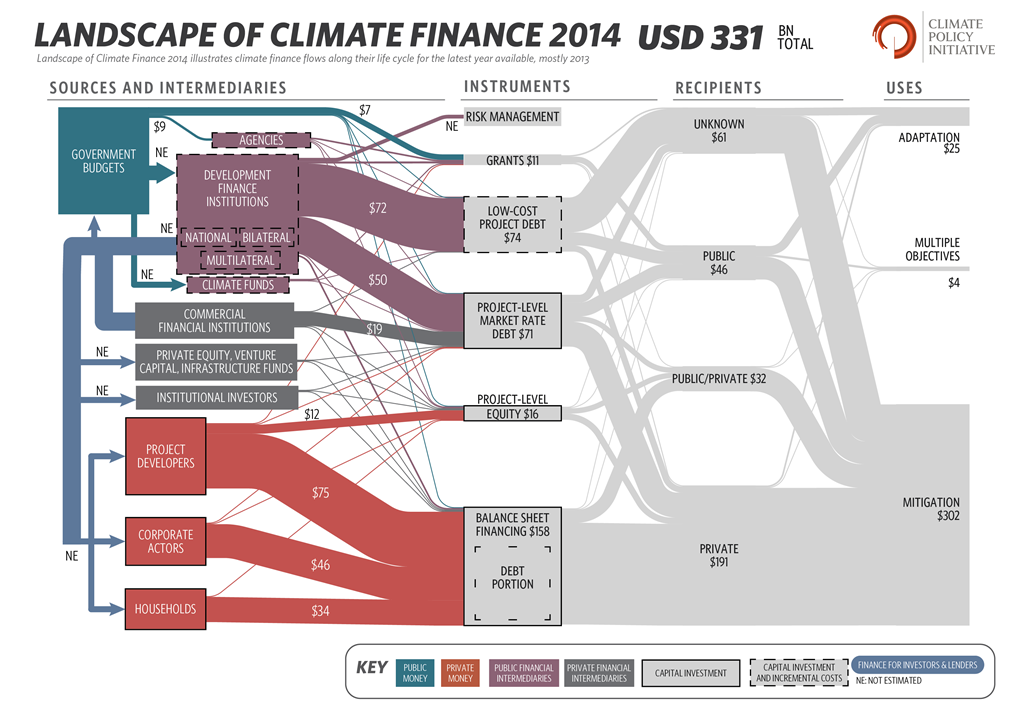
In 2013, annual global climate finance flows totalled approximately USD 331 billion, falling USD 28 billion below 2012 levels.
Public actors and intermediaries contributed USD 137 billion (USD 134-140 billion) largely unchanged from last year. Private investment totalled USD 193 billion, falling by USD 31 billion or 14% from 2012, see Figure ES1. The actual decrease in total flows may be even larger as, for the first time, Landscape 2014 captures public finance flowing to large hydro and research and development (USD 4 billion and USD 3 billion respectively).
Climate finance flows were split almost equally between developed (OECD) and developing (non-OECD) countries, USD 164 billion and USD 165 billion respectively. The amount we tracked flowing from developed to developing countries fell by USD 8 billion from 2012, to USD 34 billion, with multilateral DFI contributions falling by USD 5 billion and private investment contracting by USD 2 billion.
Almost three-quarters of total flows were invested in their country of origin. Private actors had an especially strong domestic investment focus with USD 174 billion or 90% of their investments remaining in the country of origin. This demonstrates that investment environments that are more familiar and perceived to be less risky are key to investment decisions, highlighting the importance of domestic policy frameworks in unlocking scaled up climate finance flows.


Global warming ruined the world 15 years ago, apparently
06 Mar 2015 Leave a comment
in environmental economics, global warming Tags: climate alarmism, doomsday predictions, false prophets, global warming
The bandwagon effect
06 Mar 2015 Leave a comment
in economics of media and culture, environmental economics, environmentalism, global warming Tags: climate alarmism, conjecture and refutation, philosophy of science
 Utopia, you are standing in it!
Recent Comments