HT: Whale Oil
Celebrating humanity's flourishing through the spread of capitalism and the rule of law
20 May 2016 Leave a comment
in health economics Tags: vegans, vegetarians
HT: Whale Oil
17 May 2016 Leave a comment
in economics, health economics Tags: anti-vaccination movement, measles, Quacks, vaccination, vaccines
17 May 2016 Leave a comment
in development economics, economic history, growth disasters, growth miracles, health economics Tags: antimarket bias, Botswana, economics of AIDS, life expectancies, reactionary left, Swaziland, The Great Escape, Uganda
Since 1985, extreme poverty has halved in Botswana and dropped by a 3rd in Swaziland and Uganda.

Source: World Poverty – Our World In Data.
Life expectancies are increasing again in Swaziland and Botswana after the HIV epidemic has come under more control.

Source: Life Expectancy by Age in selected Country from 1990 to 2013 | Health Intelligence

Source: Life Expectancy by Age in selected Country from 1990 to 2013 | Health Intelligence
Closer to achieving #foodsecurity in #WestAfrica w/ 60% decline in under-nourished since 90s bit.ly/1M1Fzvt https://t.co/ezPM05lbEo—
(@OECD) October 28, 2015
The battle against Polio in Africa http://t.co/LYB2nGZlAB—
Amazing Maps™ (@amazingmap) June 30, 2015
"Freedom is making gradual progress in Africa…the trends are in the right direction" @bill_easterly #hayek15 https://t.co/Ua1GON7ha2—
IEA (@iealondon) December 02, 2015
14 May 2016 Leave a comment
in economic history, gender, health economics, labour economics, labour supply Tags: maternal health, maternal labour force participation, The Great Escape
Medical progress contributed more than people realise to women’s liberation. The key area of progress was far fewer deaths in childbirth as the chart below for Australia shows. Deaths from childbirth disappeared from mortality statistics in the 1940s and 1950s.
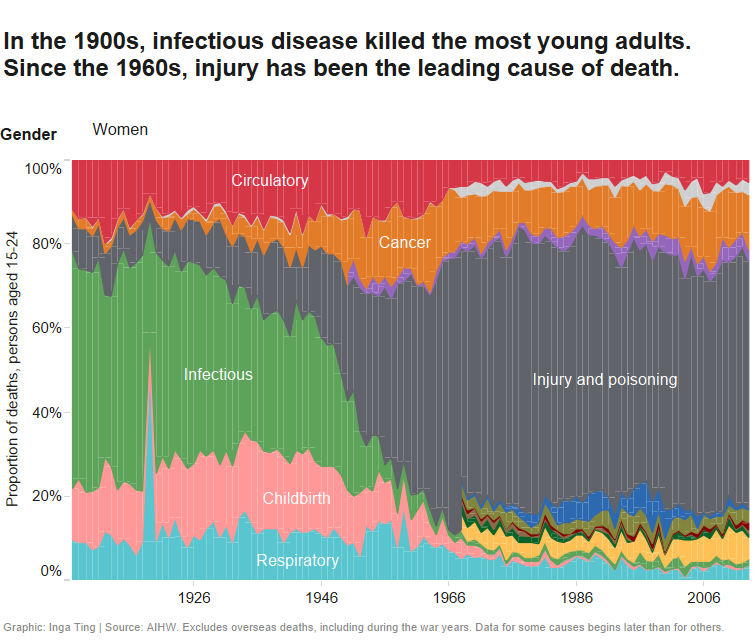
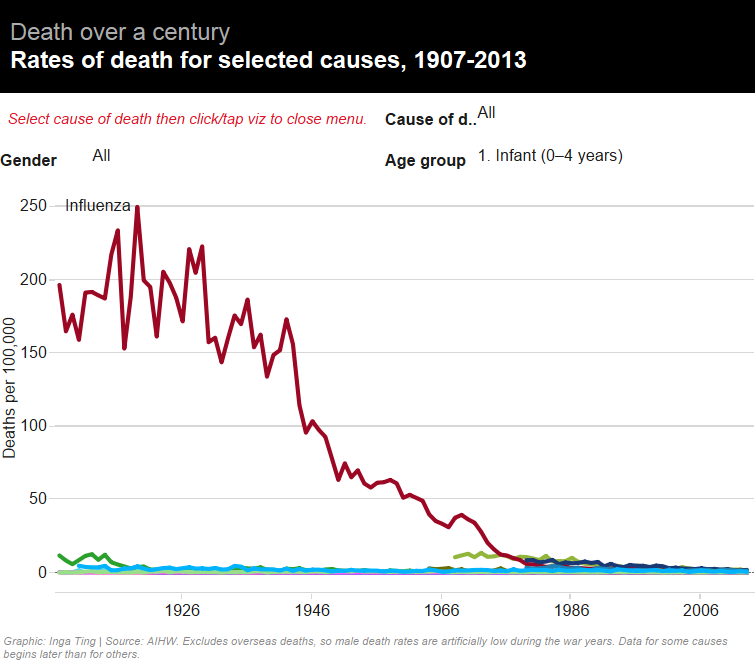
Source: Australian Institute of Health and Welfare via Sydney Morning Herald This chart shows how you will probably die, and it’s changed a lot in 100 years.
The next key area of medical progress was fewer disabling injuries subsequent because of childbirth that kept women out of the workforce for several years if not permanently. In Gender Roles and Medical Progress, Stefania Albanesi and Claudia Olivetti say
Consider a typical woman born around 1900. She married at 21 and gave birth to more than three live children between age 23 and 33. The high fetal mortality rate implied an even greater number of pregnancies, so that she would be pregnant for 36% of this time.
Health risks in connection to pregnancy and childbirth were severe. Septicemia, toxaemia, hemorrhages and obstructed labour could lead to prolonged physical disability and, in the extreme, death. In 1920 one mother died for each 125 living births. At a rate of 3.6 pregnancies per woman, the compounded risk of death from maternal causes was 2.9%.
For every death, twenty times as many mothers were estimated to suffer different degrees of disablement annually. Many maternal conditions had very long lasting or chronic effects on health, hindering women’s ability to work beyond their childbearing years.
Death in childbirth and serious complications from childbirth been forgotten in modern memory. So much so that there can be an entire year in New Zealand when no child nor mother dies in childbirth. When that does happen, there is a coroner’s enquiry.
The implications of medical progress around childbirth for female life expectancy has been equally forgotten as Albanesi and Olivetti explain
The development of bacteriology, the introduction of sulfominydes and antibiotics, and the diffusion of blood banks dramatically decreased the death rate from sepsis and hemorrhage. More specific interventions, such as the standardization of obstetric practices and the increased availability of pre-natal care, reduced the incidence of hypertensive disorders of pregnancy and obstructed labour, a causal factor for many forms of post-partum disability.
These developments lead to a stark decline in maternal mortality and a rise in the female-male differential in life expectancy at age 20 from 1.5 years in 1920 to 6 years in 1960.
At the beginning of the last century, the burden of childbirth and breastfeeding simply made it impossible for married women to work in any significant number as Albanesi and Olivetti explain
In addition, due to the lack of reliable alternatives, most infants were exclusively breast fed. Women would then be nursing for approximately a third of the time between age 23 and 33.
Since the average time required to feed one child ranges between 14 and 17 hours per week, with a 40 hour workweek, mothers would be nursing for 35%-43% of their potential working time in childbearing years.
Not surprisingly given this burden, few married women worked. Only 5.4% of married women aged 25 to 34 were in the labour force in 1900.
There was an extraordinary reduction in the number of years lost in disablement after childbirth in the early and mid-20th century as Albanese in Olivetti’s explain
…the years lost to disabilities associated with maternal conditions declined from 2.31 per pregnancy in 1920 to just 0.17 in 1960.
Medical progress around childbirth is the most important force driving the rise in the participation of married women during childbearing years and post-childbearing between 1935 and 1965. The health burden of giving birth is now measured in weeks rather than years.
11 May 2016 Leave a comment
in health economics Tags: junk food, obesity
11 May 2016 Leave a comment
in discrimination, economics, gender, health economics Tags: Bell Curce, gender gap
10 May 2016 Leave a comment
in economic history, health economics Tags: child mortality, good old days, infant mortality, living standards, The Great Escape
08 May 2016 Leave a comment
in economics of regulation, health economics, politics - USA Tags: alcohol regulation, meddlesome preferences, nanny state
New York drinking establishments must post warnings against pregnant women drinking but still must serve them.
08 May 2016 Leave a comment
in applied price theory, applied welfare economics, development economics, economic history, economics of media and culture, environmental economics, growth disasters, growth miracles, health economics, industrial organisation, transport economics Tags: food miles
06 May 2016 Leave a comment
in applied price theory, health economics, income redistribution, politics - USA, Public Choice, rentseeking Tags: 2016 presidential election, do gooders, heavy-handed Samaritans, meddlesome preferences, nanny state, regressive taxes, sin taxes, soda taxes, sugar taxes
05 May 2016 Leave a comment
in economics of regulation, energy economics, health economics, politics - New Zealand, public economics Tags: cost benefit analysis, economics of housing, economics of insulation, energy efficiency gap, The fatal conceit, The pretense to knowledge, valuation of life
Various bold claims have been made about the payoff from investing more in retrofitting insulation into housing. The government recently spent $600 million on such retrofitting of insulation.
https://twitter.com/PhilTwyford/status/728137160113557505
There is a private member’s bill before Parliament to introduce minimum standards for rental properties with regard to insulation and other matters. Little is by the Leader of the Opposition Andrew Little said for the consequences for rents of this additional expense to landlords.
Ian Harrison of Tail Risk Economics initially estimated that the $600 million invested in retrofitting of insulation will save barely half of that:
After correcting for this major error and taking a more realistic view of the benefit estimates in other studies, the net benefits of $630 million disappear.
The $600 million insulation investment will probably generate benefits of closer to $170 million, for an economic loss of $430 million.
After meeting with Ian, I read through the rather dull background documents behind a cost benefit analysis relied upon by the government to spend the $600 million dollars.
The most interesting part of the cost benefit analysis is most of the benefits come from fewer cardiovascular related hospitalisation of the elderly and not from respiratory diseases among children.
I found the error was far more fundamental than a incorrect transfer of a calculation between tables discussed in the first publication by Harrison. I had to read the background documents several times to understand what had been done wrong.
The cost benefit analysis for the Warm Up New Zealand Heat Smart Programme assumes that the number of elderly occupants of the newly insulated house increases by one each year and after 5 years, one of these dies but is replaced by a new elderly occupant.
We have modelled the probability of a vulnerable person avoiding mortality as a result of the intervention. The probability of this is (112.7/1000)*0.27= 0.03 (3%). We treat avoidance of mortality by treatment in each year as independent events.
The multi-year benefit calculated above would accrue based on the life years gained as a result of deaths avoided in year one.
However, we would expect these benefits to accrue in year two for different vulnerable individuals (aged 65 and over with a cardiovascular related hospitalisation in previous 18 months), and for different individuals again in every subsequent year that the treatment continues to have an effect, i.e. an on-going stream of benefits of $1,050.74 per year. This assumes a constant proportion of people aged 65+ who have recently been hospitalised with circulatory problems….( p.38).
In the first year of the new insulation, the first occupant benefits and the net present value is included in the benefit cost analysis calculation – the erroneous benefit cost analysis calculations which its authors still defend.
In the 2nd year, another elderly person moves into that same house and the same calculation is done for them. In the following year, yet another elderly person moves into the same house and the net present value calculation is repeated.
By the end of 5 years, there are 5 occupants in this house all benefiting from the same insulation investment. In the 6th year, the first elderly occupant dies to be replaced by a new elderly occupant who then gains from the insulation upgrade.
There was double counting of the number of people who benefited from the insulation as Iain Harrison explains
The analysis assumed that there was not one, but five occupants who had been hospitalised with a cardiovascular illness in the previous 18 months in each of the relevant insulated houses. There should have been only one such occupant.
The retrofitting of insulation was estimated to cost $600 million. Iain Harrison estimated the benefits to be $300 million, not $1.2 billion. That is a benefit cost ratio of 0.5.
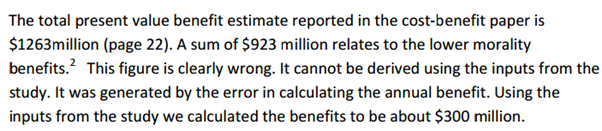
Source: Iain Harrison, The mortality reduction benefits of insulation: the error identified.
03 May 2016 Leave a comment
in defence economics, energy economics, entrepreneurship, financial economics, health economics Tags: BDS, efficient markets hypothesis, entrepreneurial alertness, ethical investing
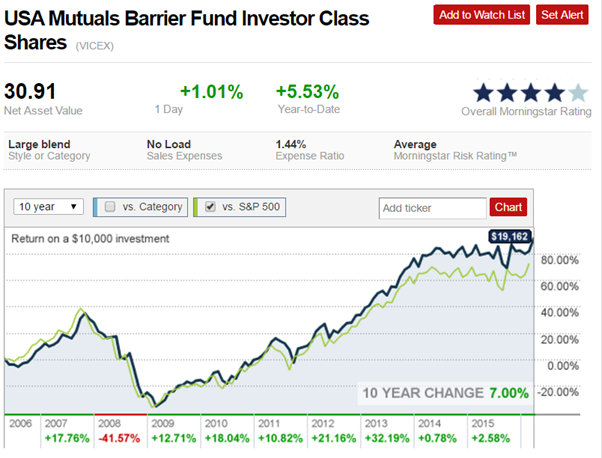
Source: VICEX – USA Mutuals Barrier Fund Investor Class Shares Mutual Fund Quote – CNNMoney.com
The Vice Fund has outperformed the S&P 500 since 2004 as shown by the green line. This mutual fund invests invest in sinful stocks as its managers describe it:
Designed with the goal of delivering better risk-adjusted returns than the S&P 500 Index. It invests primarily in stocks in the tobacco, alcohol, gaming and defence industries. Vice Funds believes these industries tend to thrive regardless of the economy as a whole.
The Vice Fund is now known as the Barrier Fund because it extended out of sinful stocks into industries with high barriers to entry. Minimum Investment is $2,000.
The Barrier Fund primarily invests in the following industries: Aerospace/Defense, Gaming, Tobacco and Alcoholic Beverages. These four industries were chosen because they demonstrate one or more of these compelling and distinctive investment characteristics:
The Barrier Fund believes numerous investment opportunities in these industries which have been largely overlooked by other funds.
The Fund has high management fees of 2%. Americans can buy Vanguard’s or Fidelity’s index funds and pay only 0.1% in expenses.
03 May 2016 Leave a comment
in economics of media and culture, health economics Tags: drug lags
The $2,558 million figure per approved compound is based on estimated:
Estimated average cost of post-approval R&D—studies to test new indications, new formulations, new dosage strengths and regimens, and to monitor safety and long-term side effects in patients required by the U.S. Food and Drug Administration as a condition of approval—of $312 million boosts the full product lifecycle cost per approved drug to $2,870 million. All figures are expressed in 2013 dollars.
Source: PR Tufts CSDD 2014 Cost Study | Tufts Center for the Study of Drug Development
Celebrating humanity's flourishing through the spread of capitalism and the rule of law
Celebrating humanity's flourishing through the spread of capitalism and the rule of law
Celebrating humanity's flourishing through the spread of capitalism and the rule of law
A History of the Alt-Right
Econ Prof at George Mason University, Economic Historian, Québécois
Celebrating humanity's flourishing through the spread of capitalism and the rule of law
Scholarly commentary on law, economics, and more
Beatrice Cherrier's blog
Celebrating humanity's flourishing through the spread of capitalism and the rule of law
Celebrating humanity's flourishing through the spread of capitalism and the rule of law
Celebrating humanity's flourishing through the spread of capitalism and the rule of law
Why Evolution is True is a blog written by Jerry Coyne, centered on evolution and biology but also dealing with diverse topics like politics, culture, and cats.
Celebrating humanity's flourishing through the spread of capitalism and the rule of law
A rural perspective with a blue tint by Ele Ludemann
DPF's Kiwiblog - Fomenting Happy Mischief since 2003
Celebrating humanity's flourishing through the spread of capitalism and the rule of law
The world's most viewed site on global warming and climate change
Tim Harding's writings on rationality, informal logic and skepticism
A window into Doc Freiberger's library
Let's examine hard decisions!
Commentary on monetary policy in the spirit of R. G. Hawtrey
Thoughts on public policy and the media
Celebrating humanity's flourishing through the spread of capitalism and the rule of law
Politics and the economy
A blog (primarily) on Canadian and Commonwealth political history and institutions
Reading between the lines, and underneath the hype.
Economics, and such stuff as dreams are made on
"The British constitution has always been puzzling, and always will be." --Queen Elizabeth II
Celebrating humanity's flourishing through the spread of capitalism and the rule of law
Celebrating humanity's flourishing through the spread of capitalism and the rule of law
WORLD WAR II, MUSIC, HISTORY, HOLOCAUST
Undisciplined scholar, recovering academic
Celebrating humanity's flourishing through the spread of capitalism and the rule of law
Res ipsa loquitur - The thing itself speaks
In Hume’s spirit, I will attempt to serve as an ambassador from my world of economics, and help in “finding topics of conversation fit for the entertainment of rational creatures.”
Researching the House of Commons, 1832-1868
Articles and research from the History of Parliament Trust
Reflections on books and art
Posts on the History of Law, Crime, and Justice
Celebrating humanity's flourishing through the spread of capitalism and the rule of law
Exploring the Monarchs of Europe
Cutting edge science you can dice with
Small Steps Toward A Much Better World
“We do not believe any group of men adequate enough or wise enough to operate without scrutiny or without criticism. We know that the only way to avoid error is to detect it, that the only way to detect it is to be free to inquire. We know that in secrecy error undetected will flourish and subvert”. - J Robert Oppenheimer.
The truth about the great wind power fraud - we're not here to debate the wind industry, we're here to destroy it.
 Utopia, you are standing in it!
Recent Comments