The CDC essentially argues that only the richest countries have safe drinking water. vox.com/2014/8/13/5998… http://t.co/7iBfYjj6cC—
Vox Maps (@VoxMaps) May 20, 2015
Only the richest countries have safe drinking water
31 Jul 2015 Leave a comment
in development economics, growth disasters, growth miracles, health economics Tags: safe drinking water, water pollution
Life expectancies at age 65 by sex and race, USA, 1950 – 2010
31 Jul 2015 1 Comment
in applied welfare economics, economic history, health economics, politics - USA Tags: life expectancies, The Great Escape
There was quite a jump in life expectancy in the decades of the 1950s and 1960s, followed by slow progress for white females and black females. In the case of men of both races, the situation appears to be steady progress in post retirement life expectancy since 1950. Black male life expectancy actually fell in the 1960s for those aged 65.
Figure 1: life expectancies at age 65 by sex and race, USA, 1950 – 2010
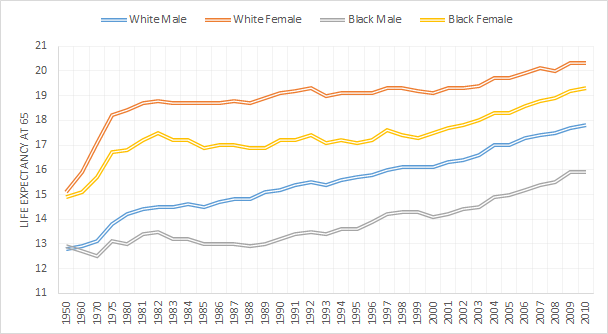
Source: Centres for Disease Control and Prevention.
Harm caused by drugs
31 Jul 2015 Leave a comment
in economics of regulation, health economics Tags: alcohol regulation, economics of smoking, marijuana decriminalisation economics of prohibition, meddlesome preferences, tobacco regulation
Harm caused by drugs http://t.co/4gTLCm3hqS—
Charts and Maps (@ChartsandMaps) June 06, 2015
Alcohol consumption per adult across countries
31 Jul 2015 Leave a comment
in health economics, politics - Australia, politics - New Zealand, politics - USA Tags: alcohol regulation, meddlesome preferences, nanny state
Jane Kelsey opposes handcuffs on the democratic choices of future governments! Does she oppose labour and environmental standards in trade agreements too?
30 Jul 2015 6 Comments
in applied price theory, applied welfare economics, comparative institutional analysis, constitutional political economy, economics of regulation, environmental economics, health economics, industrial organisation, international economic law, international economics, International law, law and economics, property rights, Public Choice Tags: climate treaties, copyrights, customs unions, environmental standards, free trade agreements, free trade zones, intellectual property law, ISDS, Jane Kelsey, Labour standards, Left-wing hypocrisy, neocolonialism, patents, preferential trading agreeents, regional trade agreements, regulatory harmonisation, TPA, TPPA, WTO
Jane Kelsey in a television interview said she opposes the reductions in sovereignty in trade agreements that result from investor-state dispute settlement (ISDS) provisions because they limit the democratic choices of future governments.
If so, she must oppose environmental and labour standards in trade agreements and, more importantly, binding the hands of future governments with climate treaties. All international treaties are about restrictions on sovereignty.
Environmental and labour clauses in trade agreements and climate treaties all limit the powers of governments to legislate on environmental and employment law in accordance with the will of the people as expressed in the most recent election and change of government. Power to the people.
https://twitter.com/rorymccourt/status/625540621457960960
Jane Kelsey would do better focusing on those parts of the TPPA deal that lowers the net value of the deal such as those extending the term of patents over the drugs. All international treaties are about trade-offs.

The most important reason for focusing on intellectual property law in trade agreements is Kelsey is likely to actually win people over that are not on the far left, including many on the right of politics over to her cause. Kelsey is too busy rounding up the usual suspects.

Ranting about big corporate conspiracies and the investor state dispute settlement clauses puts people off.
As copyright duration's at play in #TPPA, a reminder of the costs when copyright's too long.
offsettingbehaviour.blogspot.co.nz/2014/03/orphan… http://t.co/tOtihpDmSU—
Eric Crampton (@EricCrampton) July 29, 2015
These gusts of paranoia lose support on issues where there is common ground to be suspicious about the growing scope of trade agreements and their reach behind borders.

Regulatory harmonisation is advisable only when there are compelling reasons such as the prevention of hazards or technical compatibility of products – do the plugs fit into each other? As Sykes argues:
as a normative matter, harmonization is inferior to a legal system that tolerates regulatory differences subject to legal constraints, and that relies on mutual recognition where appropriate (the exception to this claim being matters of technical compatibility between products).
Related, as a positive manner, harmonization will often lack any political constituency and thus instances of true harmonization will be rare.
The Great Escape in infant mortality is still on-going
30 Jul 2015 Leave a comment
in development economics, growth disasters, growth miracles, health economics Tags: capitalism and freedom, child mortality, infant mortality, life expectancies, The Great Escape, The Great Fact
New Blog: "MDG4: A dramatic decline in child mortality over the last 20 years" blogs.worldbank.org/opendata/mdg4-… #opendata http://t.co/lSAS8SU5Od—
World Bank Data (@worldbankdata) July 16, 2015
#TPPA The first Paul Krugman on trade agreements that level the playing field behind the border
29 Jul 2015 2 Comments

Measles cases and measles deaths in the USA
29 Jul 2015 Leave a comment
in applied welfare economics, health economics, politics - USA Tags: measles commonly anti-vaccination movement, The Grade Escape, The Great Fact, vaccines
The Nirvana fallacy and vaccinations
28 Jul 2015 Leave a comment
in applied welfare economics, comparative institutional analysis, health economics Tags: anti-vaccination movement vaccines, Nirvana fallacy, risk risk trade-offs, vaccinations
Map of pubs with late closing times
27 Jul 2015 Leave a comment
in economic history, economics of regulation, health economics Tags: alcohol regulation, pub closing time, UFO sightings, UFOs
Where Aliens Attack!
Three maps tracking UFO sightings.
googlemapsmania.blogspot.com/2015/07/close-… http://t.co/WK3Hv77lL7—
(@gmapsmania) July 27, 2015
The Great Escape in South Korea
27 Jul 2015 Leave a comment
in development economics, economic history, growth disasters, growth miracles, health economics Tags: child mortality The Great Escape, infant mortality, South Korea
Child Mortality decreased incredibly fast in South Korea.
My History of Global Health: OurWorldInData.org/VisualHistoryO… http://t.co/dMl8YOOuuJ—
Max Roser (@MaxCRoser) July 20, 2015
I thought America’s poor never had health insurance cover!? I’ve watched too much American TV?
26 Jul 2015 1 Comment
in applied welfare economics, economic history, economics of media and culture, health economics, industrial organisation, politics - USA, Public Choice, rentseeking, survivor principle Tags: adverse selection, expressive voting, health insurance, Leftover Left, media bias, medicaid, Medicare, moral hazard, Obamacare, rational ignorance, rational irrationality
#Medicaid expands access to health coverage and supports work: bit.ly/1RKHQ2x #Medicaidat50 http://t.co/mydZMggcXg—
Center on Budget (@CenterOnBudget) July 20, 2015
6.4 million seniors get the vital support & care they need thanks to Medicaid: bit.ly/1HqYvNG #Medicaidat50 http://t.co/onWMiYj301—
Center on Budget (@CenterOnBudget) July 23, 2015
Reminder: #Medicaid helps millions of babies: bit.ly/1RS7ME5 #Medicaidat50 http://t.co/SeJ7MFPGWE—
Center on Budget (@CenterOnBudget) July 20, 2015
#Medicaid help millions of children across the country live healthier lives. #Medicaidat50: bit.ly/1RS7ME5 http://t.co/LT6rXhNzUg—
Center on Budget (@CenterOnBudget) July 16, 2015
50 years of coverage that every American deserves. #Medicare http://t.co/uRtERV2k9K—
American Progress (@amprog) July 30, 2015
Mann: Celebrating historic gains in coverage for kids CCF#2015 http://t.co/g7CYQ7DuwN—
Georgetown CCF (@GeorgetownCCF) July 22, 2015
#Medicare has been keeping seniors insured and healthy for 50 years. http://t.co/mXW4x12Rhi—
American Progress (@amprog) July 30, 2015
The majority of Americans of all ages don't recognize that gov subsidizes their health care: vox.com/2015/3/1/81257… http://t.co/ivq5eLThsi—
(@SocImages) April 22, 2015
If Roe v Wade was to fall
26 Jul 2015 Leave a comment
in constitutional political economy, economic history, economics of media and culture, health economics, politics - USA, Public Choice Tags: abortion, constitutional law, expressive voting, median voter, rational ignorance, rational irrationality, social change
On abortion, the USA is split on pro-life versus pro-choice. State legislatures pass laws safe in the knowledge that they will be struck down the next day. they were playing to a grandstand made up of values voters.
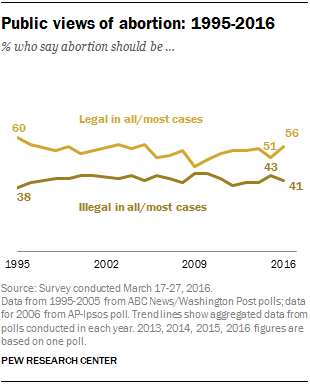
When the supreme court became a little vague on some procedural aspects of abortion law in the early 1990s, the state legislatures started showing much more restraint because the median voter would be annoyed.
Where Roe v. Wade to fall, some states would permit abortion, some would not. The Center for Reproductive Rights predicts that 21 states are likely to outlaw abortion immediately where Roe v. Wade to fall. This assessment is based not only on current law, but on the political makeup of the state legislatures. On the other hand, abortion is likely to remain legal in many states, according to these groups.
The essence of the antiscience Left
26 Jul 2015 Leave a comment
in economics of regulation, energy economics, environmental economics, health economics Tags: anti-GMOs movement, anti-vaccination movement, antimarket bias, antiscience left, cranks, GMOs, Leftover Left, precautionary principle, quackery


Recent Comments