Have We Lost the War on Drugs? – Gary Becker and Kevin Murphy – WSJ 2013
29 Nov 2014 Leave a comment
in economics of crime, economics of regulation, Gary Becker, health economics, law and economics, liberalism

One moderate alternative to the war on drugs is to follow Portugal’s lead and decriminalize all drug use while maintaining the illegality of drug trafficking. Decriminalizing drugs implies that persons cannot be criminally punished when they are found to be in possession of small quantities of drugs that could be used for their own consumption.
Decriminalization would reduce the bloated U.S. prison population since drug users could no longer be sent to jail.
Decriminalization would make it easier for drug addicts to openly seek help from clinics and self-help groups, and it would make companies more likely to develop products and methods that address addiction…
A study published in 2010 in the British Journal of Criminology found that in Portugal since decriminalization, imprisonment on drug-related charges has gone down; drug use among young persons appears to have increased only modestly, if at all; visits to clinics that help with drug addictions and diseases from drug use have increased; and opiate-related deaths have fallen.
Some quacks and con artists are a bit lazy in their promotional material
27 Nov 2014 Leave a comment
in health economics Tags: con artists, Quacks
Environmental and Urban Economics: Do Demographers Really Predict Future Population Trends Without Incorporating Women’s Economic Incentives?
26 Nov 2014 Leave a comment
in discrimination, economics of love and marriage, gender, health economics, human capital, labour economics
To my amazement, this work does not discuss how women’s potential earnings in the labor market correlates with fertility decisions.
At least in the Demography paper linked to above, the word “incentives” does not appear in the paper and nobody makes a choice based on the costs and benefits of fertility.
Without incorporating such factors, how can a statistical model yield a credible prediction?
Behind on my food snob blogging
24 Nov 2014 Leave a comment
in health economics, liberalism Tags: expressive voting, food snobs organic food
An organ shortage kills 30 Americans every day. Is it time to pay donors? – The Washington Post
24 Nov 2014 Leave a comment
in applied welfare economics, Austrian economics, health economics Tags: organ donation

via An organ shortage kills 30 Americans every day. Is it time to pay donors? – The Washington Post.
It Took Studying 25,782,500 Kids To Begin To Undo The Damage Caused By 1 Doctor
23 Nov 2014 Leave a comment
in health economics, liberalism Tags: anti-vaccination movement, autism, Quacks, vaccination, vaccines

Steven Landsburg on the difference between an absurdity and a lie about Obamacare
20 Nov 2014 Leave a comment
in applied price theory, applied welfare economics, health economics, politics - USA

Jon Stewart demolishes Gruber and the Democrats on Obamacare
20 Nov 2014 Leave a comment
in applied price theory, applied welfare economics, economics, economics of regulation, health economics, politics - USA Tags: health insurance, Jon Stewart, Obamacare
Measles has risen from the dead
17 Nov 2014 Leave a comment
in health economics Tags: anti-vaccination movement, measles, vaccinations, vaccines
Amazing ambulance drone cuts response time to 1 minute on heart attacks
09 Nov 2014 Leave a comment
in health economics Tags: ambulance drones, The Great Enrichment, The Great Fact
Once the heart stops beating, it takes about 4-6 minutes for the brain to die. The average response time for ambulances is about 10 minutes.
A professional response within a single minute could potentially increase the cardiac arrest survival rate to an astonishing 80%.
Though defibrillators are commonly available in public areas in case of emergency, 4 out of 5 cardiac arrests occur at home where the equipment likely isn’t available.
Currently, only 20% of untrained people are able to successfully apply a defibrillator, but this rate can be increased to 90% if people are provided with instructions at the scene.
My impression is that the sky will be quite crowded with drones in about 5 to 10 years and there will be an air traffic control problem.
HT: ambulance-drone-could-drastically-increase-heart-attack-survival
A New Measure of Suspense
03 Nov 2014 Leave a comment
in economics of media and culture, health economics Tags: sport
Sporting suspense as measured by the number of heart attacks during world cup finals.

In our paper, Alex Frankel, Emir Kamenica and I argue that soccer is among the most suspenseful sports according to our theoretical measure. Now, via Matt Dickenson, comes an empirical validation of this finding using German cardiac arrest data:
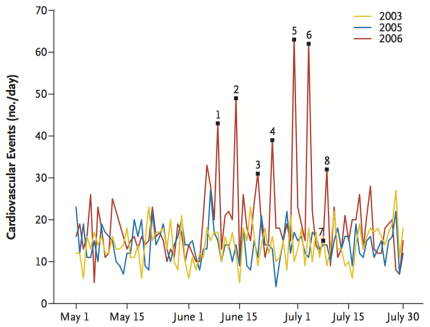
The red line shows the spike in heart attacks on the dates of 2006 World Cup matches involving the German national team. Note that point 7 is the third place match against Portugal after Germany had been eliminated in their semi-final match against Italy (point 6.)


Recent Comments