Rob MacCulloch writes – The underlying aim of the Treaty of Waitangi, at least in economic terms, was to promote a higher standard of living for Māori and non-Māori alike. This article’s purpose is to argue how its words were unambiguously designed to achieve that purpose, but have since been hijacked by political operatives and NZ’s legal […]
Treaty of Waitangi legal “experts” have misunderstood its economic rationale – and endangered national prosperity
Treaty of Waitangi legal “experts” have misunderstood its economic rationale – and endangered national prosperity
20 Sep 2024 Leave a comment
in comparative institutional analysis, constitutional political economy, development economics, economic history, history of economic thought, liberalism, politics - New Zealand, Public Choice Tags: constitutional law
Equality Act 2010
18 Sep 2024 Leave a comment
in applied price theory, comparative institutional analysis, economic history, history of economic thought, human capital, job search and matching, labour economics, labour supply, law and economics, occupational choice, poverty and inequality Tags: British politics, compensating differences, pay equity

The UK’s Orwellian sounding Equality Act 2010 is strikingly Marxist. It demands equal pay for work of equal value where these are defined as follows: A’s work is equal to that of B if it is like B’s work, rated as equivalent to B’s work, or of equal value to B’s work. A’s work is […]
Equality Act 2010
It Happened Again! The New York Times Writes about Venezuela’s Collapse and Fails to Mention Socialism
16 Sep 2024 Leave a comment
in development economics, economic growth, economic history, growth disasters, history of economic thought, income redistribution, liberalism, macroeconomics, Marxist economics, politics - USA, Public Choice Tags: regressive left, useful idiot, Venezuela
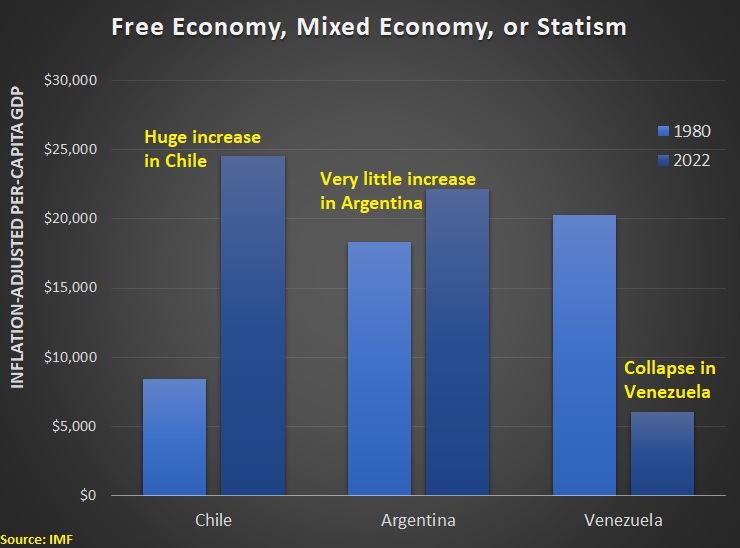
I sometimes make the theoretical case against socialism. Usually, this means exposing the flaws of the core components of the socialist ideology. Government ownership of the means of production is a recipe for resource misallocation. Central planning has a miserable track record of failure because consumer preferences are ignored. Price controls distort incentives to make […]
It Happened Again! The New York Times Writes about Venezuela’s Collapse and Fails to Mention Socialism
Friedman vs Stiglitz: Estonia and Poland vs. Argentina and Venezuela
06 Sep 2024 Leave a comment
in applied price theory, comparative institutional analysis, development economics, economic history, economics of bureaucracy, entrepreneurship, growth disasters, growth miracles, history of economic thought, income redistribution, industrial organisation, international economics, labour economics, law and economics, liberalism, Marxist economics, poverty and inequality, property rights, Public Choice, rentseeking, survivor principle Tags: Argentina, Chile, Poland, regressive left, Venezuela
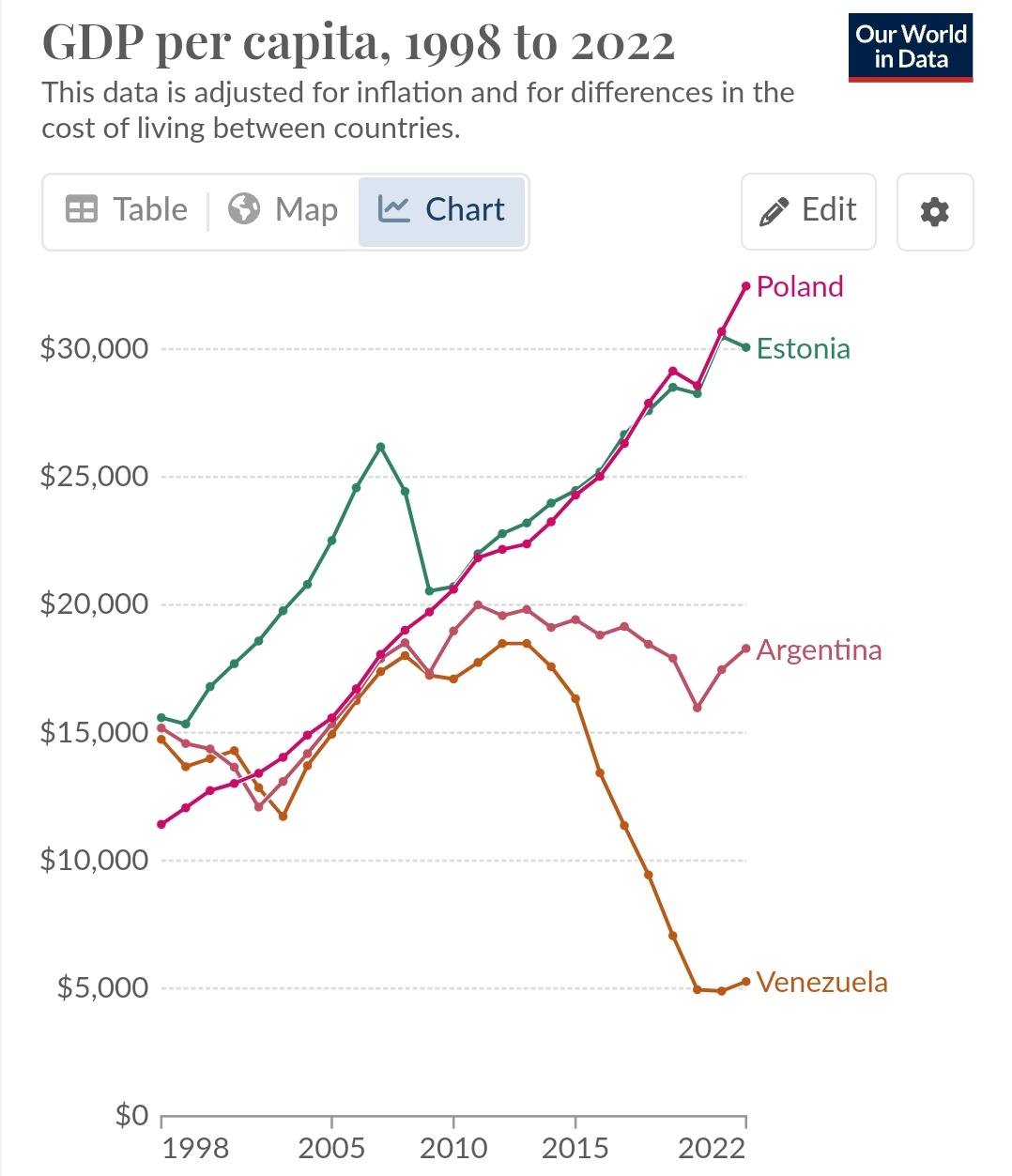
About 10 days ago, i showed that Milton Friedman was a much better economist than Joseph Stiglitz by comparing Chile (which followed Friedman’s ideas) and Venezuela (which followed Stiglitz’s ideas). It was a slam-dunk win for Friedman. Chile started poor and has become relatively prosperous. The opposite happened in Venezuela, which started relatively prosperous and […]
Friedman vs Stiglitz: Estonia and Poland vs. Argentina and Venezuela
Interview with Greg Mankiw: New Keynesian Macro, Growth, and Economic Policy
04 Sep 2024 Leave a comment
in applied price theory, budget deficits, business cycles, development economics, econometerics, economic growth, economic history, Edward Prescott, fiscal policy, great depression, history of economic thought, labour economics, law and economics, macroeconomics, Milton Friedman, monetarism, monetary economics, politics - USA, Public Choice, Robert E. Lucas, unemployment
Jon Hartley interviews Greg Mankiw on topics including New Keynesian macroeconomics, growth, and economic policy more broadly at his Capitalism and Freedom website (August 20, 2024, video and transcript available). Here are a few of the comments that caught my eye. On big models and small models in studying the macroeconomy: [O]n the issue of…
Interview with Greg Mankiw: New Keynesian Macro, Growth, and Economic Policy
Marx explained
01 Sep 2024 Leave a comment
in applied price theory, Austrian economics, entrepreneurship, history of economic thought, human capital, income redistribution, labour economics, labour supply, law and economics, liberalism, Marxist economics, occupational choice, poverty and inequality, property rights, Public Choice

It is wonderful to put inefficient firms out of business
31 Aug 2024 1 Comment
in applied price theory, econometerics, economic history, entrepreneurship, history of economic thought, industrial organisation, survivor principle Tags: creative destruction
The differences between the most and least productive companies can be startlingly high. By one estimate, in the US alone the most productive firms in a sector can be more than two to four times more cost-effective than the least productive ones. Given the size of those discrepancies, any expansion of trade or innovation that makes […]
It is wonderful to put inefficient firms out of business
Why the @NZGreens are beside the point
31 Aug 2024 Leave a comment
in applied welfare economics, Austrian economics, comparative institutional analysis, constitutional political economy, development economics, economic growth, economic history, entrepreneurship, growth miracles, history of economic thought, human capital, income redistribution, industrial organisation, labour economics, labour supply, law and economics, liberalism, macroeconomics, Marxist economics, politics - New Zealand, poverty and inequality, property rights, Public Choice, rentseeking, technological progress Tags: child poverty, family poverty, The Great Enrichment
Fiscal and monetary policy
27 Aug 2024 Leave a comment
in budget deficits, business cycles, econometerics, economic growth, economic history, financial economics, fiscal policy, history of economic thought, inflation targeting, macroeconomics, monetary economics, politics - New Zealand Tags: monetary policy

Over the last few years, The Treasury seems to have been toying with bidding for a more significant role for fiscal policy as a countercyclical stabilisation tool It seemed to start when Covid hubris still held sway – didn’t we do well? – and the first we saw of it in public was at a […]
Fiscal and monetary policy
Price Controls Reflect Utter Economic Insanity
25 Aug 2024 Leave a comment
in applied price theory, economics of regulation, entrepreneurship, history of economic thought, industrial organisation, liberalism, Marxist economics, politics - USA Tags: 2024 presidential election, price controls, regressive left, rent control
TweetIn the print edition of tomorrow’s (Friday’s) Wall Street Journal, Richard McKenzie and I explain some of the many unintended ill-consequences of the price controls proposed by Kamala Harris. A slice: Price-control proponents often justify their position by claiming that grocery stores are monopolies. They point to a fantasy economic theory that purports to show how…
Price Controls Reflect Utter Economic Insanity
Guest Post: Criticising Cuba
23 Aug 2024 Leave a comment
in comparative institutional analysis, constitutional political economy, development economics, economic history, economics of crime, growth disasters, history of economic thought, law and economics, liberalism, Marxist economics, politics - New Zealand, Public Choice Tags: Cuba
A guest post by Lucy Rogers: Today (as of the time of writing) I saw Associate Professor Michael Mawson of the theology faculty at Auckland University advertise on Facebook an event hosting Professor Miguel De La Torre, a Cuban academic specialising in liberation theology. The event is to be held at the Maclaurin Chapel at […]
Guest Post: Criticising Cuba
The Intellectual Roots of YIMBYism
23 Aug 2024 Leave a comment
in applied price theory, comparative institutional analysis, economic history, economics of regulation, history of economic thought, politics - USA, urban economics Tags: housing affordability, zoning
At the Democratic National Convention former President Obama came out strongly in favor of housing deregulation saying “we need to build more homes and clear away some of the outdated laws and regulations that make it harder to build homes”. Robert Kwasny asks on X, “What are the intellectual roots of present-day YIMBYism?” Looking at […]
The Intellectual Roots of YIMBYism
Telephone Operators: The Elimination of a Job
20 Aug 2024 Leave a comment
in economic growth, economic history, gender, history of economic thought, industrial organisation, labour economics, labour supply, macroeconomics, market efficiency, occupational choice, survivor principle, unemployment Tags: creative destruction
My tradition on this blog is to take a break (mostly!) from current events in the later part of August. Instead, I pre-schedule daily posts based on things I read during the previous year about three of my preoccupations: economics, editing/writing, and academia. With the posts pre-scheduled, I can then relax more deeply when floating…
Telephone Operators: The Elimination of a Job
Kamala Harris, Price Controls, and the Contest for the Dumbest Policy Proposal of 2024
17 Aug 2024 Leave a comment
in applied price theory, comparative institutional analysis, economic history, economics of bureaucracy, economics of regulation, energy economics, health economics, history of economic thought, income redistribution, industrial organisation, international economics, liberalism, Marxist economics, politics - USA, Public Choice, rentseeking Tags: 2024 presidential election, price controls, tariffs

As a Senator, Kamala Harris embraced all sorts of terrible ideas, such as the Green New Deal and Medicare for All. But she’s now disavowed those proposals in an attempt to make herself seem more reasonable. Trump, by contrast, is consistent. For better or worse, he’s pushing in 2024 the same agenda that he ran […]
Kamala Harris, Price Controls, and the Contest for the Dumbest Policy Proposal of 2024
Should the government operate petrol stations?
17 Aug 2024 Leave a comment
in applied price theory, comparative institutional analysis, economics of regulation, entrepreneurship, history of economic thought, industrial organisation, law and economics, politics - Australia, politics - New Zealand, privatisation, property rights
The extent to which the government should be involved in the provision of goods and services generates a lot of debate. Most of that debate is unhelpful, since it involves small-government, market-fundamentalist types arguing against anti-market socialist types. It’s all ideological, and there’s a pretty good chance that neither of the sides in that argument…
Should the government operate petrol stations?
 Utopia, you are standing in it!
Recent Comments