How many times have I heard versions of that claim? Erik Brynjolfsson picks up the telephone in the FT: While initial reports suggested a year of steady labour expansion in the US, the new figures reveal that total payroll growth was revised downward by approximately 403,000 jobs. Crucially, this downward revision occurred while real GDP…
“You see tech and AI everywhere but in the productivity statistics”
“You see tech and AI everywhere but in the productivity statistics”
17 Feb 2026 Leave a comment
in applied price theory, econometerics, history of economic thought, industrial organisation, labour economics, labour supply Tags: creative destruction
Debunking Trump’s Error-Filled WSJ Column
04 Feb 2026 Leave a comment
in applied price theory, budget deficits, economic growth, economic history, fisheries economics, history of economic thought, income redistribution, industrial organisation, international economic law, international economics, macroeconomics, politics - USA, Public Choice, rentseeking Tags: free trade, tarrifs
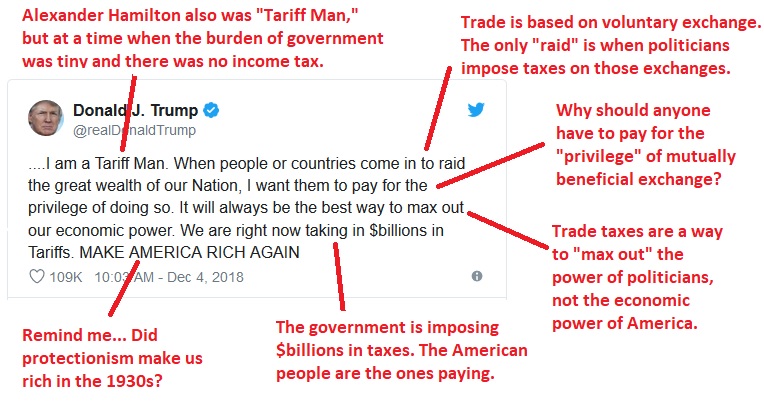
Donald Trump, who describes himself as “Tariff Man,” recently wrote a column in defense of his protectionist trade policy for the Wall Street Journal. After reading the column, my first thought was that Trump was trying to show he is more economically illiterate than Joe Biden (a big challenge, as seen here and here). And […]
Debunking Trump’s Error-Filled WSJ Column
Netflix, WBD, and the Myth of the Streaming Monopoly
03 Feb 2026 Leave a comment
in entrepreneurship, history of economic thought, industrial organisation, law and economics, politics - USA Tags: competition law

The proposed acquisition of Warner Bros. Discovery (WBD) assets by Netflix is already being cast as a landmark antitrust “test case.” If past deals are any guide, the critiques will follow a familiar script: narrow market definitions, selective data points, and headline-friendly market-share claims designed to trigger alarm. Yet in a video ecosystem defined by…
Netflix, WBD, and the Myth of the Streaming Monopoly
Colonialism, Slavery, and Foreign Aid (with William Easterly) 12/8/25
01 Feb 2026 1 Comment
in applied price theory, comparative institutional analysis, constitutional political economy, development economics, economic history, growth disasters, growth miracles, history of economic thought, labour economics, labour supply, law and economics, property rights Tags: age of empires, economics of colonialism, economics of slavery
Exciting New Research on the Laffer Curve
30 Jan 2026 Leave a comment
in applied price theory, econometerics, economic growth, economic history, fiscal policy, history of economic thought, labour economics, labour supply, macroeconomics Tags: taxation and investment, taxation and labour supply

Unless you’re a policy wonk, I realize “exciting” may not be the right word to describe new developments in public-finance economics. For nerds, however, three economists at the Joint Committee on Taxation have some important new research on the Laffer Curve. The study, authored by Rachel Moore, Brandon Pecoraro, and David Splinter, concludes that the […]
Exciting New Research on the Laffer Curve
Violent Saviors: The West’s Conquest of the Rest
29 Jan 2026 Leave a comment
in applied price theory, comparative institutional analysis, constitutional political economy, development economics, economic history, economics of bureaucracy, growth disasters, growth miracles, history of economic thought, income redistribution, law and economics, liberalism, libertarianism, Marxist economics, property rights, Public Choice, rentseeking Tags: age of empires, economics of colonialism
Some Links
26 Jan 2026 Leave a comment
in applied price theory, economic history, history of economic thought, international economics, liberalism, Marxist economics, politics - USA, Public Choice
TweetPhil Magness’s new essay on the origins of the vague and derogatory term “neoliberalism” is superb. A slice: While most versions of the neoliberal label still come from the academic left today, the term has come back into favor within a certain, curious strand of the right. Conservative writers such as Patrick Deneen, Adrian Vermeule,…
Some Links
‘Market Power in Antitrust Cases,’ by William M. Landes and Richard A. Posner
17 Jan 2026 Leave a comment
in applied price theory, economics of regulation, history of economic thought, industrial organisation, law and economics, politics - USA, Richard Posner Tags: competition law

William M. Landes and Richard A. Posner’s 1981 Harvard Law Review article “Market Power in Antitrust Cases” is a true classic. Showing the value of interdisciplinary work within the law & economics tradition, it brought real clarity to what “market power” means and how courts should assess it—cutting through vague labels like “monopoly power” and…
‘Market Power in Antitrust Cases,’ by William M. Landes and Richard A. Posner
Reflections on the Caplan-Bruenig Poverty Debate
09 Jan 2026 Leave a comment
in applied price theory, history of economic thought, labour economics, labour supply, liberalism, libertarianism, Marxist economics, politics - USA, poverty and inequality, welfare reform Tags: child poverty, family poverty
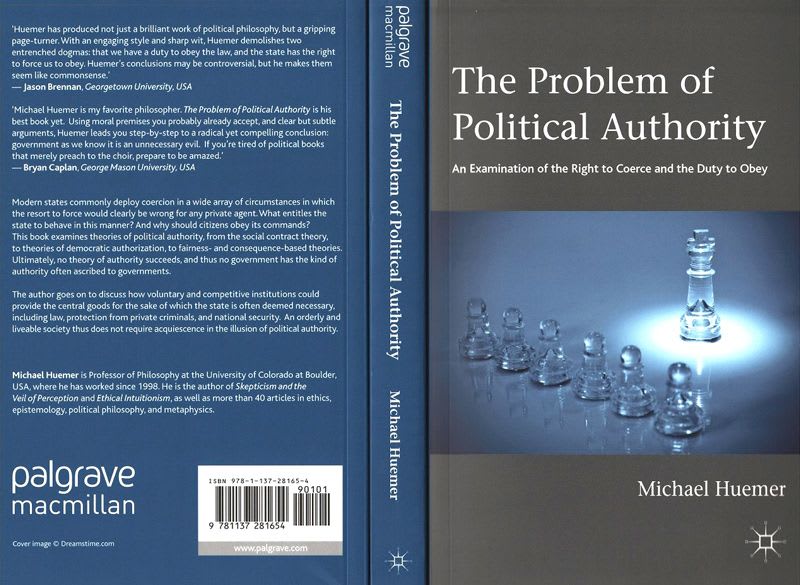
Last month, Econoboi hosted a debate on poverty between myself and Matt Bruenig. Here are my reflections on that debate.I was pleasantly surprised by Bruenig’s openness to most of my proposed supply-side reforms. He wasn’t just pro-immigration, but also pro-deregulation of housing and pro-nuclear. He was happy to admit that these policies aren’t just good…
Reflections on the Caplan-Bruenig Poverty Debate
Mamdani and Other Socialists Tout South Africa and Cuba as Models for Good Government
09 Jan 2026 Leave a comment
in development economics, growth disasters, history of economic thought, law and economics, liberalism, Marxist economics, politics - USA, property rights, Public Choice

Below is my column in the New York Post on the bizarre effort of Democratic Socialist leaders to herald South…
Mamdani and Other Socialists Tout South Africa and Cuba as Models for Good Government
Keynes: Free Trade and the Nationalist Impulse
04 Jan 2026 1 Comment
in applied price theory, economic history, history of economic thought, international economics
In 1933, John Maynard Keynes gave the first Finlay Lecture delivered at University College, Dublin, on the subject of “National Self-Sufficiency” (Studies: An Irish Quarterly Review,” June 1933, 22: 86, pp. 177-193). The Irish Free State of 1933 was a transition phase: after the Irish War of Independence that had ended in 1921, but before…
Keynes: Free Trade and the Nationalist Impulse
Celebrating Two Years of Libertarian Success in Argentina
27 Dec 2025 Leave a comment
in applied price theory, Austrian economics, budget deficits, comparative institutional analysis, constitutional political economy, development economics, economic growth, economics of bureaucracy, economics of regulation, fiscal policy, growth disasters, history of economic thought, income redistribution, industrial organisation, labour economics, liberalism, libertarianism, macroeconomics, Public Choice, rentseeking, unemployment Tags: Argentina
As explained in my four-part series (here, here, here, and here) and in this clip from a recent interview, Javier Milei’s first two years have been amazingly successful. There are two points in the interview that deserve emphasis. First, Javier Milei’s libertarian policies already have been extremely beneficial for the Argentine economy. Inflation has dramatically […]
Celebrating Two Years of Libertarian Success in Argentina
Quotation of the Day…
27 Dec 2025 Leave a comment
in Adam Smith, Bill Easterly, development economics, economic history, history of economic thought, Milton Friedman

Tweet… is from page 298 of William Easterly’s brilliant 2025 book, Violent Saviors: The West’s Conquest of the Rest [footnote deleted; link added]: The Friedman’s [Milton and Rose] liked markets because they could make individual self-determination possible for all groups. Markets allowed “the freedom of individuals to pursue their own objective.” Markets made this possible…
Quotation of the Day…
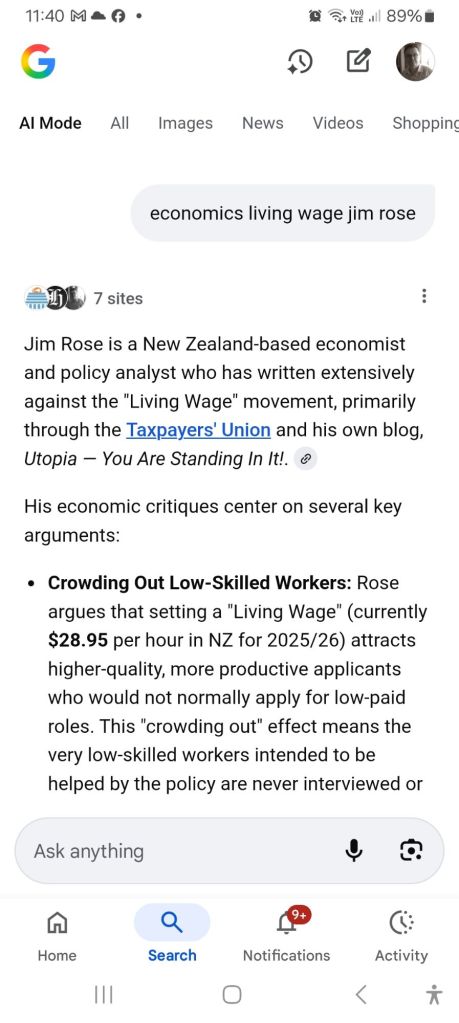
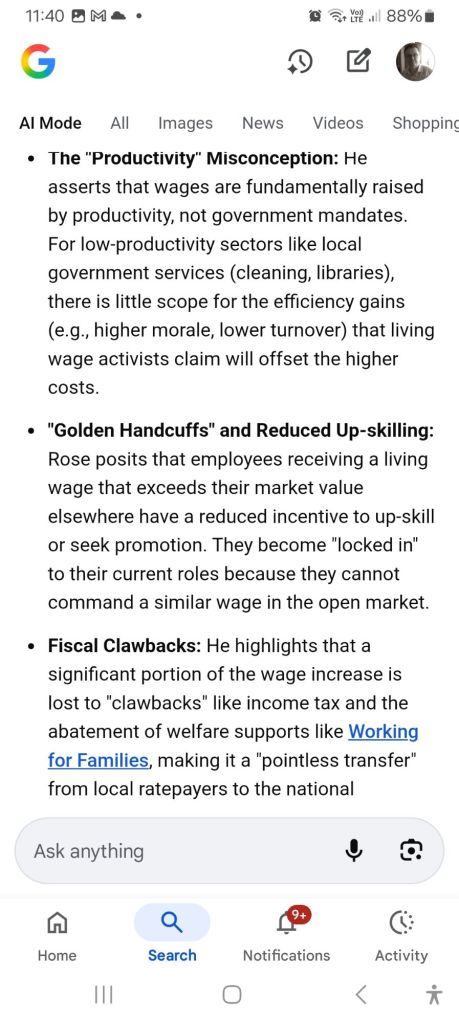
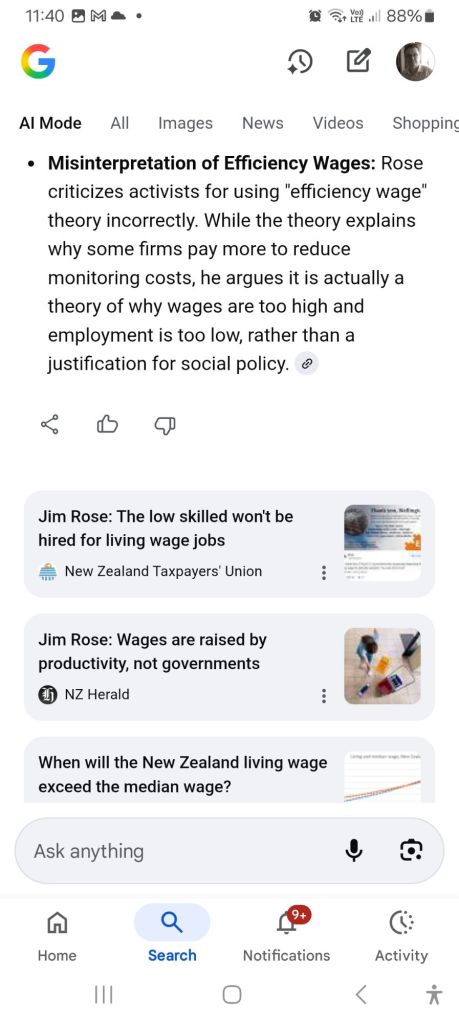
AI summary of my living wage paper
24 Dec 2025 Leave a comment
in applied price theory, history of economic thought, income redistribution, job search and matching, labour economics, labour supply, macroeconomics, minimum wage, politics - New Zealand, poverty and inequality, Public Choice, rentseeking Tags: living wage
Adam Smith And Joseph Campbell On The Dangers Of “The Man Of System”
23 Dec 2025 Leave a comment
in Adam Smith, applied price theory, comparative institutional analysis, economics of information, economics of regulation, history of economic thought
Here is a passage from The Theory of Moral Sentiments by Smith (author of the book The Wealth of Nations in 1776 that started economics) at the Library of Economics and Liberty. Smith emphasizes the arrogance and conceit of those who think they can arrange society any way they want. In a separate passage, Smith…
Adam Smith And Joseph Campbell On The Dangers Of “The Man Of System”


Recent Comments