Regular readers of this blog will know that I enjoy blogging about research that uses a sports setting to illustrate economic concepts (except when the research is terrible). Sport makes for an interesting setting for testing economic theories. The rules are known. The incentives are usually clear. The outcomes are usually unambiguous. Other real-world settings…
Ask not what economics can do for sports; ask what sports can do for economics
Ask not what economics can do for sports; ask what sports can do for economics
20 Dec 2025 Leave a comment
in applied price theory, econometerics, history of economic thought, sports economics
“AI is everywhere but in the productivity statistics…”
15 Dec 2025 Leave a comment
in applied price theory, econometerics, economic history, economics of information, entrepreneurship, history of economic thought, industrial organisation Tags: creative destruction
These people are saying it is there too. Though I am not quite sure what they (or anyone, for that matter) mean by AI: First, we argue that AI can already be seen in productivity statistics for the United States. The production and use effects of software and software R&D (alone) contributed (a) 50 percent…
“AI is everywhere but in the productivity statistics…”
Humanity Has a Huge Surplus of Economic Misunderstanding
13 Dec 2025 Leave a comment
in applied price theory, history of economic thought, industrial organisation, international economics, politics - USA, Public Choice, rentseeking Tags: free trade, tarrifs
TweetHere’s a letter to AP Fact Check. Editor: Melissa Goldin does a deep dive into the cause(s) of the U.S. “agricultural trade deficit” (“FACT FOCUS: Trump blames Biden for the agricultural trade deficit. It’s not that simple,” December 10). To what extent is this “deficit” caused by the policies of Biden? To what extent is…
Humanity Has a Huge Surplus of Economic Misunderstanding
Three Nobel lectures in economic science
11 Dec 2025 Leave a comment
in economic growth, history of economic thought, macroeconomics
The post Three Nobel lectures in economic science appeared first on Marginal REVOLUTION.
Three Nobel lectures in economic science
Unfettered: Fishback 25 Years Later
07 Dec 2025 Leave a comment
in applied price theory, economic history, history of economic thought, labour economics, labour supply, poverty and inequality
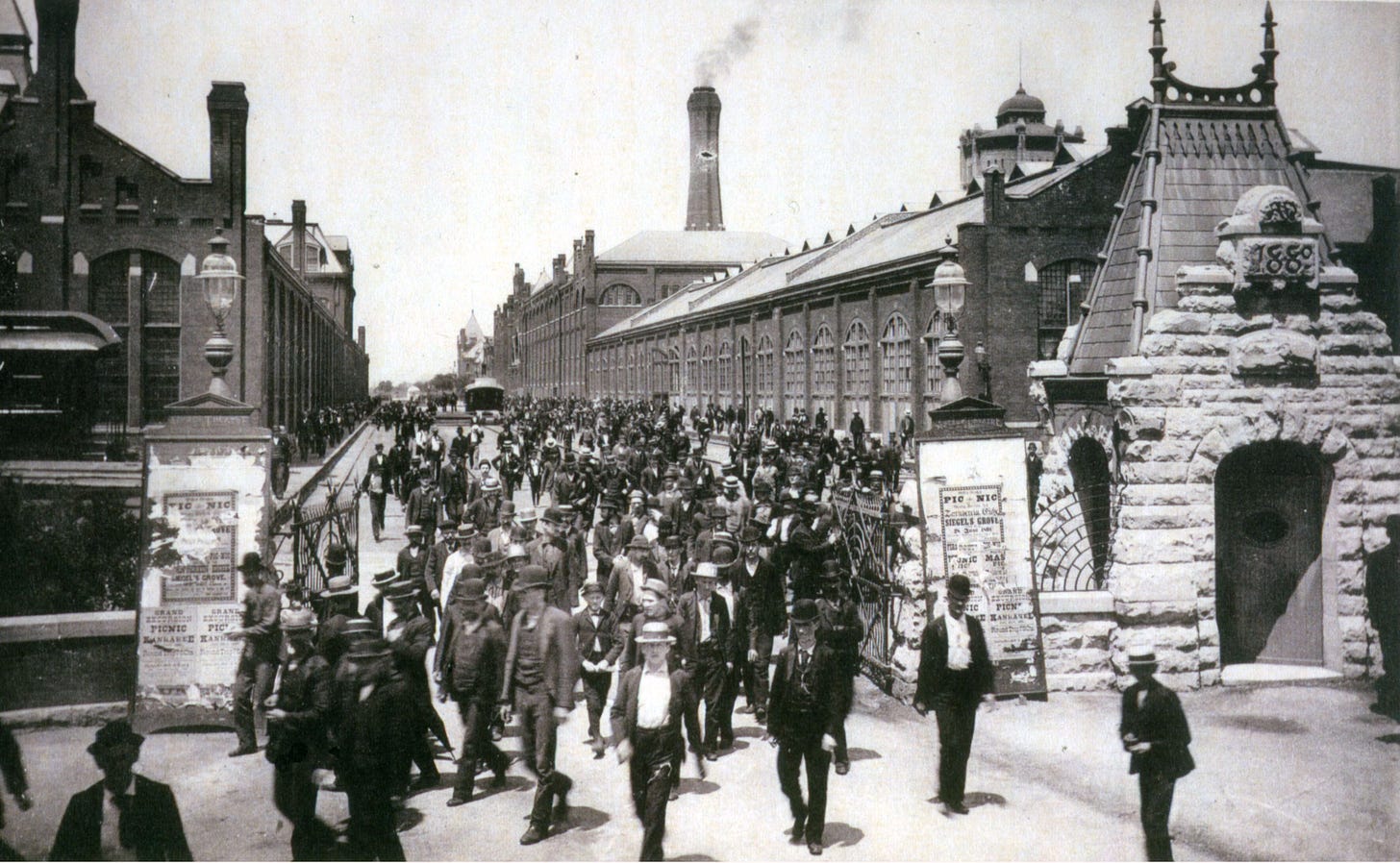
A quarter century ago, economist Price Fishback published “Operations of ‘Unfettered’ Labor Markets: Exit and Voice in American Labor Markets at the Turn of the Century” 1,762 more words
Unfettered: Fishback 25 Years Later
The Great Means-Testing Debate
05 Dec 2025 Leave a comment
in applied price theory, history of economic thought, human capital, labour economics, labour supply, Milton Friedman, occupational choice, poverty and inequality, unemployment, welfare reform
Nine years ago, I critically analyzed the Cohen-Friedman debate on means-testing Social Security. Only recently, though, did I find the original footage from 1971. As far as I know, this is the first time that any prominent social scientist made the “A program only for the poor will always be a poor program” argument that…
The Great Means-Testing Debate
Quotation of the Day…
03 Dec 2025 Leave a comment
in applied price theory, history of economic thought, labour economics, labour supply, poverty and inequality
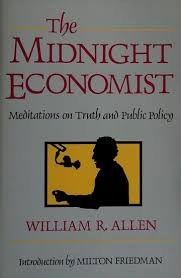
Tweet… is from page 181 of the late UCLA economist William Allen’s superb 1989 collection of the transcripts of his radio addresses, The Midnight Economist; specifically, it’s from Allen’s April 1985 address “Employment and Wages, Competition and Fairness”: The more valuable the worker, the higher the bid for his services. The high wage offer reflects…
Quotation of the Day…
Who Won the Socialist Calculation Debate (with Peter Boettke) 2/17/25
29 Nov 2025 Leave a comment
in applied price theory, Austrian economics, comparative institutional analysis, development economics, economic history, economics of information, entrepreneurship, F.A. Hayek, history of economic thought, industrial organisation, law and economics, Ludwig von Mises, market efficiency, property rights, survivor principle, Thomas Sowell
Should We Privatise More Government Businesses?
24 Nov 2025 Leave a comment
in applied price theory, comparative institutional analysis, financial economics, history of economic thought, industrial organisation, politics - New Zealand, privatisation
Pragmatic analysis says maybe we should, but we should also consider nationalisation. We should certainly consider better regulation. Brian Easton writes – An earlier column argued that we should make the government’s net worth – the value of its assets less its liabilities – more prominent in fiscal policy. Net worth is also fundamental when we are […]
Should We Privatise More Government Businesses?
Argentine Rental Market Natural Experiment
24 Nov 2025 Leave a comment
in applied price theory, development economics, economics of regulation, growth disasters, history of economic thought, income redistribution, law and economics, property rights, Public Choice, public economics, regulation, rentseeking, transport economics, urban economics Tags: Argentina, rent control
One of Argentine President Milei’s radical reforms was to “take a chainsaw” to rent control laws. Argentina had had some of the most restrictive rent control regimes ever. All of that was abandoned almost over night. Many media outlets noted with glee that rents fell dramatically. Even most economists were surprised by how much supply…
Argentine Rental Market Natural Experiment
Dishwashers and the 24/7 Time Constraint
22 Nov 2025 Leave a comment
in applied price theory, economic history, history of economic thought, labour economics, labour supply
In my own family, the reverence that we have for the dishwasher (and other time-saving devices) is such that we have a cat named “Josephine” after the Josephine Cochrane–the inventor of the first commercially viable dishwasher. (Also named because, as a kitten, she liked to forage in the back of the dishwasher.) Erin Braid provides…
Dishwashers and the 24/7 Time Constraint
Nobel Prize Winners’ Work Supports Dynamic Antitrust Enforcement
21 Nov 2025 Leave a comment
in applied price theory, economic growth, entrepreneurship, history of economic thought, industrial organisation, macroeconomics, survivor principle Tags: creative destruction

Antitrust should center on dynamic market forces that drive major technological change, rather than on static “big is bad” market analysis, based on the work of the 2025 economics Nobel Prize winners. Antitrust enforcers in the United States and around the world could benefit by incorporating these insights into their policy development. Focus on Dynamic […]
Nobel Prize Winners’ Work Supports Dynamic Antitrust Enforcement
‘Limits of Antitrust’ by Frank Easterbrook
20 Nov 2025 Leave a comment
in history of economic thought, industrial organisation, law and economics Tags: competition law
The Core Argument: Markets Beat Courts at Correcting Monopoly Frank H. Easterbrook’s 1984 Texas Law Review article “Limits of Antitrust” advances a deceptively simple thesis that fundamentally reoriented competition policy: antitrust law should recognize its own institutional limitations and design rules accordingly. The article contains two central insights. The first is that, because “antitrust is […]
‘Limits of Antitrust’ by Frank Easterbrook
Andrew Leigh on big data vs. randomised controlled trials
20 Nov 2025 Leave a comment
in econometerics, history of economic thought
‘Big data’ has become the catchcry of many data scientists and researchers in recent years. It’s also become increasingly used in economics. However, by itself the analysis of big data doesn’t provide anything but big data correlations. Even when big datasets are available, there is still a place for randomised controlled trials (RCTs). That is…
Andrew Leigh on big data vs. randomised controlled trials
Quotation of the Day…
19 Nov 2025 Leave a comment
in applied price theory, history of economic thought, income redistribution, industrial organisation, international economics, Milton Friedman, politics - USA, Public Choice, rentseeking Tags: free trade, tariffs
Tweet… is from page 158 of Milton Friedman’s 1953 paper “The Case for Flexible Exchange Rates,” as this paper is reprinted in Friedman’s 1953 collection, Essays in Positive Economics: In brief, it [free trade] is desirable in its own right as one of the basic freedoms we cherish; it promotes the efficient use of resources…
Quotation of the Day…


Recent Comments