I, Pencil Extended Commentary: Trade & Specialization
22 Dec 2015 1 Comment
in applied price theory, industrial organisation, international economics, survivor principle Tags: division of labour, international trade, specialisation and exchange
Which occupations are up and which are down
21 Dec 2015 Leave a comment
in economic history, human capital, industrial organisation, labour economics, labour supply, occupational choice, survivor principle Tags: creative destruction, skill biased technical change
Creative destruction in retailing
20 Dec 2015 Leave a comment
in economics of media and culture, entrepreneurship, financial economics, industrial organisation, survivor principle Tags: amazon, creative destruction
I, Pencil Extended Commentary: Creative Destruction
19 Dec 2015 Leave a comment
in applied price theory, economic history, entrepreneurship, industrial organisation, survivor principle, technological progress Tags: creative destruction, division of labour, entrepreneurial alertness, IPencil, specialisation and exchange, The meaning of competition
Public opinion about the profit margin of Wal-Mart
18 Dec 2015 Leave a comment
in industrial organisation, organisational economics Tags: creative destruction, the alertness, The meaning of competition, voter demographics, Walmart
Tourism as % of employment across the OECD
17 Dec 2015 Leave a comment
in industrial organisation, international economics, labour economics, labour supply Tags: economics of tourism, labour market demographics

Labour productivity growth in the New Zealand retail services confounds Baumol’s cost disease
17 Dec 2015 Leave a comment
in applied price theory, economic history, industrial organisation, managerial economics, market efficiency, organisational economics, personnel economics, politics - New Zealand, survivor principle Tags: Baumol's disease, labour productivity
Internet access across the OECD
16 Dec 2015 Leave a comment
in economics of media and culture, industrial organisation Tags: creative destruction, Internet, Internet access, living standards
Why @JohnKeyPM is tourism minister – tourism as a % of GDP across the OECD
16 Dec 2015 1 Comment
in industrial organisation, politics - New Zealand
John Key is both Prime Minister and Minister for Tourism. Previously the portfolio was held by a junior minister. I am not sure if that was a good idea. Government departments tend to be gravestones of industries.
The New Zealand tourism industry grew on its own to be the 4th largest relatively speaking in the world without the guiding hand of a Minister of Tourism. Maybe it should have stayed that way.

@donal_curtin @smalltorquer Does competition law in high-tech markets help consumers?
14 Dec 2015 2 Comments
in applied price theory, economics of regulation, Gary Becker, industrial organisation, politics - New Zealand, politics - USA, Sam Peltzman Tags: Aaron Director, anti-trust law, cartels, competition law, creative destruction, entrepreneurial alertness, merger law enforcement, offsetting the, The fatal conceit, unintended consequences
New Zealand has decriminalised cartels. Price fixers cannot be sent to prison but can still be fined. Some agree, some disagree with the wisdom of this move.
Those that agreed with the wisdom of this move were christened cartel apologists by one of those that disagree with the removal of criminal penalties for cartels.
There is an infallible rule in competition law enforcement. It arises mostly crisply in merger law enforcement. If competitors oppose a merger, the merger must be pro-consumer. If the merger is anti-competitive, that merger will increase prices. The competing firms can follow those prices up and profit from the weakening of competition.
Under the collusion hypothesis, rivals of the merging firm benefit since there is a higher probability of successful collusion limits output and raises product prices. The share prices of these rival firms should increase in anticipation of enhanced cartel profits. As Eckbo explains:
Using Stigler (1964) theory of oligopoly, a horizontal merger can reduce the monitoring costs by reducing the number of independent producers in the industry. The fewer the members of the industry the more “visible” are each producers actions, and the higher is the probability of detecting members who try to cheat on the cartel by increasing output.
When was the last time an entrepreneur complained about his rivals putting their prices up? The entrepreneur can either match that price increase or undercut it to win more business. The real reason competitors oppose a merger is the merged firm will have lower costs, making it a fiercer competitor.

If the share prices of competitors fall on news of the merger, they are worse off as a result because they face a fiercer competitor. If their share prices rise, that suggests either that others in the industry are to benefit from higher prices or rival firms will soon replicate the cost savings discovered in the course of the merger. The latter is the information effect of mergers:
…since the production technologies of close competitors are (by definition) closely related, the news of a proposed efficient merger can also signal opportunities for the rivals to increase their productivity
Mergers are a high-risk way of securing higher prices unless there are offsetting cost saving of combining the two firms. Mergers disturb previously efficient firm sizes and risk diseconomies of scale and a burgeoning corporate hierarchy. A cartel is a safer way to raise prices by jointly agreeing to restrict output.

Cartels have few redeeming features. Cartels are inherently unstable because the history of cartels is the history of double-crossing. The best place in a cartel is to be on the outside undercutting it slightly to sell as you can at inflated cartel price.
The complication with cartels is competitors must sometimes coordinate their activities with their rivals in various ways such as agreeing product standards, undertaking joint ventures or licensing technologies to them.
Criminalisation of cartels may deter these business practices that promote consumer welfare. The process of innovation in new industries in particular often involves successful firms taking over the unsuccessful firms.
Serial competition is common in rapidly innovating industries with one dominant firm making hay for a while then quickly swept away. Merger law enforcement agencies do not handle the wake of creative destruction well.

There is no more cutthroat market than Hollywood. Yet the movie industry is riddled with collusion and joint ventures. Actors and producers can be collaborating on one film and also be making another film that will be its rival in the box office when released.
The movie industry would not work without this incestuous mix of competition and collaboration. Joint ventures are aplenty between otherwise direct competitors in the film industry. When do these joint ventures become cartels threatened with criminal penalties?
What should be another working rule in competition law enforcement is when there is reasons to stay your hand, that is usually a good idea even if you do not have the reasons worked out yet. When in doubt, stay your hand.
It goes back to that extremely famous 1984 essay by Frank Easterbrook on the limits of anti-trust law. The essay was about errors in competition policy and law enforcement:
- When a competition law enforcer makes a mistake and closes off an efficiency enhancing practice or stops a pro-consumer merger, there are few mechanisms to correct this mistake; and
- If a competition law enforcer inadvertently does not stop a anti-competitive merger or lets a collusive or inefficient practice get through, at least there is market processes that will slowly chip away at his mistake.
Easterbrook argued that courts and enforcers should craft liability and procedural rules to minimise the sum of competition law’s error and decision costs:
The legal system should be designed to minimize the total costs of (1) anticompetitive practices that escape condemnation; (2) competitive practices that are condemned or deterred; and (3) the system itself
Competition law enforcers and policymakers made plenty of errors in the past. Chastened by their follies aplenty in the past, competition law policymakers should not approach any issue with overconfidence. They have had a dismal track record in aligning competition law with applied price theory and the basics of the economics of industrial organisation.
That is at best only a good start for the competition law enforcement agencies. This is because the economics of industrial organisation spent a lot of time condemning practices that neither restricted output or increased prices.
It took many decades for consumer welfare to be the exclusive goal of competition. Time and again protecting competitors from competition was the priority of competition law enforcement agencies.

The ICT revolution coincided with a revolution in competition law economics and policy. That revolution consisted of basing competition law on applied price theory and not condemning every novel or as yet unexplained practice.
In the high-tech industries, competition law runs a high risk of chilling innovation. As Joshua Wright said:
Innovation is critical to economic growth. Incentives to innovate are at the heart of the antitrust enterprise in dynamically competitive industries, and, thus, getting antitrust policy right in high-tech markets is an increasingly important component of regulatory policy in the modern economy. While antitrust enforcement activity in high-tech markets in the United States and the rest of the world is ever-increasing, there remain significant disputes as to how to assess intervention in dynamically competitive markets.
The relentless pursuit of Microsoft by the US Department of Justice at the behest of its competitors such as Netscape is notorious example of the chilling of innovation.
You are showing your age if you even remember who Netscape was. Its complaint was that Microsoft by giving away its browser was engaging in predatory competition.

Netscape want to protect consumers from the scourge of lower prices – from not having to pay $49 for the Netscape browser. You are showing your age if you have ever paid to install a browser.
Netscape had the advantage of a senior US senator representing the state where it was based. He happened to sit on the committee overseeing the budget of the US Anti-trust enforcement agencies.

We are still waiting for the day when Microsoft finishes giving away its browser, excludes competition from the market for browsers, jacks up its price to make up for a good 20 years of giving away its browser and is not immediately threatened by new entry.
Facebook is now worth more than Walmart
buff.ly/1fuvV7V h/t @DKThomp
$FB $WMT buff.ly/1fuvSZB http://t.co/FtIIJP3EGN—
Ninja Economics (@NinjaEconomics) June 22, 2015
The intrepid competition law enforcers of the 1990s did not anticipate a business model where competitors profitably give their product away.
Thankfully, Facebook did not face competitors who charged for their social media. If Facebook had faced such competition, what would the US Department of Justice thought of this anti-competitive practice of giving social media away. The scourge of lower prices again. That great bugbear of competition law enforcement agencies.
10 years ago today Facebook was founded by Mark Zuckerberg and his college friends http://t.co/IVFDFvu2VM—
History Pics (@HistoryPixs) February 04, 2014
Facebook is doing the exact same thing that Microsoft did when it gave away the Internet Explorer browser. To this day, competition law enforcement agencies including the New Zealand Commerce Commission do not accept lower prices to be lawful in all cases without exception.

A test of how imbibed you are with the fatal conceit about competition law is to cast your mind back as to what your attitude was to the Department of Justice anti-trust lawsuit against Microsoft.
If you thought the anti-trust lawsuit against Microsoft was well-founded, you are an optimist about the efficient scope of competition law. To quote McKenzie and Shughart:
Microsoft’s critics come far closer to the mark when they complain that Microsoft has been “brutally competitive” than when they claim Microsoft is a “monopoly.” From our perspective, it appears that once again the Justice Department is using the antitrust laws to thwart competition by a highly successful American firm. To protect unsuccessful competitors, it is squelching competition.
A long time has passed since that suit. People can reflect upon the extent to which Microsoft have successfully monopolised browsing the Internet. It hasn’t. As Gary Becker said:
Anti trust policy should recognize that dynamic competition is often a powerful force when static competition is weak. The big policy question then is whether it is worthwhile to bring expensive and time consuming anti trust cases against still innovating firms that have considerable profits and monopoly power, given the significant probability that new competitors will before long greatly erode this power through different products? I believe the answer to that is no, and that policy should often rely on dynamic competition, even when that allows dominant firms only temporarily to enjoy economic power.
The law and economics of competition has been a bit of a glass house for the last 50 years. People should be careful about criticising new idea and attempts to be more modest about the positive contribution the competition law makes to society.
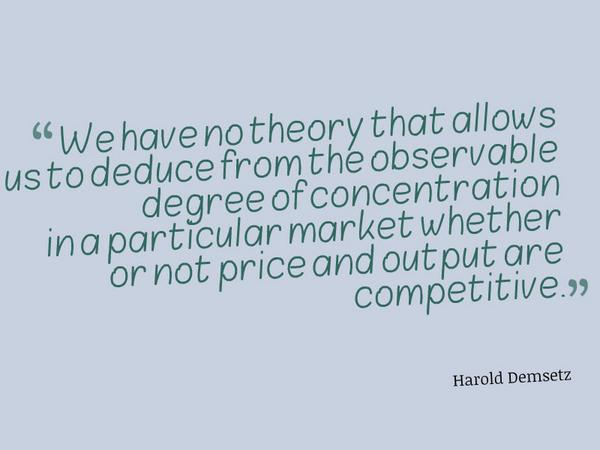
Competition law can subvert competition by stymieing the introduction of new goods and the temporary monopoly often necessary to recoup their invention costs and induce innovation. Sam Peltzman, when reflecting on the contributions of Aaron Director to the law and economics of competition said:
There are the myriad of ways in which real world business practices behave differently from the caricaturing in textbooks. Those differences sometimes arouses suspicious responses from economists. Visions of market power and deadweight loss triangles dance their heads, and some of the suspect practices have been constrained by anti-trust policy. Director rejected this kind of intellectual laziness, and he sought, sometimes successfully, to inoculate those around him against it.
Director approached all business practices with the methodology that entailed asking very basic questions and answering them in a rigorous logic that it appealed ultimately to facts. The style was verbal – some combination of Socratic dialogue and Adam Smith. This style had the disadvantage of producing few closed-form solutions. But it had the advantage of permitting analysis of the kind of problems that eluded simple solutions.
Indeed I believe that one reason for Director’s lasting influence he was able to show that simple judgements about business practices often cannot withstand rigorous scrutiny.
Economic theory and empirical evidence are full of examples of business conduct that reduce choice but increase consumer welfare through lower prices, more innovation, or higher quality products and services. Manne and Wright noted in the paper, Innovation and the Limits of Antitrust that:
Both product and business innovations involve novel practices, and such practices generally result in monopoly explanations from the economics profession followed by hostility from the courts (though sometimes in reverse order) and then a subsequent, more nuanced economic understanding of the business practice usually recognizing its pro-competitive virtues.
Competition law enforcement agencies are suing Google because it is anti-competitive. The dead hands of the competitors to Google are buried somewhere in those suits. Is there no learning. There is certainly no modesty about past mistakes about the proper scope of competition law.

The coalition of obsolete industries still needs your support! Stop progress now?
14 Dec 2015 Leave a comment
in development economics, economic history, entrepreneurship, industrial organisation, survivor principle, technological progress Tags: creative destruction, entrepreneurial alertness, Luddites, The Great Enrichment, The Great Fact
The gales of creative destruction are quickening
14 Dec 2015 Leave a comment
in economic history, entrepreneurship, industrial organisation, technological progress Tags: creative destruction, technology diffusion, technology diffusion lags
What is creative destruction?
12 Dec 2015 Leave a comment
in economic history, entrepreneurship, industrial organisation, survivor principle, technological progress Tags: creative destruction, entrepreneurial alertness
Manufacturing as a proportion of GDP
11 Dec 2015 Leave a comment
in economic history, industrial organisation, survivor principle Tags: creative destruction, manufacturing industry
Are CEOs denied their labour surplus?
11 Dec 2015 Leave a comment
in applied price theory, entrepreneurship, fisheries economics, human capital, industrial organisation, labour economics, labour supply, managerial economics, occupational choice, organisational economics, personnel economics, survivor principle Tags: CEO pay, moral hazard, promotion tournaments, superstar, superstar wages
Bang Dang Nguyen and Kasper Meisner Nielsen looked at how share prices reacted to 149 cases of the chief executive or another prominent manager dying suddenly in American companies between 1991 and 2008.
If the shares rise on an executive’s death, he was overpaid; if they fall, he was not. Only 42% of the bosses studied were overpaid. Those with the bigger pay packages gave the best value for money as measured by the share-price slump when they passed away unexpectedly.
Share prices do speak to the value of the company and the contribution of its CEO. The share price of Apple went up and down by billions on the back of rumours about the health of Steve Jobs.
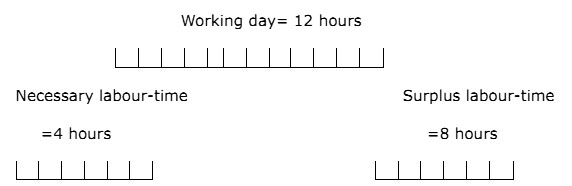
In terms of splitting of what some call the labour surplus increase from a firm hiring an executive, these employees retain on average about 71% and their employer keeps 29%. Others call this rent sharing.

71% going to the CEO might initially sound high, “but it’s not like he’s taking home more than he produced for the company,” says Nguyen.

The exploitation of CEOs gets worse when you consider the extensive use of promotion tournaments by their employers when setting their wages. They are thrust into rat races. Promotion tournaments are an integral and often invisible part of their workplaces.
Executive level employees are often ranked by their employers relative to each other and promoted not for being good at their jobs but for being better than their rivals. These promotion tournaments sent one employee against another – one worker against another – to the profit of the owners of the firm.
The rat race set up by the owners of the firm are so cutthroat that in competitions to determine promotions the capitalists who own the firm may find that their employees discover that the most efficient way of winning a promotion is by sabotaging the efforts of their rivals.
Lazear and Rozen’s tournament theory of executive pay has stood the test of time. The key to this rat race is the larger is your boss’s pay, the bigger the motivation for you as an underling to work for a promotion. As Lazear wrote in his book, Personnel Economics for Managers
The salary of the vice president acts not so much as motivation for the vice president as it does as motivation for the assistant vice presidents.
 Utopia, you are standing in it!
Recent Comments