More than half of start-ups fail within the first five years. Read more bit.ly/1DtN24o http://t.co/D4VMffLYIF—
OECD Statistics (@OECD_Stat) September 27, 2015
Creative destruction in start-ups
29 Sep 2015 Leave a comment
in economic history, economics, industrial organisation, survivor principle Tags: business demographics, creative destruction, entrepreneurial alertness, start-ups
KiwiRail’s financial performance since 2007
28 Sep 2015 1 Comment
in economic history, industrial organisation, politics - New Zealand
In addition to the $10+ billion write-off and collapsed to negative equity, KiwiRail has not paid any dividends for quite some time now to the taxpayer.

Source: The New Zealand Treasury – data released under the Official Information Act.

Source: The New Zealand Treasury – data released under the Official Information Act.
The financial performance of Solid Energy (NZ state-owned enterprise) since 2007
28 Sep 2015 Leave a comment
in energy economics, industrial organisation, politics - New Zealand Tags: expressive voting, privatisation, state owned enterprises
Leaving aside the fortunes and vicissitudes of the mining industry, Solid Energy’s numbers have been up and down by so much that if this was in a private company, you would start to wonder.

Source: The New Zealand Treasury – data released under the Official Information Act.
Taxpayers barely saw a cent of those multibillion-dollar valuations of just a few years ago for a company now under receivership. I doubt the ride was worth the price of passage for the taxpayer.
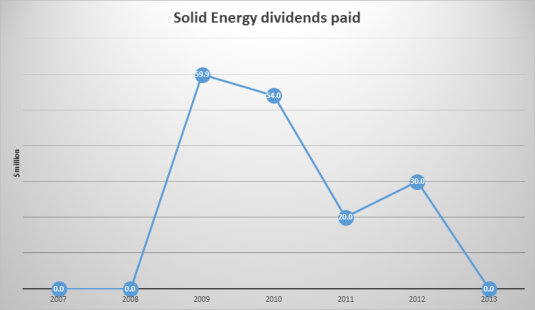
Source: The New Zealand Treasury – data released under the Official Information Act.

Source: The New Zealand Treasury – data released under the Official Information Act.
The financial performance of TVNZ since 2007
28 Sep 2015 Leave a comment
in economic history, economics of media and culture, industrial organisation, politics - New Zealand Tags: creative destruction, expressive voting, legacy media, privatisation, state owned enterprises
The volatile returns to taxpayers from Television New Zealand shows that continuing to own a state-owned enterprise operating a legacy media adds considerable risk to the taxpayers’ portfolio.

Source: The New Zealand Treasury – data released under the Official Information Act.
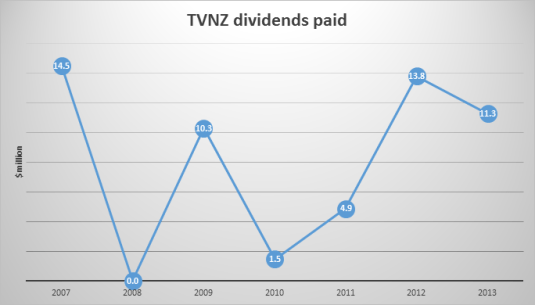
Source: The New Zealand Treasury – data released under the Official Information Act.

Source: The New Zealand Treasury – data released under the Official Information Act.
The financial performance of New Zealand Post since 2007
28 Sep 2015 Leave a comment
in economic history, industrial organisation, politics - New Zealand Tags: expressive voting, NZ Post, privatisation, state owned enterprises, sunset industries
New Zealand Post is slowly going out the door with declining dividends to taxpayers, a sustained decline in its commercial valuation and a negative or poor Total Shareholder Return. Letter volumes declined by a one-half in 10 years but the parcels business is growing because of the rise of e-commerce and Internet shopping.

Source: The New Zealand Treasury – data released under the Official Information Act.
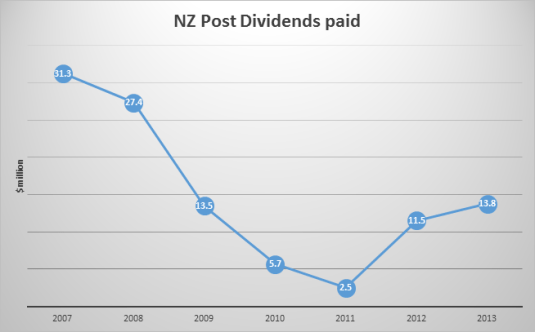
Source: The New Zealand Treasury – data released under the Official Information Act.

Source: The New Zealand Treasury – data released under the Official Information Act.

@nzlabour @NZGreens New Zealand state-owned enterprises dividends paid and capital injections since 2007
25 Sep 2015 Leave a comment
in financial economics, industrial organisation, politics - New Zealand, public economics, rentseeking, survivor principle, transport economics Tags: government ownership, KiwiRail, privatisation, rational ignorance, rational rationality, state owned enterprises, suppressive voting
The New Zealand Labour Party and New Zealand Greens both make much of the fact that when you privatise a state-owned enterprise the taxpayer is no longer entitled to dividends from the privatised business. The fact that the sale price is the net present value of those future dividends is a rating fallacy that is not the subject of this post.
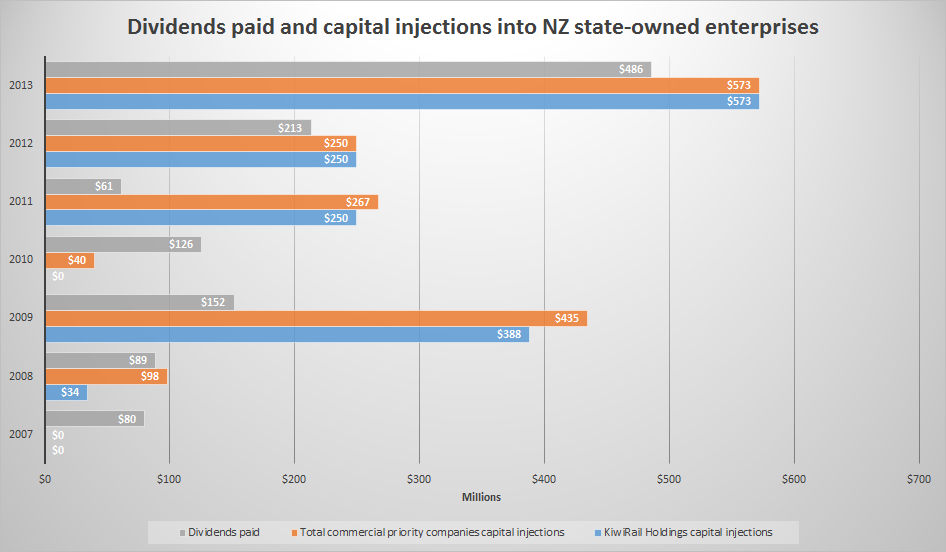
Source: New Zealand Treasury – data released under the Official Information Act.
What is the subject of this post is whether there are indeed any dividends paid to taxpayers after capital injections. 2007 was the last year in which dividends to the taxpayer exceeded capital injections. The reason was that dog called KiwiRail.
Drug Price Controls End Up Costing Patients Their Lives
24 Sep 2015 Leave a comment
in applied price theory, applied welfare economics, comparative institutional analysis, economics of regulation, entrepreneurship, health economics, industrial organisation, law and economics, politics - USA, property rights, survivor principle Tags: creative destruction, endogenous growth theory, innovation, intellectual property rights, patents and copyrights, pharmaceutical innovation, price controls
Our research shows that when prices fall, innovation falls even more. Patients would see their lives cut short by delayed or absent drugs.
Source: Drug Price Controls End Up Costing Patients Their Health – NYTimes.com
…cutting prices by 40 to 50 percent in the United States will lead to between 30 and 60 percent fewer R and D projects being undertaken in the early stage of developing a new drug. Relatively modest price changes, such as 5 or 10 percent, are estimated to have relatively little impact on the incentives for product development – perhaps a negative 5 percent.
Source: The Effect of Price Controls on Pharmaceutical Research


Is this evidence of the great stagnation?
24 Sep 2015 Leave a comment
in applied price theory, economic history, entrepreneurship, industrial organisation, survivor principle, technological progress Tags: creative destruction, great stagnation, The Great Enrichment
Are today's young Americans the luckiest generation in history? ow.ly/R425e @Mark_J_Perry @AEIdeas http://t.co/8lHZNkq1Ak—
AEI on Campus (@AEIonCampus) August 18, 2015
Entrepreneurial alertness in vehicle emissions testing
23 Sep 2015 1 Comment
in economics of crime, entrepreneurship, environmental economics, industrial organisation, law and economics, survivor principle, transport economics Tags: air pollution, entrepreneurial alertness, vehicle emissions testing, Volkswagen
Here's how Volkswagen's system for fooling the emission tests worked: nyti.ms/1Fdlcus http://t.co/U7hlLejNK0—
NYT Business (@nytimesbusiness) September 22, 2015
Mises on entrepreneurs and consumer sovereignty
21 Sep 2015 Leave a comment
in applied price theory, Austrian economics, economic history, industrial organisation, Ludwig von Mises, survivor principle Tags: competition and monopoly, consumer sovereignty, creative destruction, entrepreneurial alertness, market selection, The meaning of competition
Stigler on economics as a big tent @RusselNorman @NZGreens @GreenpeaceNZ @Mark_J_Perry
21 Sep 2015 1 Comment

The iPhone cycle
20 Sep 2015 Leave a comment
in industrial organisation, survivor principle Tags: cell phones, creative destruction, smart phones
The #iPhone cycle – when do people upgrade their phones?
statista.com/chart/3784/iph… http://t.co/zbkhEx2jmT—
Statista (@StatistaCharts) September 10, 2015
Creative destruction in computing power
19 Sep 2015 Leave a comment
in entrepreneurship, industrial organisation, survivor principle, technological progress Tags: creative destruction, Moore's law
One dollar buys you increasingly more computing power – vastly more computing power!
from: bit.ly/1AGa3NP http://t.co/vrNf5TOyKI—
Max Roser (@MaxCRoser) June 26, 2015


Recent Comments