People really forget how awesomely powerful IBM was in the 1980s: @evankirstel http://t.co/TkpuU5sAXg—
Marc Andreessen (@pmarca) April 04, 2015
Creative destruction in the US technology sector since 1980
04 Apr 2015 Leave a comment
in entrepreneurship, industrial organisation, survivor principle Tags: creative destruction, entrepreneurial alertness, Joseph Schumpeter
Why Did Wal-Mart Raise Its Wages?
03 Apr 2015 Leave a comment
in industrial organisation, labour economics, labour supply, minimum wage, politics - USA, survivor principle Tags: Paul Krugman, supply and demand, Walmart
Why Did Walmart Raise Its Wages?
forbes.com/sites/realspin… http://t.co/0LRQQcKGKm—
Benn Steil (@BennSteil) April 02, 2015
The retail sector quits rate, the number of people quitting jobs as a per cent of total employment, is also considerably higher than the quits rate in the private sector broadly: 2.9% versus 2.2%.
Not surprisingly, Gap and Ikea have made wage-hike announcements similar to Wal-Mart’s. Retailers are clearly having more and more trouble finding and keeping workers at the federal minimum wage.
In short, Krugman’s story of Wal-Mart raising wages in response to political pressure simply flies in the face of the evidence. Wal-Mart is just being Wal-Mart: making a rational decision to lure and retain workers in a tightening retail labour market through greater compensation.
The problem with ignoring this evidence is that it encourages the notion that we can make wages, in Krugman’s words, “a political choice,” with no concern for its effect on employment.
Who trusts which news source?
03 Apr 2015 Leave a comment
in economics of media and culture, industrial organisation, survivor principle Tags: media bias, voter demographics
@47Patriots @GaltsGirl @corrcomm @lyndseyfifield @CathyYoung63
whoever u r, u r more trustworthy than @BuzzFeed http://t.co/sv4snHyMF2—
SonOfPatriarchy (@sports2inflatio) April 02, 2015
The importance of defining Internet trolls properly
30 Mar 2015 1 Comment
in economics of information, economics of media and culture, health economics, industrial organisation Tags: information cocoons, infotopia, Internet trolls
Data plans vary quite a lot in price
30 Mar 2015 Leave a comment
in applied welfare economics, development economics, economics of media and culture, growth miracles, industrial organisation, survivor principle Tags: cell phones
India’s cut-throat mobile market is a boon to consumers, but an auction is shaking things up econ.st/1Celv2O http://t.co/Fqp95eR145—
The Economist (@EconEconomics) March 27, 2015

People have no illusions when they read the tabloids
26 Mar 2015 Leave a comment
Possibly more concerning: the 'trust gap' between upmarket (e.g. Telegraph) and tabloid papers is down from 51 to 30 http://t.co/q9VurKexys—
William Jordan (@williamjordann) February 18, 2015
Apparently there are people who claim they haven’t used the Internet
25 Mar 2015 Leave a comment
in economics of media and culture, industrial organisation Tags: creative destruction, Internet, opinion polls, revealed preference
Paul Krugman on the importance of not taking cheap shots in public policy discussions
25 Mar 2015 1 Comment
in applied price theory, applied welfare economics, history of economic thought, industrial organisation, international economics, Public Choice Tags: conjecture and refutation, Paul Krugman, pop internationalism, public intellectual

The North–South theory of product life cycles
23 Mar 2015 Leave a comment
in comparative institutional analysis, entrepreneurship, industrial organisation, law and economics, managerial economics, organisational economics, property rights, survivor principle, theory of the firm Tags: entrepreneurial alertness, foreign direct investment, incomplete contracts, incomplete property rights, North-South product life cycle, product life cycles
Forecasts of the offshoring of service jobs, as an example, can be constituted into a theory of North-South product cycles. The North-South theory of the life cycle of products starts with their research and development and refinement by entrepreneurs in the advanced countries (the North) with some exporting (Grossman and Helpmann 1991a, 1991b). These innovations require resources to be invested with uncertain prospects of success. Entrepreneurs in the North compete to discover new technology-intensive products using the ample supply of R&D workers and human capital-rich workers in the industrialised countries (Grossman and Helpmann 1991a, 1991b).

As a new product matures and its production becomes more standardised, the bulk of its production can migrate to the less developed countries (the South) to take advantage of lower production costs, and these countries will become net exporters. In the South, entrepreneurs focus more on imitation. They invest resources in importing and learning the production processes developed and proven to be a success in the North (Grossman and Helpmann 1991a, 1991b).
The shifting of production of standardised products to lower-wage foreign locations will frequently be within the originating company via a foreign affiliate, because of uncertainties about property rights and contract enforcement institutions in the host countries, and only later to independent foreign firms (Antràs 2005). Within corporate hierarchies, the high-skilled managers in the developed countries will specialise in problem-solving and non-routine tasks. They will interact with middle managers and production workers in developing countries who perform the routine tasks (Antràs et al. 2006, 2008).
Contracts are typically incomplete either because they are difficult to write and/or because the court cannot enforce them. The World Trade Organization (2005, 2008) concluded that, for example, the location of offshored services depends on:
- labour costs,
- trade costs,
- the quality of institutions, particularly the legal framework,
- the tax and investment regime,
- the quality of infrastructure, particularly telecommunications, and
- skills, particularly language and computer skills.
Risks in contract negotiation and enforcement will influence which types of production is outsourced. Roughly one-third of world trade is infra-firm, and this intra-firm trade is concentrated in the capital-intensive industries because of the costs and risks of investing in contracting with arm’s-length suppliers (Antràs 2003). Considerations about R&D incentives, the availability of human capital and the quality of contract enforcement institutions weigh heavily on the development of new products and their initial and later locations of different stages of production.
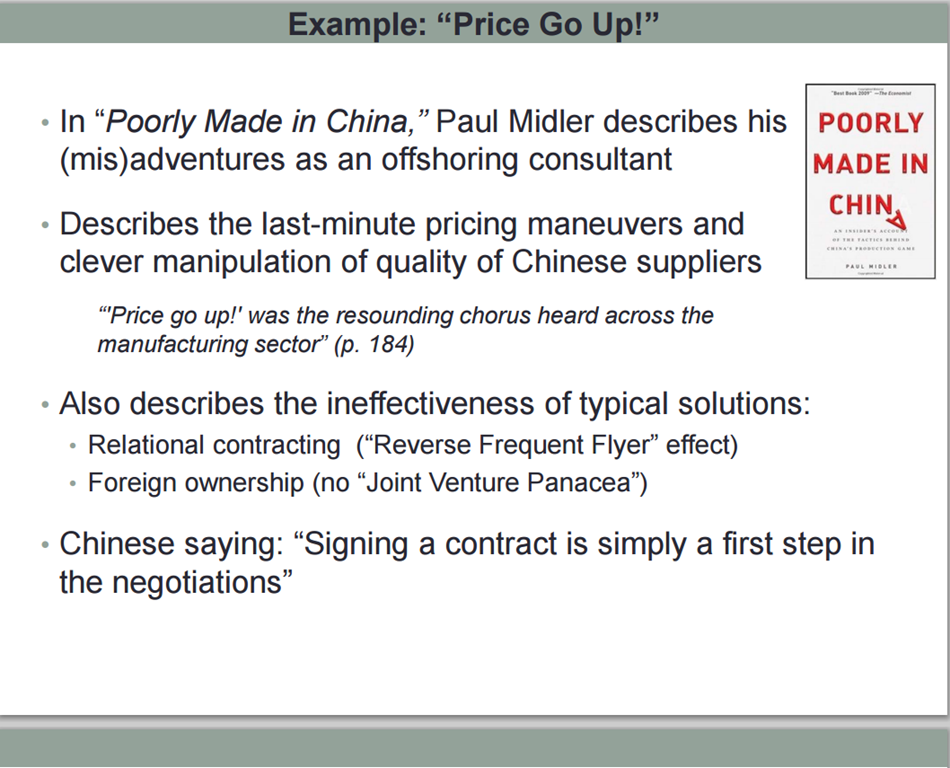
Products are initially developed in the highly industrialised countries because their sophisticated legal systems allow contracts to be enforced. Even then, in industrialised countries, the difficulties of writing and enforcing complicated contracts over the quality of new products early in the product life cycle encourages firms to make those products internally within the firm. Early in the product life cycle, if sub-contractors were used for key imports, there would have to be continual renegotiation of contracts contracts to incorporate new innovations and learning by doing. As Antras says:
Global production networks necessarily entail intensive contracting between parties located in different countries and thus subject to distinct legal systems0
As the new product standardises, and product quality in consequence becomes easier to measure and contract over, initially the innovating firm will sub-contract within the industrialised country but in time will import from developing countries. In the first instance, these imports may be from affiliates established in the developing country to ensure greater control of product quality through direct ownership of the factory. As Antras says:
Firms contemplating doing business in a country with weak contracting institutions might decide to do so within firm boundaries to have more control.
The size and shape of the firm is a direct response to mitigate the costs of contracting over quality that is hard to measure and which is constantly changing early in the product cycle. By assigning ownership rights to the party undertaking the more important investment in quality early in the product life cycle, entrepreneurs and innovators can minimise the losses caused by lack of enforceable contracts over quality when quality is changing rapidly as the firm moves through the product life cycle.

Boeing blamed the delays on the delivery of the Dreamliner on an unwillingness of sub-contractors to stand by their contractual obligations. In response, Boeing acquired some of the key sub-contractors to ensure that they delivered as promised. This is a classic operation of the theory of the firm where the entrepreneur brings within the firm what is too expensive to transact on the market because of difficulties in measuring quality and defining and enforcing property rights over what has been contracted.
Creative destruction in cell phone battery gripes
22 Mar 2015 Leave a comment
in economics of media and culture, entrepreneurship, industrial organisation, Joseph Schumpeter
A few months ago, my complaint about my cell phone battery was it ran out after a couple of hours use.

Now my complaint about my new HTC 510 is the battery lasts so long that it takes quite some time to recharge it. My current and previous phones were HTC. The new phone costs the same $299 as I paid for the previous HTC, but is about three times as good as the old one which I bought about 18 months ago.
When researching the purchase of my new phone, I read a few reviews where I discovered they are written by complete snobs who own the latest iPhone and looked down on anything cheaper.
Landlines are certainly on the way out
21 Mar 2015 Leave a comment
in economics of media and culture, entrepreneurship, industrial organisation, survivor principle Tags: cell phones, creative destruction, mobile phones, network industries
Digital devices are taking over the day
20 Mar 2015 Leave a comment
in economics of media and culture, industrial organisation, survivor principle Tags: creative destruction, network industries, The Great Enrichment
What if you could replace performance evaluations with four simple questions?
20 Mar 2015 Leave a comment
in industrial organisation, managerial economics, organisational economics, personnel economics, survivor principle Tags: Dilbert, performance reviews

at the end of every project, or once a quarter if employees have long-term assignments, managers would answer four simple questions — and only four. The first two are answered on a five-point scale, from "strongly agree" to "strongly disagree;" the second two have yes or no options:
1. Given what I know of this person’s performance, and if it were my money, I would award this person the highest possible compensation increase and bonus.
2. Given what I know of this person’s performance, I would always want him or her on my team.
3. This person is at risk for low performance.
4. This person is ready for promotion today.

via What if you could replace performance evaluations with four simple questions? – The Washington Post.
 Utopia, you are standing in it!
Recent Comments