
HT: antidismal.blogspot via cafehayek
Celebrating humanity's flourishing through the spread of capitalism and the rule of law
10 Jul 2014 2 Comments
in applied price theory, applied welfare economics, entrepreneurship, industrial organisation, market efficiency, survivor principle, technological progress Tags: entrepreneurship, innovation, Walmart
HT: antidismal.blogspot via cafehayek
08 Jul 2014 Leave a comment
in applied price theory, applied welfare economics, comparative institutional analysis, David Friedman, economics of information, economics of regulation, entrepreneurship, industrial organisation, labour economics, law and economics, managerial economics, market efficiency, Milton Friedman, personnel economics, politics - New Zealand, Ronald Coase Tags: adverse selection, asymmetric information, blackboard economics, moral hazard, occupational regulation, screening, signalling
There are at least 98 regulated occupations in New Zealand covering about 20% of the workforce. In 2011, this amounts to 440,371 workers. The skills that are regulated range across all skill sets and many occupations:
There are 32 different governing Acts that regulated occupations in New Zealand with 55% of the workers subject to occupational regulation are employed in just five occupations:
The Health Practitioners Competency Assurance Act 2003 regulates 22 occupations and a total of 89,807 workers. The next best is the 10 occupations regulated by the Health and Safety in Employment Act 2002 which regulates an unknown number of occupations. The Civil Aviation Act 1990 regulates eight occupations and 19,095 workers, the Building Act 2004 regulates seven occupations and 21,101 workers and the Maritime Transport Act 1994 regulates six occupations and 20,500 workers. 12 of the regulated occupations are regulated under laws passed since 2007.
The purpose of occupational regulation is to protect buyers from quacks and lemons – to overcome asymmetric information about the quality of the provider of the service.
Adverse selection occurs when the seller knows more than the buyer about the true quality of the product or service on offer. This can make it difficult for the two people to do business together. Buyers cannot tell the good from the bad products on offer so many they do not buy to all and withdraw from the market.
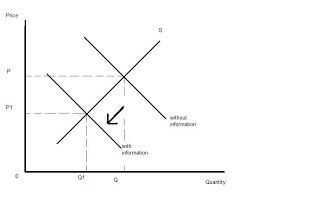
Goods and services divide into inspection, experience and credence goods.
The problem of adverse selection over experience and credence goods present many potentially profitable but as yet unconsummated wealth-creating transactions because of the uncertainty about quality and reliability.
Buyers are reluctant to buy if they are unsure of quality, but if such assurances can be given in a credible manner, a significant increase in demand is possible.
Any entrepreneur who finds ways of providing credible assurances of the quality of this service or work stands to profit handsomely. Brand names and warranties are examples of market generated institutions that overcome these information gaps through screening and signalling.
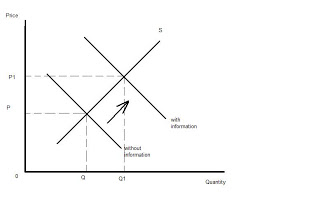
Screening is the less informed party’s effort, usually the buyer, to learn the information that the more informed party has. Successful screens have the characteristic that it is unprofitable for bad types of sellers to mimic the behaviour of good types.
Signalling is an informed party’s effort, usually the seller, to communicate information to the less informed party.
The main issue with quacks in the labour market is whether there are a large cost of less than average quality service, and is there a sub-market who will buy less than average quality products in the presence of competing sellers competing on the basis of quality assurance. This demand for assurance creates opportunities for entrepreneurs to profit by providing assurance.
David Friedman wrote a paper about contract enforcement in cyberspace where the buyer and seller is in different countries so conventional mechanisms such as the courts are futile in cases where the quality of the good is not as promised or there is a failure to deliver at all:
Public enforcement of contracts between parties in different countries is more costly and uncertain than public enforcement within a single jurisdiction.
Furthermore, in a world where geographical lines are invisible, parties to publicly enforced contracts will frequently not know what law those contracts are likely to fall under. Hence public enforcement, while still possible for future online contracts, will be less workable than for the realspace contracts of the past.
A second and perhaps more serious problem may arise in the future as a result of technological developments that already exist and are now going into common use. These technologies, of which the most fundamental is public key encryption, make possible an online world where many people do business anonymously, with reputations attached to their cyberspace, not their realspace, identities
Online auction and sales sites address adverse selection with authentication and escrow services, insurance, and on-line reputations through the rating of sellers by buyers.
E-commerce is flourishing despite been supposedly plagued by adverse selection and weak contract enforcement against overseas venders.
In the labour market, screening and signalling take the form of probationary periods, promotion ladders, promotion tournaments, incentive pay and the back loading of pay in the form of pension investing and other prizes and bonds for good performance over a long period.
In the case of the labour force, there are good arguments that a major reason for investments in education is as a to signal quality, reliability, diligence as well as investment in a credential that is of no value the case of misconduct or incompetence. Lower quality workers will find it very difficult if not impossible to fake quality and reliability in this way – through investing in higher education.
In the case of teacher registration, for example, does a teacher registration system screen out any more low quality candidates for recruitment than do proper reference checks and a police check for a criminal record.
Mostly disciplinary investigations and deregistrations under the auspices of occupational regulation is for gross misconduct and criminal convictions rather than just shading of quality.
Much of personnel and organisational economics is about the screening and sorting of applicants, recruits and workers by quality and the assurance of performance.
Alert entrepreneurs have every incentive to find more profitable ways to manage the quality of their workforce and sort their recruitment pools.
Baron and Kreps (1999) developed the recruitment taxonomy made up of stars, guardians and foot-soldiers.
Stars hold jobs with limited downside risk but high performance is very good for the firm – the costs of hiring errors for stars such as an R&D worker are small: mostly their salary. Foot-soldiers are employees with narrow ranges of good and bad possible outcomes.
Guardians have jobs where bad performance can be a calamity but good job performance is only slightly better than an average performance.
Airline pilots and safety, compliance, finance and controller jobs are all examples of guardian jobs where risk is all downside. Bad performance of these jobs can bring the company down. Dual control is common in guardian jobs.
The employer’s focus when recruiting and supervising guardians is low job performance and not associating rewards and promotions with risky behaviours. Employers will closely screen applicants for guardian jobs, impose long apprenticeships and may limit recruiting to port-of-entry jobs.
The private sector has ample experience in handling risk in recruitment for guardian jobs. Firms and entrepreneurs are subject to a hard budget constraints that apply immediately if they hire quacks and duds.
Blackboard economics says that governments may be able to improve on market performance but as Coase warned that actually implement regulatory changes in real life is another matter:
The policy under consideration is one which is implemented on the blackboard.
All the information needed is assumed to be available and the teacher plays all the parts. He fixes prices, imposes taxes, and distributes subsidies (on the blackboard) to promote the general welfare.
But there is no counterpart to the teacher within the real economic system
Occupational regulation comes with the real risk of the regulation turning into an anti-competitive barrier to entry as Milton Friedman (1962) warned:
The most obvious social cost is that any one of these measures, whether it be registration, certification, or licensure, almost inevitably becomes a tool in the hands of a special producer group to obtain a monopoly position at the expense of the rest of the public.
There is no way to avoid this result. One can devise one or another set of procedural controls designed to avert this outcome, but none is likely to overcome the problem that arises out of the greater concentration of producer than of consumer interest.
The people who are most concerned with any such arrangement, who will press most for its enforcement and be most concerned with its administration, will be the people in the particular occupation or trade involved.
They will inevitably press for the extension of registration to certification and of certification to licensure. Once licensure is attained, the people who might develop an interest in undermining the regulations are kept from exerting their influence. They don’t get a license, must therefore go into other occupations, and will lose interest.
The result is invariably control over entry by members of the occupation itself and hence the establishment of a monopoly position.
Friedman’s PhD was published in 1945 as Income from Independent Professional Practice. With co-author Simon Kuznets, he argued that licensing procedures limited entry into the medical profession allowing doctors to charge higher fees than if competition were more open.
Data Source: Martin Jenkins 2012, Review of Occupational Regulation, released by the Ministry of Business, Innovation and Employment under the Official Information Act.
04 Jul 2014 Leave a comment

27 Jun 2014 Leave a comment

22 Jun 2014 Leave a comment
in entrepreneurship, industrial organisation Tags: blackboard economics, competition is process, meaning of competition, monopoly, Paul J McNulty, perfect competition, Schumpeter, the market process

As it is, it is one of the great paradoxes of economic science that every act of competition on the part of a businessman is evidence, in economic theory, of some degree of monopoly power, while the concepts of monopoly and perfect competition have this important common feature: both are situations in which the possibility of any competitive behaviour has been ruled out by definition
Paul J McNulty, Economic Theory and the Meaning of Competition

20 Jun 2014 Leave a comment
in applied price theory, economics, economics of regulation, entrepreneurship, industrial organisation Tags: decriminalisation, grey markets, marijuana

Evan Cox left pizza delivery and now employs 50 people in Washington state in his pot delivery company:
Although it is legal to buy marijuana in Washington state, the person who delivers it could be guilty of a felony. That hasn’t stopped Winterlife from attracting competitors.
Mr Cox has registered as a business with the city and state, but he cannot open a bank account, thanks to federal rules.
In April, he paid $167,000 in sales tax to the Washington State Department of Revenue—in cash.
via Door-to-Door Dope Delivery: "Pot Is the New Pizza" in Washington State – Hit & Run : Reason.com.
18 Jun 2014 Leave a comment
in development economics, industrial organisation, international economics Tags: game theory, mega sports events, mega-events, Olympics, signalling
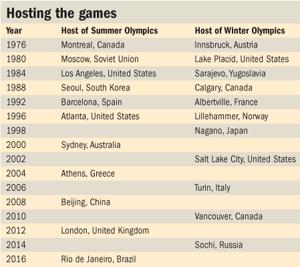
Both successful and unsuccessful bids to host the Olympics have a similar positive impact on exports according to Andrew Rose – no relation.
The Olympic effect on trade is from a signal that a country sends when bidding to host the games, rather than actually hosting the event.

A country that wishes to liberalise its trade may want to signal this by bidding to host a mega-event. It generates extra trade-related investment and creates a political atmosphere where back-sliding on trade liberalisation or the mega-event becomes difficult.
Many of the countries that are hosted the Olympic Games in recent years such as China have done so as part of showing to the world that they have made it and there’s no going back.
The trick then for the taxpayer is for your country’s bid to host the Olympics to come a close second without anyone knowing you really want to lose.

The trouble with treating the Olympic bid is all show to boost your image as an investment destination and a liberalising economy is your beard might actually win. Throwing a fight is never easy as many a boxer knows.
16 Jun 2014 Leave a comment
in history of economic thought, industrial organisation, law and economics, Ronald Coase Tags: blackboard economics, methodology of economics

This neglect of other aspects of the system has been made easier by another feature of modern economic theory – the growing abstraction of the analysis, which does not seem to call for a detailed knowledge of the actual economic system or, at any rate, has managed to proceed without it.
Holmstrom and Tirole, writing on The Theory of the Firm in the recently published Handbook of Industrial Organization, conclude at the end of their article of 63 pages that "the evidence/theory ratio… is currently very low in this field". Peltzman has written a scathing review of the Handbook in which he points out how much of the discussion in it is theory without any empirical basis.
What is studied is a system which lives in the minds of economists but not on earth.
I have called the result "blackboard economics". The firm and the market appear by name but they lack any substance. The firm in mainstream economic theory has often been described as a "black box". And so it is.
This is very extraordinary given that most resources in a modern economic system are employed within firms, with how these resources are used dependent on administrative decisions and not directly on the operation of a market.
Consequently, the efficiency of the economic system depends to a very considerable extent on how these organisations conduct their affairs, particularly, of course, the modern corporation.
Even more surprising, given their interest in the pricing system, is the neglect of the market or more specifically the institutional arrangements which govern the process of exchange.
As these institutional arrangements determine to a large extent what is produced, what we have is a very incomplete theory.
Four years before his Nobel lecture, Coase was more specific:
Marginal cost pricing is a policy is largely without merit.
How then can one explain the widespread support that it has enjoyed in the economics profession?
I believe it is the result of economists using an approach which I have termed “blackboard economics.”
The policy under consideration is one which is implemented on the blackboard. All the information needed is assumed to be available and the teacher plays all the parts. He fixes prices, imposes taxes, and distributes subsidies (on the blackboard) to promote the general welfare.
But there is no counterpart to the teacher within the real economic system. There is no one who is entrusted with the task that is performed on the black- board.
In the back of the teacher’s mind (and sometimes in the front of it) there is, no doubt, the thought that in the real world the government would fill the role he plays. But there is no single entity within the government which regulates economic activity in detail, carefully adjusting what is done in one place to accord with what is done elsewhere.
Coase argued that marginal cost pricing is not only inefficient, but even inferior to average cost pricing due to:
(i) the fact that under marginal cost pricing, consumers are not forced to pay the full costs of the goods they purchase, leading to potentially inefficient consumption choices;
(ii) the lack of information necessary for the government to determine whether consumers would be willing to pay an amount sufficient to cover the total cost of the goods produced, and costly nature of attempts to make such estimates; and
(iii) the fact that the governmental subsidy necessary to ensure firm survival under a marginal cost pricing scheme will likely be financed through distortionary taxes, thereby creating or exacerbating a distortion in one market at the same time that it corrects a distortion in another.
10 Jun 2014 Leave a comment
in entrepreneurship, industrial organisation, international economics, Public Choice, rentseeking Tags: picking winners

What World Bank consultant would risk his fee and return business on advising Egypt to specialise in the export of toilets to Italy? But Egypt’s largest single manufacturing export is toilets to Italy where it captured 93% of the market.
Kenya has a booming export business in cut flowers for men to buy for their wives. Kenya has 40% of the European markets for cut flowers. Nigeria has 84% of the Norwegian market for floating docks. The Philippines has 71% of the global market for electronic integrated circuits.
What development expert would have picked these winners? They’re far too far away from the conventional wisdom and the safe bets that are behind picking winners in government circles.
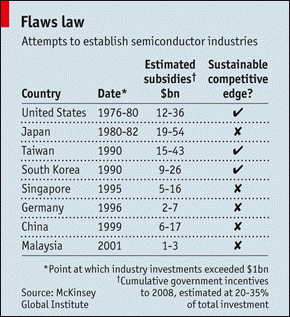
Picking winners by governments requires heroic assumptions not only about the information politicians and bureaucrats have about the present and their ability to predict the future, but also about their motivations and their ability to resist capture by special interests. The Economist explains:
None of these studies addresses a deeper problem with the way industrial policy tends to develop over time.
Earlier efforts have tended to degenerate into rent-seeking, lobbying and cosy deals between incumbent firms and bureaucrats, stifling innovation and the process of creative destruction.
The problem, of course, is that … industrial policy requires disinterested, benevolent policymakers who can do it well. Unfortunately, they do not yet have a recipe for how such policymakers can be created.
Policy is made by real people with political and personal motivations. What they come up with is unlikely to be as well designed as the ones in the models.
10 Jun 2014 Leave a comment
in industrial organisation, liberalism Tags: monopoly, progressivism
A surprising number of well-meaning people want to protect consumers from the scourge of lower prices. These abominations come from imports, new entry or cost reductions.

Richard Epstein talked about how progressives think they can tell the difference between a good monopoly and a bad monopoly.

There is one instance in which monopoly could arise in the free market – exclusive ownership of an essential input (Kirzner 1973):
Monopoly … in a market free of government obstacles to entry, means for us the position of a producer whose exclusive control over necessary inputs blocks competitive entry into the production of his product.
Monopoly thus does not refer to the position of a producer who, without any control over resources, happens to be the only producer of a particular product. This producer is fully subject to the competitive market process, since other entrepreneurs are entirely free to compete with him.
In all other cases, monopoly is the grant by government of an exclusive privilege to produce or sell a product (Rothbard 1962). This definition is from the common law as per Lord Coke:
A monopoly is an institution or allowance by the king, by his grant, commission, or otherwise . . . to any person or persons, bodies politic or corporate, for the sole buying, selling, making, working, or using of anything, whereby any person or persons, bodies politic or corporate, are sought to be restrained of any freedom or liberty that they had before, or hindered in their lawful trade.
10 Jun 2014 Leave a comment
in Alfred Marshall, entrepreneurship, industrial organisation Tags: moral hazard, The fatal conceit, The pretense to knowledge

A Government could print a good edition of Shakespeare’s works, but it could not get them written…
I am not urging that municipalities should avoid all such undertakings without exception. For, indeed, when a large use of rights of way, especially in public streets, is necessary, it is doubtless generally best to retain the ownership, if not also the management, of the inevitable monopoly in public hands.
I am only urging that every new extension of Governmental work in branches of production which need ceaseless creation and initiative is to be regarded as prima facie anti-social, because it retards the growth of that knowledge and those ideas which are incomparably the most important form of collective wealth.
Celebrating humanity's flourishing through the spread of capitalism and the rule of law
Celebrating humanity's flourishing through the spread of capitalism and the rule of law
Celebrating humanity's flourishing through the spread of capitalism and the rule of law
Celebrating humanity's flourishing through the spread of capitalism and the rule of law
Celebrating humanity's flourishing through the spread of capitalism and the rule of law
Celebrating humanity's flourishing through the spread of capitalism and the rule of law
Celebrating humanity's flourishing through the spread of capitalism and the rule of law
Celebrating humanity's flourishing through the spread of capitalism and the rule of law
Celebrating humanity's flourishing through the spread of capitalism and the rule of law
Celebrating humanity's flourishing through the spread of capitalism and the rule of law
Celebrating humanity's flourishing through the spread of capitalism and the rule of law
Celebrating humanity's flourishing through the spread of capitalism and the rule of law
A History of the Alt-Right
Econ Prof at George Mason University, Economic Historian, Québécois
Celebrating humanity's flourishing through the spread of capitalism and the rule of law
Scholarly commentary on law, economics, and more
Beatrice Cherrier's blog
Celebrating humanity's flourishing through the spread of capitalism and the rule of law
Celebrating humanity's flourishing through the spread of capitalism and the rule of law
Celebrating humanity's flourishing through the spread of capitalism and the rule of law
Why Evolution is True is a blog written by Jerry Coyne, centered on evolution and biology but also dealing with diverse topics like politics, culture, and cats.
Celebrating humanity's flourishing through the spread of capitalism and the rule of law
A rural perspective with a blue tint by Ele Ludemann
DPF's Kiwiblog - Fomenting Happy Mischief since 2003
Celebrating humanity's flourishing through the spread of capitalism and the rule of law
The world's most viewed site on global warming and climate change
Tim Harding's writings on rationality, informal logic and skepticism
A window into Doc Freiberger's library
Let's examine hard decisions!
Commentary on monetary policy in the spirit of R. G. Hawtrey
Thoughts on public policy and the media
Celebrating humanity's flourishing through the spread of capitalism and the rule of law
Politics and the economy
A blog (primarily) on Canadian and Commonwealth political history and institutions
Reading between the lines, and underneath the hype.
Economics, and such stuff as dreams are made on
"The British constitution has always been puzzling, and always will be." --Queen Elizabeth II
Celebrating humanity's flourishing through the spread of capitalism and the rule of law
Celebrating humanity's flourishing through the spread of capitalism and the rule of law
WORLD WAR II, MUSIC, HISTORY, HOLOCAUST
Undisciplined scholar, recovering academic
Celebrating humanity's flourishing through the spread of capitalism and the rule of law
Res ipsa loquitur - The thing itself speaks
In Hume’s spirit, I will attempt to serve as an ambassador from my world of economics, and help in “finding topics of conversation fit for the entertainment of rational creatures.”
Researching the House of Commons, 1832-1868
Reflections on books and art


Recent Comments