
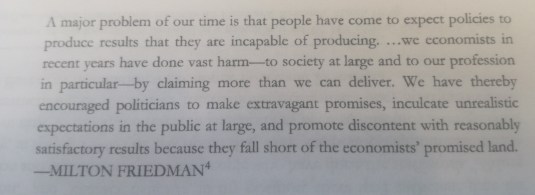
George Stigler doesn’t think much of the influence over economists over public policy
11 May 2018 Leave a comment
CofC Adam Smith Week 2018 – Dr. Lynne Kiesling
09 May 2018 Leave a comment
in applied price theory, comparative institutional analysis, economics of regulation, history of economic thought, industrial organisation
Was Karl Marx right? | The Economist
05 May 2018 Leave a comment
in applied price theory, business cycles, development economics, economic history, economics of bureaucracy, entrepreneurship, history of economic thought, industrial organisation, labour economics, macroeconomics, Marxist economics, poverty and inequality, Public Choice, public economics Tags: economics of socialism
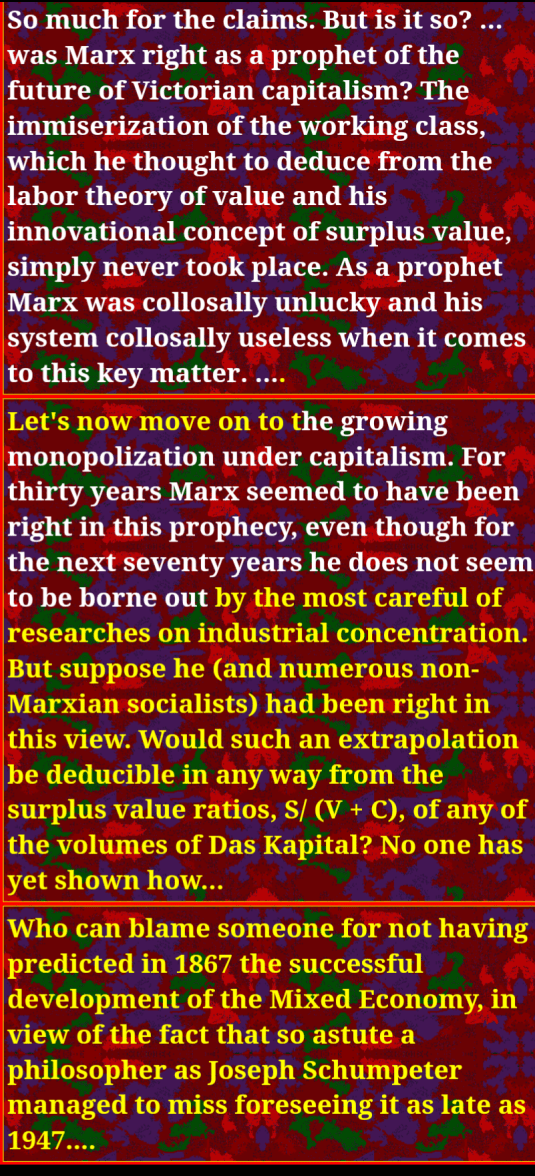
From Paul Samuelson’s essay on marxist economics
I am now a @DomPost hack as well as a @NZHerald hack according to some of @Whaleoil’s commentariat?!
04 May 2018 Leave a comment
in administration, energy economics, industrial organisation, politics - New Zealand
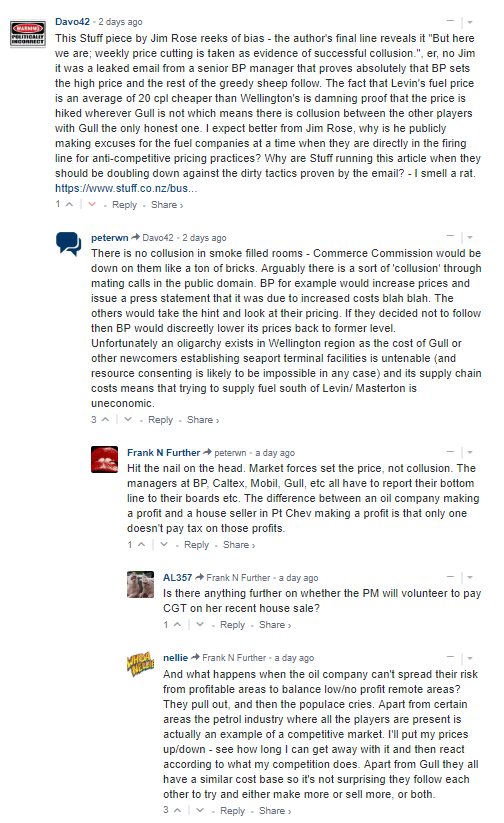

From https://www.whaleoil.co.nz/2018/05/whaleoil-general-debate-1411/
As Ronald Coase said in 1972
One important result of this preoccupation with the monopoly problem is that if an economist finds something—a business practice of one sort or other—that he çloes not understand, he looks for a monopoly explanation. And as in this field we are very ignorant, the number of ununderstandable practices tends to be rather large, and the reliance on a monopoly explanation, frequent.
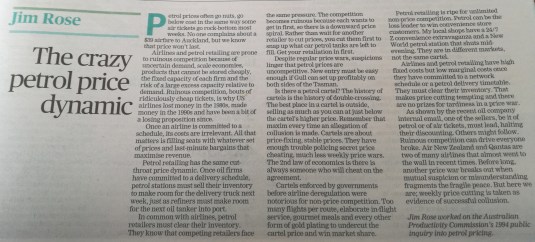
My @DomPost op-ed on petrol pricing and the theory of the empty core @EricCrampton
03 May 2018 Leave a comment
in applied price theory, energy economics, industrial organisation, politics - New Zealand Tags: cartel theory, conspiracy theories, game theory
USA ranked 45th for press freedom by @RSF_en despite no defamation suits for public figures, the 1st Amendment and more newspapers, magazines and social media than you can poke a stick at
30 Apr 2018 Leave a comment
in applied price theory, economics of media and culture, industrial organisation, survivor principle

Armen Alchian and George Stigler both argued that realised profits are the criterion by which the market process selects survivors: those who realise positive profits survive and will grow their market share; those who suffer losses will eventually disappear unless they improve themselves. The surviving media outlets will be those firms that anticipated or adapted fastest to the current and future demands of their readers and viewers.
Any media bias is likely to be slightly to the centre-left for the following reasons:
-
Young women tend to be one of the most marginal groups of news consumers (i.e., they are the most willing to switch to activities besides reading or watching the news).
-
Young women often make more of the consumption decisions for the household so advertisers will pay more to reach this group.
-
Since young women tend to be more centre-left, on average, a news outlet may want to slant its coverage that way. Media sell space to advertisers and tailor the way they cover politics to gain more readers and viewers.
Puglisi and Snyder found that:
- Using endorsements of state-level initiatives and referendums, newspapers are located almost exactly with the median voter – the average voter – in their home states.
- Newspapers are moderate relative to interest groups and political parties.
- Although newspapers exhibit some variation in their ideological position, they tend to be much closer to the median voter than most interest groups.
- Newspapers appear to be more liberal than voters on social and cultural issues such as gay marriage, but tend to be more conservative on economic issues such as the minimum wage.
- On average, the news and editorial sections have almost identical partisan positions.
Positive profits accrue to media outlets that are better at serving their readers and viewers than their competitors. Their lesser rivals will lose money, exhaust their retained earnings and fail to attract further investor support.
Most economists now know their limits? @EricCrampton @TaxpayersUnion
20 Apr 2018 Leave a comment
in applied price theory, applied welfare economics, comparative institutional analysis, economics of bureaucracy, economics of regulation, industrial organisation, labour economics, law and economics, macroeconomics, Public Choice Tags: The fatal conceit
Remember MySpace?
15 Apr 2018 Leave a comment
in entrepreneurship, industrial organisation, survivor principle Tags: competition law, creative destruction

HT Lorenzo Warby

Iggy Pop – John Peel Lecture 2014 Free music in a capitalist society
30 Mar 2018 Leave a comment
in entrepreneurship, industrial organisation, Music, survivor principle Tags: creative destruction, digital goods, economics of copyright, intellectual property rights
Uber: Revolutionary but Controversial – (The Story of Uber)
30 Mar 2018 Leave a comment
in economics of bureaucracy, entrepreneurship, industrial organisation, Public Choice, rentseeking, survivor principle, transport economics Tags: creative destruction, taxi regulation, Uber
The labour theory of value
29 Mar 2018 Leave a comment
in applied price theory, entrepreneurship, human capital, industrial organisation, labour economics, labour supply, Marxist economics, survivor principle Tags: labour theory of value
“A few observations:
- The Labor Theory of Value is incapable of functionally explaining even basic economic relationships. See Menger 1871.
-
The notion that class identity functionally drives political or any other type of collective action is hopelessly incoherent and undermined by a pervasive free rider problem. See Olson 1965.
-
Even if one were to assume that the initial allocation of all property is by mere theft (and it is not), its effectual consequences are entirely subordinate to the question of whether property rights exist in the first place. See Coase 1960.
-
The predictive ability of historical materialism in the ~150 years since its formulation is practically zero, although the cost of attempting to force its predictions into being is several hundred million bodies.
-
In practice, the concept of alienation is indistinguishable from subjective emoting about things that the individual exhibiting “estrangement” envies, and envy is a difficult concept to defend as the basis of a system of social allocation as it reduces to little more than subjective valuation executed by forcible acquisition.
If the above observations are true, what exactly remains again of the Marxist system of thought that is of any value in explaining anything?”
- Phil Magness
 Utopia, you are standing in it!
Recent Comments