https://twitter.com/FurchtgottRoth/status/717362503160881152
Privatizing local bus services could save $5.7 billion
19 May 2016 Leave a comment
in industrial organisation, politics - New Zealand, politics - USA, privatisation, survivor principle, theory of the firm, transport economics, urban economics Tags: privatisation, state owned enterprises
Is it merchandising that drives gender bias in Hollywood casting?
17 May 2016 Leave a comment
in discrimination, economics of media and culture, gender, industrial organisation, labour economics, labour supply, occupational choice, survivor principle Tags: entrepreneurial alertness, gender gap, gender wage gap, Hollywood economics

Iron Man 3 changed the gender of the film’s villain from female to male after pressure from the production company Marvel, which feared toy merchandise would not sell as well.
This is a rather frank admission of what drives gender bias in Hollywood casting decisions. Its customer preferences – customer discrimination. It was not nasty producers and directors choosing not to hire women.
It was producers and directors casting a movie that might sell at the box office given what the box office wants. The great majority of box office sales is outside of the USA and US cultural values, interests and concepts of humour.

Hollywood is a cutthroat market where producers and directors do do whatever it takes to make their movie sell at the box office. But would not last very long if they indulge their personal preferences at the expense of the box office.
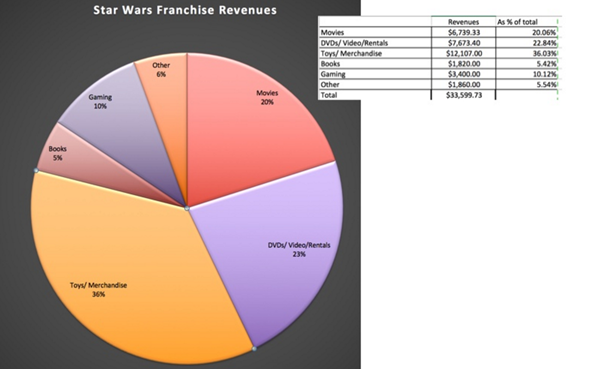
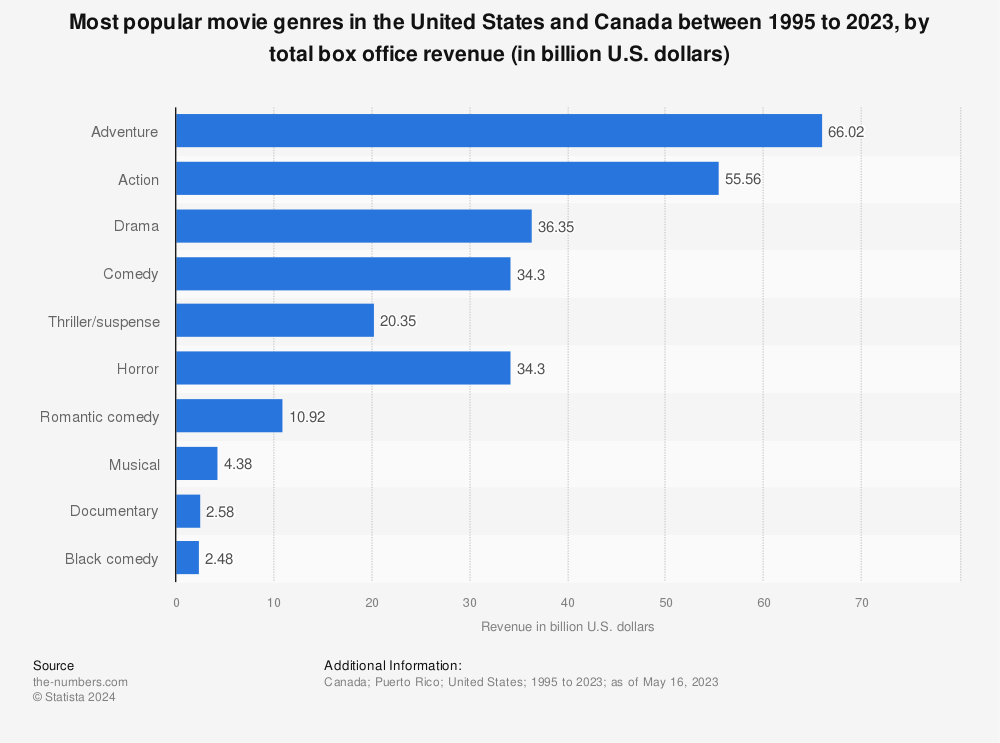
Not every movie has the merchandising potential of action films but they still have to pay careful attention to what audiences want to avoid having produced a run of flops and never get financing again.
That is not made any easier by the first law of Hollywood economics, which is nobody knows nothing. Audiences have a constant demand for novelty but they do not know what they want delay see it.
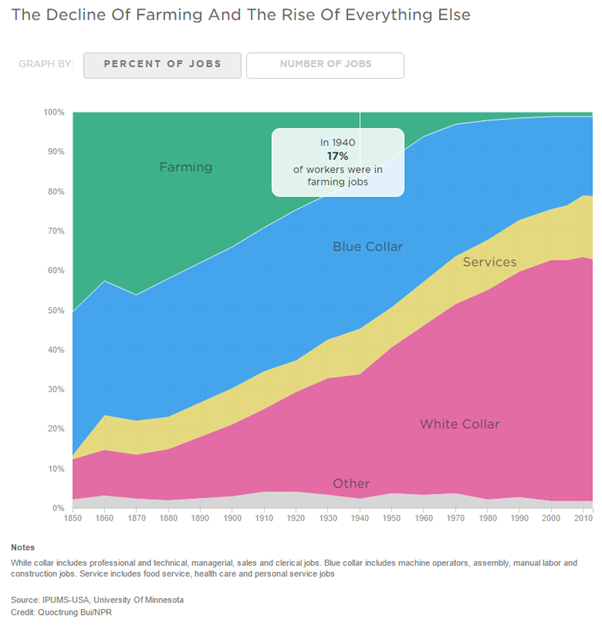
Where did all the farmers go when the tractors came from their jobs?
17 May 2016 1 Comment
in industrial organisation, labour economics, labour supply, survivor principle Tags: agricultural economics, creative destruction
Can private enterprise save our public lands?
17 May 2016 Leave a comment
in applied price theory, applied welfare economics, environmental economics, industrial organisation, privatisation, survivor principle Tags: economics of national parks
Profits Are Progressive
10 May 2016 Leave a comment
in applied price theory, economics of media and culture, entrepreneurship, industrial organisation, survivor principle, theory of the firm Tags: anti-market bias, entrepreneurial alertness, profit and loss, rational irrationality, superstars
The economics of Bollywood
10 May 2016 Leave a comment
in economics of media and culture, industrial organisation, survivor principle Tags: Hollywood economics
Common response to new technology: "Commercial Use In Doubt"
08 May 2016 Leave a comment
in economic history, industrial organisation, survivor principle, technological progress Tags: creative destruction, economics of television, entrepreneurial alertness, pessimism bias
John Sculley on the ‘myth’ of home computer market “it doesn’t exist”
08 May 2016 Leave a comment
in economic history, entrepreneurship, industrial organisation, survivor principle Tags: creative destruction, pessimism bias
Creative destruction in top ICT company pay
05 May 2016 Leave a comment
in human capital, industrial organisation, labour economics, labour supply, occupational choice, survivor principle Tags: Apple, CEO pay, creative destruction, entrepreneurial alertness, Facebook, Google, Microsoft, superstar wages, superstars, top 1%, Twitter, Uber, Yahoo
I am surprised to see that Yahoo is in business much less competing for top talent. Microsoft is in decline too. Apple does not pay people as much as everybody else.
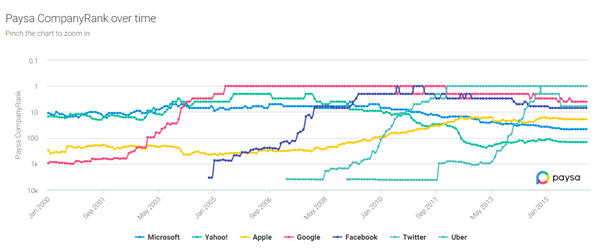
Source: Paysa Company Rank | Paysa.
Some other colours seem to duplicate so you will have to work out which is which by when they exploded in hiring top talent.
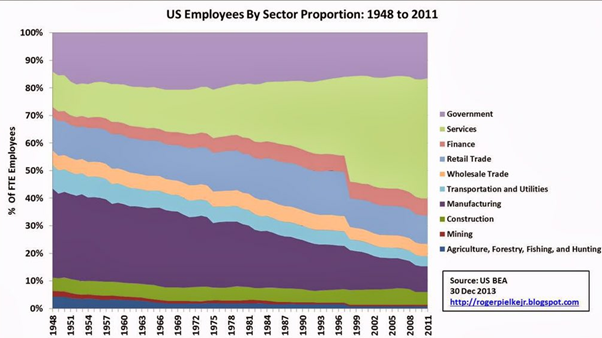
Jobs in the US economy as a percentage of total.
01 May 2016 Leave a comment
in economic history, industrial organisation, labour economics, labour supply, survivor principle Tags: labour demographics
Two myths about multinationals by Tyler Cowen
30 Apr 2016 Leave a comment
in comparative institutional analysis, development economics, economics, economics of media and culture, entrepreneurship, growth disasters, growth miracles, industrial organisation, survivor principle Tags: multinational corporations
“Bourgeois Equality” lecture
28 Apr 2016 Leave a comment
in applied welfare economics, development economics, economic history, economics, economics of regulation, entrepreneurship, growth disasters, growth miracles, history of economic thought, industrial organisation, poverty and inequality, survivor principle Tags: Deirdre McCloskey, industrial revolution, The Great Enrichment
Why Private Investment Works & Govt. Investment Doesn’t
27 Apr 2016 1 Comment
in applied price theory, comparative institutional analysis, constitutional political economy, economic history, economics of media and culture, economics of regulation, industrial organisation, survivor principle Tags: industry policy, picking winners, The fatal conceit, The pretence to knowledge
 Utopia, you are standing in it!
Recent Comments