Selfishly Speaking, Who Should Skip College?

The central thesis of my The Case Against Education is that actually-existing education is a terrible waste of taxpayer money. Since signaling, not building human capital, is the main function of education, the main effect of government subsidies is credential inflation. In economic jargon, my claim is that education has a low (indeed, negative) social…

Selfishly Speaking, Who Should Skip College?

David Friedman on Modern Economics, Austrian Economics, and Uncertainty

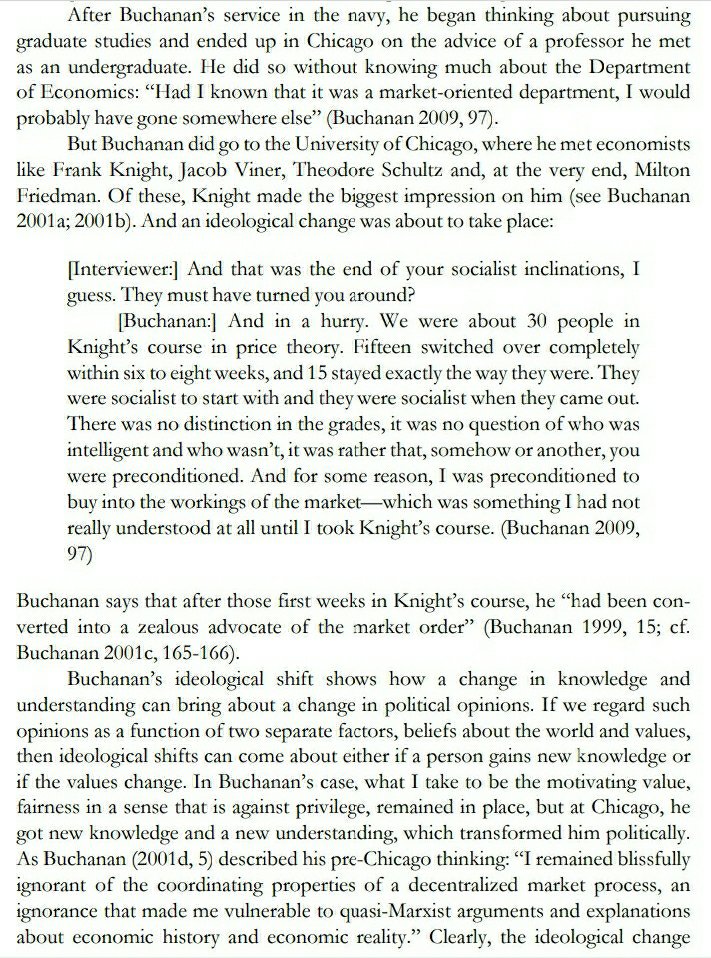
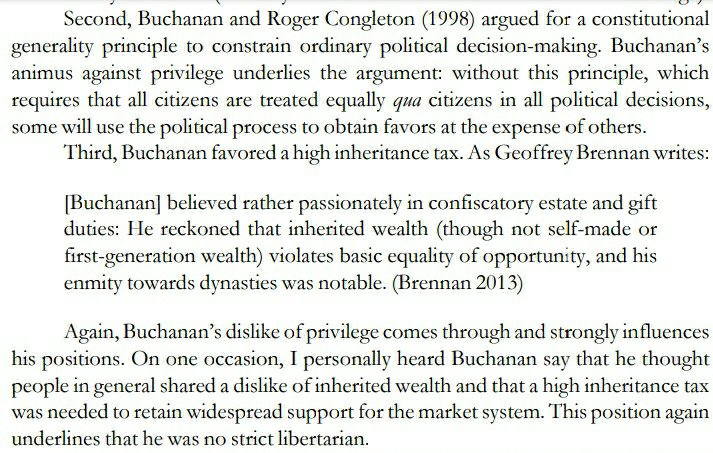
Recovering socialist James Buchanan on eating the rich

Image

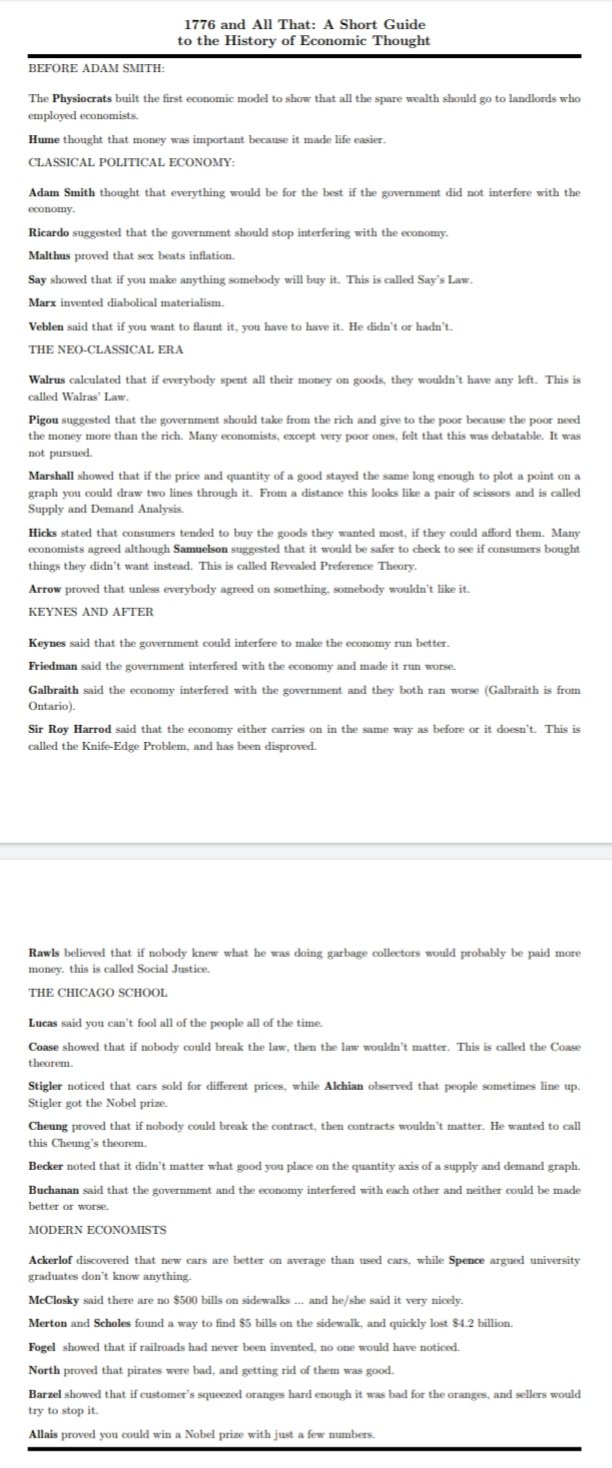
Econ101 is unsafe for socialists

Image

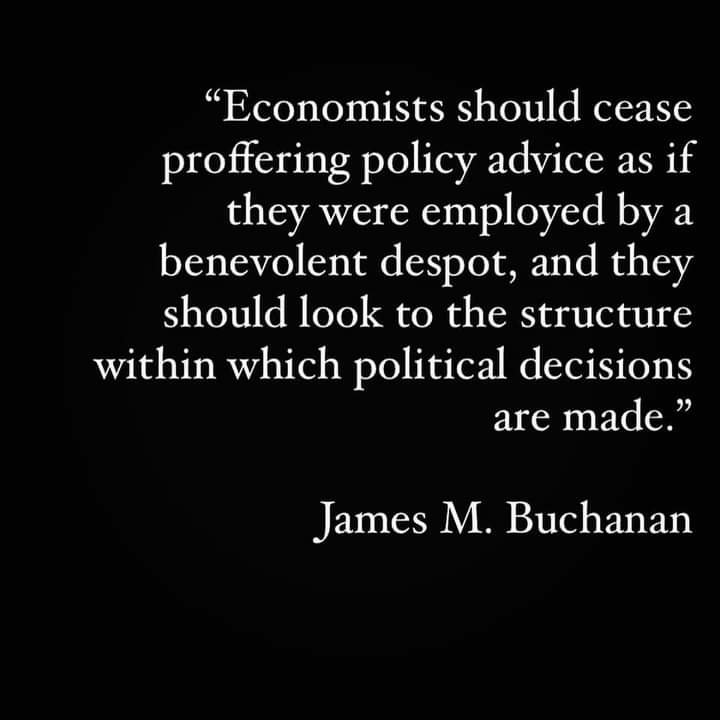
What should public service economists do?

Good summary

Friedrich von Hayek and James Buchanan Part II (S1010) – Full Video

James M. Buchanan: Antitrust and Politics as a Process

Gordon Tullock and James Buchanan: The Calculus of Consent After 25 Years

PRC Forum: James Buchanan (U1026) – Full Video

More reversing gender gaps

Nancy MacLean: The GOP’s Long Game |also #OTD 3rd US libertarian elected (a town mayor)

James Buchanan couldn’t lead a political revolution because he was such a dry writer and boring speaker.

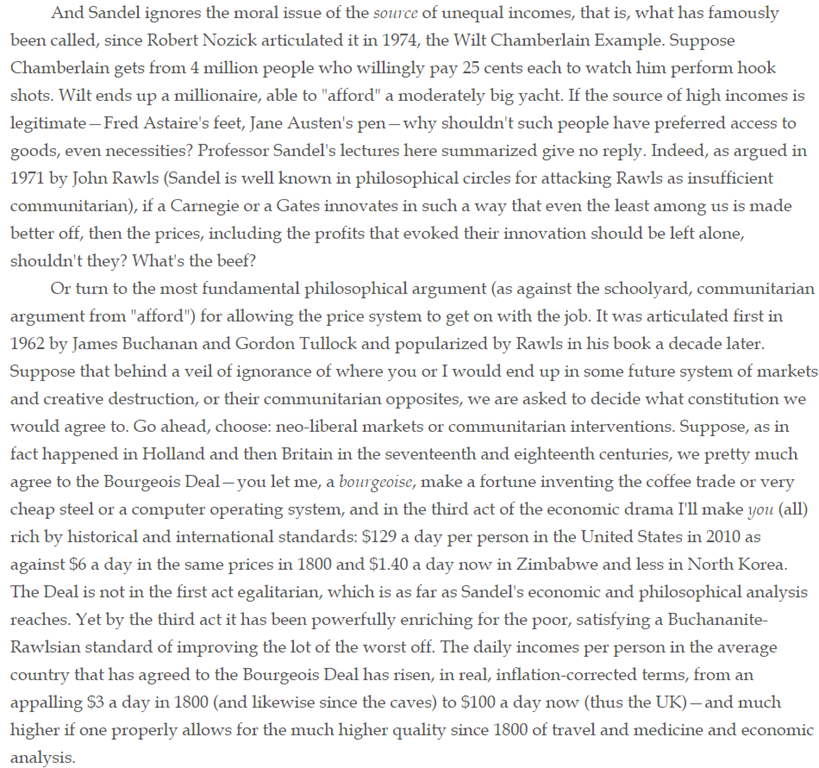
Deirdre McCloskey summarises Rawls and Nozick on unequal incomes

image

Source: Review of Michael J. Sandel’s What Money Can’t Buy: The Moral Limit of Markets by Deirdre McCloskey August 1, 2012. Shorter version published in the Claremont Review of Books XII(4), Fall 2012 via Deirdre McCloskey: editorials.

Who do members of parliament represent?

Delegate - selected for perfect obedience

The theoretical literature on political representation focused on whether representatives should act as delegates or as trustees. James Madison articulated a delegate conception of representation. Representatives who are delegates simply follow the expressed preferences of their constituents.

The classical liberals of the 18th century were highly sceptical about the capability and willingness of politics and politicians to further the interests of the ordinary citizen, and thought the political direction of resource allocation retards rather than facilitates economic progress.

Governments were considered to be institutions to be protected from but made necessary by the elementary fact that all persons are not angels. Constitutions were a means to constrain collective authority. The problem of constitutional design was ensuring that government powers would be effectively limited.

  • Sovereignty was split among several levels of collective authority; federalism was designed to allow for a deconcentration or decentralization of coercive state power.
  • At each level of authority, separate branches of government were deliberately placed in continued tension, one with another.
  • The dominant legislative branch was further restricted by the constitutional establishment of two houses bodies, each of which was elected on a separate principle of representation.

These constitutions were designed and put in place by the classical liberals to check or constrain the power of the state over individuals. The motivating force was never one of making government work better or even of insuring that all interests were more fully represented.

Members of parliament as trustees are representatives who follow their own understanding of the best action to pursue in another view. As Edmund Burke wrote:

Parliament is not a congress of ambassadors from different and hostile interests; which interests each must maintain, as an agent and advocate, against other agents and advocates; but parliament is a deliberative assembly of one nation, with one interest, that of the whole; where, not local purposes, not local prejudices ought to guide, but the general good, resulting from the general reason of the whole.

You choose a member indeed; but when you have chosen him, he is not a member of Bristol, but he is a member of parliament. …

Our representative owes you, not his industry only, but his judgment; and he betrays instead of serving you if he sacrifices it to your opinion.

Burke does not seem to be a fan of federalism and vote trading to protect minorities. Madison liked conflict and tension as a constraint of power and the size of government.

Schumpeter disputed that democracy was a process by which the electorate identified the common good, and that politicians carried this out:

• The people’s ignorance and superficiality meant that they were manipulated by politicians who set the agenda.

• Democracy is the mechanism for competition between leaders.

• Although periodic votes legitimise governments and keep them accountable, the policy program is very much seen as their own and not that of the people, and the participatory role for individuals is usually severely limited.

Modern democracy is government subject to electoral checks. John Stuart Mill had sympathy for this view that parliaments are best suited to be places of public debate on the various opinions held by the population and to act as watchdogs of the professionals who create and administer laws and policy:

Their part is to indicate wants, to be an organ for popular demands, and a place of adverse discussion for all opinions relating to public matters, both great and small; and, along with this, to check by criticism, and eventually by withdrawing their support, those high public officers who really conduct the public business, or who appoint those by whom it is conducted

Representative democracy has the advantage of allowing the community to rely in its decision-making on the contributions of individuals with special qualifications of intelligence or character. Representative democracy makes a more effective use of resources within the citizenry to advance the common good.

Politics without romance

Image

Previous Older Entries

Bassett, Brash & Hide

Celebrating humanity's flourishing through the spread of capitalism and the rule of law

Truth on the Market

Scholarly commentary on law, economics, and more

The Undercover Historian

Beatrice Cherrier's blog

Matua Kahurangi

Celebrating humanity's flourishing through the spread of capitalism and the rule of law

Temple of Sociology

Celebrating humanity's flourishing through the spread of capitalism and the rule of law

Velvet Glove, Iron Fist

Celebrating humanity's flourishing through the spread of capitalism and the rule of law

Why Evolution Is True

Why Evolution is True is a blog written by Jerry Coyne, centered on evolution and biology but also dealing with diverse topics like politics, culture, and cats.

Down to Earth Kiwi

Celebrating humanity's flourishing through the spread of capitalism and the rule of law

NoTricksZone

Celebrating humanity's flourishing through the spread of capitalism and the rule of law

Homepaddock

A rural perspective with a blue tint by Ele Ludemann

Kiwiblog

DPF's Kiwiblog - Fomenting Happy Mischief since 2003

The Dangerous Economist

Celebrating humanity's flourishing through the spread of capitalism and the rule of law

Watts Up With That?

The world's most viewed site on global warming and climate change

The Logical Place

Tim Harding's writings on rationality, informal logic and skepticism

Doc's Books

A window into Doc Freiberger's library

The Risk-Monger

Let's examine hard decisions!

Uneasy Money

Commentary on monetary policy in the spirit of R. G. Hawtrey

Barrie Saunders

Thoughts on public policy and the media

Liberty Scott

Celebrating humanity's flourishing through the spread of capitalism and the rule of law

Point of Order

Politics and the economy

James Bowden's Blog

A blog (primarily) on Canadian and Commonwealth political history and institutions

Science Matters

Reading between the lines, and underneath the hype.

Peter Winsley

Economics, and such stuff as dreams are made on

A Venerable Puzzle

"The British constitution has always been puzzling, and always will be." --Queen Elizabeth II

The Antiplanner

Celebrating humanity's flourishing through the spread of capitalism and the rule of law

Bet On It

Celebrating humanity's flourishing through the spread of capitalism and the rule of law

History of Sorts

WORLD WAR II, MUSIC, HISTORY, HOLOCAUST

Roger Pielke Jr.

Undisciplined scholar, recovering academic

Offsetting Behaviour

Celebrating humanity's flourishing through the spread of capitalism and the rule of law

JONATHAN TURLEY

Res ipsa loquitur - The thing itself speaks

Conversable Economist

Celebrating humanity's flourishing through the spread of capitalism and the rule of law

The Victorian Commons

Researching the House of Commons, 1832-1868

The History of Parliament

Articles and research from the History of Parliament Trust

Books & Boots

Reflections on books and art

Legal History Miscellany

Posts on the History of Law, Crime, and Justice

Sex, Drugs and Economics

Celebrating humanity's flourishing through the spread of capitalism and the rule of law

European Royal History

Exploring the Monarchs of Europe

Tallbloke's Talkshop

Cutting edge science you can dice with

Marginal REVOLUTION

Small Steps Toward A Much Better World

NOT A LOT OF PEOPLE KNOW THAT

“We do not believe any group of men adequate enough or wise enough to operate without scrutiny or without criticism. We know that the only way to avoid error is to detect it, that the only way to detect it is to be free to inquire. We know that in secrecy error undetected will flourish and subvert”. - J Robert Oppenheimer.

STOP THESE THINGS

The truth about the great wind power fraud - we're not here to debate the wind industry, we're here to destroy it.

Lindsay Mitchell

Celebrating humanity's flourishing through the spread of capitalism and the rule of law

Alt-M

Celebrating humanity's flourishing through the spread of capitalism and the rule of law

croaking cassandra

Economics, public policy, monetary policy, financial regulation, with a New Zealand perspective

The Grumpy Economist

Celebrating humanity's flourishing through the spread of capitalism and the rule of law

International Liberty

Restraining Government in America and Around the World