The rise and rise of mothers as breadwinners
05 May 2015 Leave a comment
in economics of love and marriage, gender, labour economics, labour supply, occupational choice Tags: female labour supply, gender wage gap, household division of labour, maternal labour supply
Labour stays silent over gender segregation at party rally
05 May 2015 Leave a comment
in discrimination, election campaigns, gender Tags: British general election, Left-wing hypocrisy, sex discrimination, UK politics
Labour stays silent over gender segregation at party rally specc.ie/1QcJHJf via @spectator http://t.co/Qs2FZV9Z7e—
Steerpike (@MrSteerpike) May 03, 2015
Up to a thousand expected at the great Labour Rally tomorrow at 4.00 being organised by @ansar_ali_khan http://t.co/Paec01bT8c—
Jack Dromey (@JackDromeyMP) May 01, 2015
Women are winning the human capital race | Kevin M. Murphy and Robert H. Topel
04 May 2015 Leave a comment
in applied welfare economics, discrimination, economics of education, gender, human capital, labour economics, labour supply, occupational choice Tags: gender wage gap, reversing gender gap

Why have women outpaced men? There’s little cognitive difference between the sexes, and males do better on standardized tests.
But Murphy, Becker, and Hubbard argue that women tend to have better “non-cognitive skills” than men do. Those personal skills and character traits such as persistence, self-control, and conscientiousness may help women excel academically and stay in school until they graduate.
The academic achievement gap actually starts before college: 25 percent more females than males took high-school advanced-placement tests in 2010, the Cleveland Fed economists find.
“There is a substantial gap between the measured high school performance of males and females,” Topel and Murphy write in a 2014 study, noting that female graduating high school seniors have, as a group, higher grade point averages than their male counterparts. “This high school gender gap in academic performance persists in the population that continues on to college.”
via Women are winning the human capital race | The University of Chicago Booth School of Business.
What is assortative mating?
02 May 2015 Leave a comment
in discrimination, economics of education, economics of love and marriage, gender, human capital, labour economics, labour supply, law and economics, occupational choice Tags: assortative mating
#Dailychart: Sex and money: How women's equality increases wealth inequality. econ.st/1kCYG1R http://t.co/dfrYJs4vBs—
The Economist (@ECONdailycharts) February 13, 2014
The wage stagnation that dare not speak its name
30 Apr 2015 Leave a comment
in discrimination, gender, labour economics, occupational choice Tags: gender analysis, gender wage gap, media bias, reversing gender gap, wage stagnation

The gender wage gap reverses at below 40 hours a week
30 Apr 2015 Leave a comment
in discrimination, gender, human capital, labour economics, labour supply Tags: gender wage gap

The value of a stay at home mum
29 Apr 2015 Leave a comment
in discrimination, gender, labour economics, labour supply Tags: family demographics, household production, marital division of labour
Why is the rapid closing of the gender wage gap in New Zealand not celebrated more?
27 Apr 2015 1 Comment
in discrimination, gender, human capital, labour economics, labour supply, occupational choice, politics - New Zealand Tags: activists, do gooders, gender wage gap, Left-wing hypocrisy, Leftover Left
With the rapid closure in the raw female male wage gap in New Zealand over the last 15 or so years, the lack of celebration of this achievement among equal pay activists is puzzling.
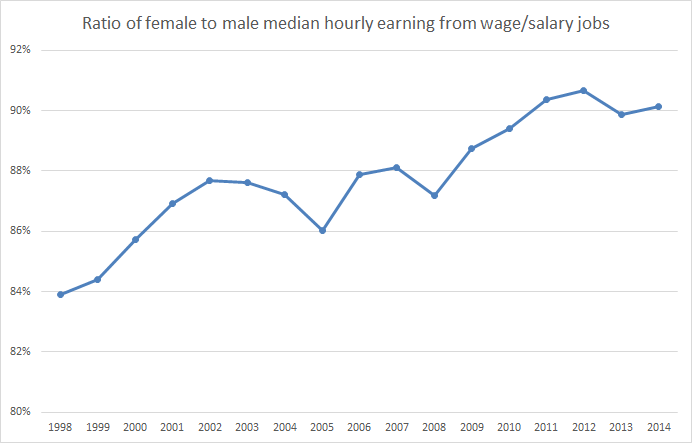
Source: Statistics New Zealand, New Zealand Social indicators, Median hourly earnings.
Gender differences in celebrity charity causes
27 Apr 2015 Leave a comment
in economics of media and culture, gender Tags: Celebrities, charities, expressive politics, expressive voting
Gender differences in celebrity charity causes, visualized f-st.co/V1NMVE6 http://t.co/czkuRlWzKF—
Co.Design (@FastCoDesign) January 20, 2015
The changing American family
24 Apr 2015 3 Comments
in economics of love and marriage, gender, labour economics, labour supply, poverty and inequality, welfare reform Tags: family demographics, single parents


via Was Moynihan Right? What happens to the children of unmarried mothers : Education Next
The reversed college gender gap
23 Apr 2015 Leave a comment
in discrimination, economics of education, gender, human capital, labour economics, labour supply, occupational choice Tags: gender wage gap reversed gender gap
CHART: The Huge College Degree Gender Gap: Since 1982, Women Have Earned ~10M MORE US College Degrees Than Men! http://t.co/83JhRfwCLE—
Mark J. Perry (@Mark_J_Perry) March 11, 2015

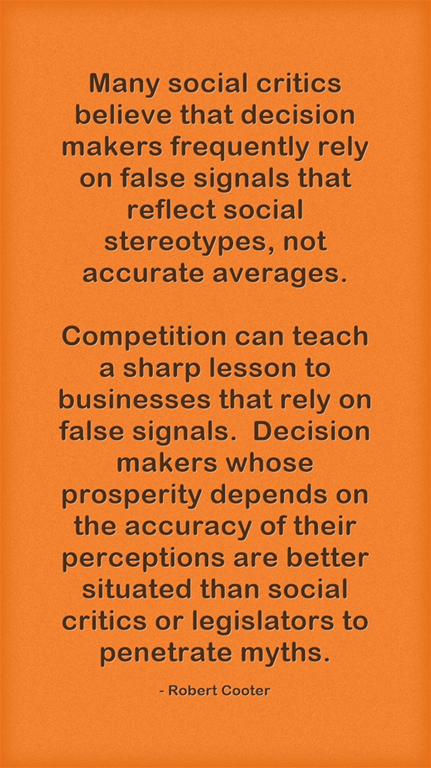
The comparative institutional analysis of stereotypes
21 Apr 2015 Leave a comment
in applied price theory, discrimination, economics of bureaucracy, entrepreneurship, gender, industrial organisation, labour economics, Public Choice, survivor principle Tags: labour market discrimination, markets selection, signaling and screening, stereotypes, The meaning of competition
Stay-at-home moms are poorer, less educated than working moms
18 Apr 2015 4 Comments
in gender, labour economics, labour supply, occupational choice, poverty and inequality, unemployment, welfare reform Tags: child poverty, demographics, family, single parents


Feminism row erupts over Paul Henry comments – They have the Internet on computers now version
16 Apr 2015 Leave a comment
in discrimination, gender, politics - New Zealand
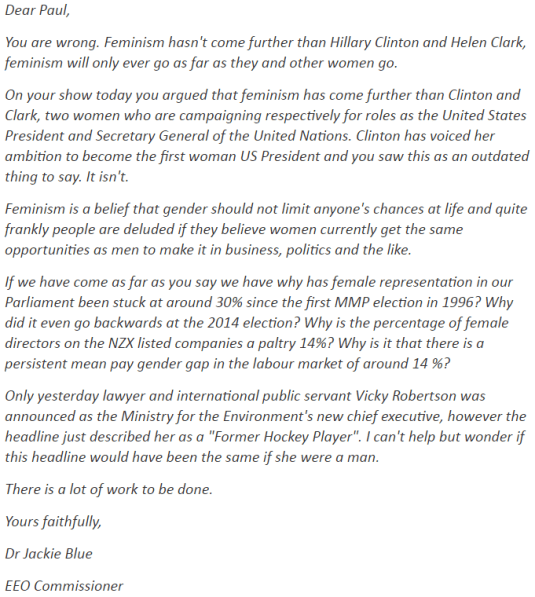
Jackie Blue, despite the resources of the Human Rights Commission, did not Google her own web site for the biography of the Chief Commissioner of the Human Rights Commission.

KiwiBlog has noted that the headline of “Ex All Black becomes Chief Executive” is common with David Kirk referred to as an ex All Black despite a successful business career.


Recent Comments