The reversing gender gap in education

The difference in reading and verbal skills between girls and boys at the age of 15 is equal to 6-months extra schooling. Six months schooling explains a lot of the wage gaps with a long ethnic, racial and previously on gender lines.

Not surprisingly, fewer women do science and engineering degrees because their superior reading and verbal skills qualify them for medicine and other sciences that take advantage of these talents.

Piketty and Pension Fund Socialism

alt

Any attack on capitalism these days is a direct attack of the retirement savings of ordinary workers. We live in the age of  what Peter Drucker called pension fund socialism in 1976. As Drucker added in 1991:

The rise of pension funds as dominant owners and lenders represents one of the most startling power shifts in economic history.

The first modern pension fund was established in 1950 by General Motors.

Four decades later, pension funds control total assets of $2.5 trillion, divided about equally between common stocks and fixed-income securities. Demographics guarantee that these assets will grow aggressively for at least another ten years.

The majority of equity capital is owned by pension funds and other collective investment vehicles corralling the savings of ordinary people. Much of the rest of physical capital is owned by workers through home ownership.

In the age of human capital, 70-90% of all capital in the economy is human capital. The notion of unskilled workers labouring away with the capital supplied by the bosses is 19th century throwback.

The rentier rich has been long replaced by the working rich. They make their fortunes in their own life times – sometimes as business entrepreneurs, sometimes through rent-seeking.

It is also the age of specific human capital, with a proliferation of technologies and products. The rising specialisation of firms and their production inputs has forced firms to try harder to find those inputs that suit their needs best. Management has the task of finding the right inputs. The role and reward to managers has therefore risen.

When the rise in returns on investments in human capital is beneficial and desirable, and policies designed to deal with inequality must take account of its cause. Growth in education levels has been a significant source of rising wages, productivity, and living standards over the past century.

The initial impact of higher returns to human capital is wider inequality in earnings, but that impact becomes more muted and may be reversed over time as young people invest more in their human capital.

The rentier class has been replaced by the working rich. The evidence on the top 1% is most consistent with theories of superstars, skill biased technological change, greater scale and their interaction of these factors.

Individuals who are really good at making money can now apply their skills to larger amounts of capital and reach far larger audiences  and markets for their products and services. That favours CEOs, athletes, celebrities, corporate lawyers, successful entrepreneurs and other working rich Who have a skill  or talent that can be supplied at little cost on a much larger scale. Some have a special dark place in their hearts for people who earned their money through honest hard work.

How 15-year-olds score at problem solving

Image

Adam Smith as a pioneering labour economist

Adam Smith anticipated much of labour economics by basing it on his principle that individuals invest resources to earn the highest possible return. All uses of a resource must yield an equal rate of return adjusted for relative riskiness for otherwise reallocation would result.

The whole of the advantages and disadvantages of the different employments of labour and stock must, in the same neighbourhood, be either perfectly equal or continually tending to equality.

If in the same neighbourhood, there was any employment evidently either more or less advantageous than the rest, so many people would crowd into it in the one case, and so many would desert it in the other, that its advantages would soon return to the level of other employments.

Smith used this insight on  be equality of returns to explain why wage rates differed. Workers care about the whole aspects of the job, not only the cash wage payment: it is the “whole advantages and disadvantages” of the job that is equated across jobs in a competitive market, not wage alone. Smith set out criteria that determined how wages compensated or were discounted for the different characteristics of specific jobs:

  1. the agreeableness or disagreeableness of the employments themselves: better for more enjoyable working conditions will lead an individual to accept lower wages for their labour. Likewise, unpleasant work will have a higher wage. Wages vary with the ease or hardship, the cleanliness or dirtiness, the honourableness or dishonourableness of a job.
  2. The easiness and cheapness, or the difficulty and expense of learning them: jobs that are difficult or time-intensive to learn will pay more. Those who invest the time are being compensated for their additional effort with higher wages. The opportunity cost of forgoing the time-spent in training will be compensated for through higher wages. The difference between the wages of skilled labour and common labour is founded upon this principle.
  3. The constancy or inconstancy of employment: workers who face only partial or inconsistent employment throughout the course of the year, such as seasonal workers of agriculture, must be paid more for their labour. Their wages carry them not only during times of employment, but also during times of unemployment.
  4. The small or great trust which must be reposed in those who exercise them: individuals who have high levels of responsibility  in their jobs will be compensated with higher wages.
  5. The probability or improbability of success: this is an entrepreneurial element in wages. Employment where the chance of success is high will be paid lower than those who take more risks. If individuals were not compensated for risk, there would lack an incentive to seek employment that may not be successful.

The supply and demand for labour in different industries  determines relative wages and the relative numbers of employees in different occupations. Individuals are willing to make a trade-off between less desirable occupations and increased income. Smith spoke of how these five circumstances  listed above  lead to considerable inequalities in the wages and profits.

George Stigler thought that the second greatest triumph of Adam Smith in his Wealth of Nations was his famous list of cost factors that generate apparent but not real differences in rates of wages and profits because of training, hardships, unemployment, risk and trust. This list was quoted almost verbatim by his successors  down to this day and is the direct ancestor of both Alfred Marshall’s famous chapters on wages and of the modern theory of human capital.

Teachers count

Image

Gender and education: Have American boys been left behind? – Christina Hoff Sommers

via Gender and education: Have American boys been left behind? – YouTube.

Charles Murray on the educational romanticism of the Left and of the Right

HT: http://www.aei.org/publication/the-age-of-educational-romanticism/

Piketty: A Wealth of Misconceptions by Don Boudreaux

Piketty’s method of doing economics involves frequent grand proclamations about "social justice" and economic "evolutions," but he offers no analyses of the dynamics of individual decision-making, often referred to as "microeconomics," that should be central to the issues he raises…

Revealingly, Piketty writes of income and wealth as being claimed or "distributed," never as being earned or produced. The resulting statistics are too aggregated—too big-picture—to reveal what is happening to individuals on the ground…

He imagines that such aggregates interact in robotic fashion through a logic of their own, unmoved by individual human initiative, creativity, or choice…

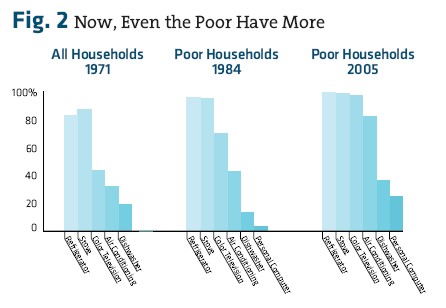
If we follow the advice of Adam Smith and examine people’s ability to consume, we discover that nearly everyone in market economies is growing richer…

THE U.S. IS THE bête noir of Piketty and other progressives obsessed with monetary inequality.

But middle-class Americans take for granted their air-conditioned homes, cars, and workplaces—along with their smartphones, safe air travel, and pills for ailments ranging from hypertension to erectile dysfunction…

At the end of World War II, when monetary income and wealth inequalities were narrower than they’ve been at any time in the past century, these goods and services were either available to no one or affordable only by the very rich.

So regardless of how many more dollars today’s plutocrats have accumulated and stashed into their portfolios, the elite’s accumulation of riches has not prevented the living standards of ordinary people from rising spectacularly…

Piketty’s disregard for basic economic reasoning blinds him to the all-important market forces at work on the ground—market forces that, if left unencumbered by government, produce growing prosperity for all. Yet, he would happily encumber these forces with confiscatory taxes.

via Piketty: A Wealth of Misconceptions – Barron’s.

The Death of the Renaissance Man?

Ben Jones in ‘The Burden of Knowledge and the Death of the Renaissance Man: Is Innovation Getting Harder? found that as knowledge accumulates as technology advances, successive generations of innovators may face an increasing educational burden.

Innovators can compensate through lengthening their time in education and narrowing expertise, but these responses come at the cost of reducing individual innovative capacities.

This has implications for the organization of innovative activity – a greater reliance on teamwork – and has negative implications for economic growth.

Jones found that the age at first invention, specialisation, and teamwork increased over time in a large micro-data set of inventors. Upward trends in academic collaboration and lengthening doctorates can also be explained in his framework.

Using data on Nobel Prize winners, Jones found that the mean age at which the innovations are produced to win the Prize has increased by 6 years over the 20th Century.

  • Before 1901, two-thirds of the Nobel laureates did their prize-winning work before the age of 40 and 20 per cent did it before age of 30.
  • By 2000, however, great achievements seldom occurred before the age of 40.

It’s now taking longer for scientists to get their basic training and start their careers. There is simply more to learn because knowledge in all fields has grown by quantum leaps in the past century.

Nobels are being handed out for different types of work than a century ago.

  • There has been a trend away from awarding prizes for abstract, theoretical ideas.
  • Now more honours are being bestowed on people who have made discoveries through painstaking lab work and experimentation – which takes a lot of time to do.

Jones’ theory provides an explanation for why productivity growth rates did not accelerate through the 20th century despite an enormous expansion in collective research effort and levels of education and many more graduates.

The more experienced readers of this blog might remember that the better of their professors seemed to be masters of the entire field of economics and could teach almost any subject.

These days, too many professors rely on textbooks with annual editions that come with the lecture notes, assignments and test-banks written for them by the publishing company.

Are there any polymaths left? Posner? Tullock?

Bill Gates “pre-reviewed” Piketty years ago

Bill Gates once said:

You take away the top 20 employees of Microsoft, we’ll just be an ordinary company. Top employees are what makes us.

File:Dts news bill gates wikipedia.JPG

via Gary Becker on Human Capital | Atanu Dey On India’s Development.

President Obama’s persistent ’77-cent’ claim on the wage gap gets a new Pinocchio rating–updated

http://www.washingtonpost.com/blogs/fact-checker/wp/2014/04/09/president-obamas-persistent-77-cent-claim-on-the-wage-gap-gets-a-new-pinocchio-rating/

The fact checker at the Washington Post said:

Few experts dispute that there is a wage gap, but differences in the life choices of men and women — such as women tending to leave the workforce when they have children — make it difficult to make simple comparisons.

…From a political perspective, the Census Bureau’s 77-cent figure is golden. Unless women stop getting married and having children, and start abandoning careers in childhood education for naval architecture, this huge gap in wages will almost certainly persist. Democrats thus can keep bringing it up every two years.

…There appears to be some sort of wage gap and closing it is certainly a worthy goal. But it’s a bit rich for the president to repeatedly cite this statistic as an “embarrassment.” …The president must begin to acknowledge that “77 cents” does not begin to capture what is actually happening in the work force and society.


In premiere episode of ‘Factual Feminist’ Christina Sommers explains how the gender wage gap is based on bogus statistics

The Case Against Education – Bryan Caplan–updated with Japanese evidence

Bryan Caplan  says that:

When you actually experience education, though, it’s hard not to notice that most classes teach no job skills.

The labour market heavily rewards educational credentials even though academic curriculum is seriously disconnected from the jobs people actually do.

The best explanation for this strange fact is that education is a strong signal of pre-existing worker productivity.

Caplan argues with annoying persuasiveness that education signals desirable employee traits such as intelligence, conscientiousness, conformity and a willingness to learn boring things:

  • Most education is for sending a signal to employers that you can jump through hoops to show off your IQ, work ethic, and conformity.
  • Schools and universities do not to produce wisdom, information, critical thinking or human capital.
  • Subsidising education creates an arms race of credentialism as each student attempts to acquire more and more education than their rival job applicants.

His particular focus is the educational psychology literature on the transfer of learning. That literature started long ago with the question did learning Latin give you muscle to learn other subjects. The educational psychology literature  has been looked at the transfer of learning for 100 years.

Educational psychologist found that Latin does not help much in studying other languages and other subjects. No significant differences were found in deductive and inductive reasoning or text comprehension among students with 4 years of Latin, 2 years of Latin, and no Latin at all.

The trouble is you do this in a race and many try to win the race by lengthening the race by going to and spending more time at university such as taking honours and master’s degrees etc.

Grades do not signal anything in Japan because everyone graduates with an A. It is the lecturer’s fault if you fail.

Japanese universities and employers make up for this everyone gets a A with strict entrance exams.

Getting into a top university signals intelligence and conscientiousness in preparing for their entrance exam. Few go to graduate school in Japan, preferring to learn more on the job.

Japanese students are lazy because everyone passes and therefore grades signal little in the way of intelligence, conscientiousness, conformity to employers.

I had great trouble getting my Japanese students to come to class. Other lecturers got around this by giving marks for attendance and replacing final exams with a pop quiz at the start of every class.

Nonetheless, something of value is acquired through 4-years at a Japanese university because otherwise why not skip straight from passing a university entrance exam to the employer exams.

The crucial objection to Caplan is that if most education expenditures are primarily about signalling, it should be possible to find other, cheaper ways to signal desirable traits to employers. As Bill Dickens noted:

For one thing I find it very hard to believe that we would waste so many resources on a nearly unproductive enterprise.

There are plenty of entrepreneurs out there trying to make money by selling cheaper, in time and money, versions of education and they aren’t very successful.

Mainstream schools have experimented with programmed learning, lectures on video, self-paced learning, etc. and none of the methods have caught on. Why wouldn’t they if they worked?

The spread of charter schools is an example of the rapid diffusion of an educational innovation valued by parents.

A major driver of the doubling of college tuition fees in the U.S. is demand for greater quality. As Becker and Murphy explain:

Indeed, it appears that the increases in tuition were partly induced by the greater return to col­lege education. Pablo Peña, in a Ph.D. dissertation in progress at the University of Chicago, argues con­vincingly that tuition rose in part because students want to invest more in the quality of their education, and increased spending per student by colleges is partly financed by higher tuition levels

What specific and general skills are learnt at school and at university matters too, as Bill Dickens explains:

Education isn’t mainly about learning specific subject matter.

Rather education is mainly about practicing the sort of self-discipline that is necessary to be productive in a modern work environment.

High school allows you to practice showing up on time and doing what you are told.

College allows you to practice and work out techniques that work for you that allow you to take on and complete on time complicated multi-part tasks in an environment where you have considerable freedom about how you spend your time.

Some people may be more talented than others at this sort of thing (you come to mind as someone who is particularly talented at self-discipline), but this is also an acquired skill that one can develop with practice, and everyone needs to develop certain work habits that make one more productive at both types of tasks.

The debate really turns on the extent to which it is possible to find easier and cheaper ways to signal conscientiousness and conformity. As Bill Dickens noted as his fall-back position, which is based on comparative institutional analysis:

most of the return to education is due to it signalling desirable characteristics, but that there is no more efficient way to sort the capable from the incapable.

I also think that signalling performs a valuable sorting function that no alternative process can out-compete. But, as Caplan notes, a conventional education benefits from large government and private subsidies as compared to other sorting devices.

Table of Contents – The Case Against Education – Bryan Caplan

Introduction

Chapter 1: The Magic of Education

Chapter 2: Useless Studies with Big Payoffs: The Puzzle Is Real

Chapter 3: Signalling Explained

Chapter 4: Measuring Signalling

Chapter 5: Who Cares If It’s Signalling? The Private, Familial, and Social Returns to Education

Chapter 6: Is Education Good for the Soul?

Chapter 7: We Need Lots Less Education

Chapter 8: We Need More Vocational Education

Conclusion

The Book’s basic plot:

The labor market heavily rewards educational credentials even though academic curriculum is seriously disconnected from the jobs people actually do.  The best explanation for this strange fact is that education is a strong signal of pre-existing worker productivity. (chapter 1)

While the return to education is often overstated, it remains high after making various statistical adjustments.  Degrees in useless subjects really do substantially raise wages. (chapter 2)

Education signals a package of desirable employee traits: intelligence of course, but also conscientiousness and conformity.  Many people dismiss the signalling model on a priori grounds, but educational signalling is at least as plausible as many widely accepted forms of of statistical discrimination. (chapter 3)

Empirically distinguishing signalling from human capital is notoriously difficult.  But literatures on the sheepskin effect, employer learning, and the international return to education confirm that signalling is moderately to highly important. (chapter 4)

How much education should you get?  The human capital-signalling distinction isn’t important at the individual level, but the policy implications are enormous. (chapter 5)

The non-pecuniary benefits of education are over-rated, and the non-pecuniary costs (especially boredom) are under-rated.  There’s a massive selection bias because the kind of people who hate school rarely publicize their complaints. (chapter 6)

The most important implication of the signalling model is that we spend way too much money on education.  Education spending at all levels should be drastically reduced, and people should enter the labor force at much younger ages. (chapter 7)

The education we offer should be more vocational.  Especially for weaker students, vocational education has a higher private and social return than traditional academic education. (chapter 8)

Caplan has also posted this nice topology below to allow you to select your starting point:

Model Effect of Education on Income Effect of Education on Productivity Notes
Pure Human Capital WYSIWYG

(What You See Is What You Get)

WYSIWYG Education may raise productivity by directly teaching job skills, but character formation, acculturation, etc. also count.
Pure Ability Bias Zero Zero “Ability” includes not just pre-existing intelligence, but pre-existing character, acculturation, etc.

Pure Ability Bias is observationally equivalent to a Pure Consumption model of education.

Pure Signalling WYSIWYG Zero Pure educational signalling can consist in (a) learning and retaining useless material, (b) learning but not retaining material regardless of usefulness, (c) simply wasting time in ways that less productive workers find relatively painful, leading to a positive correlation between education and productivity.
1/3 Pure Human Capital,
1/3 Pure Ability Bias,
1/3 Pure Signalling
2/3*WYSIWYG 1/3*WYSIWYG A good starting position for agnostics.
0.1 Pure Human Capital,
0.5 Pure Ability Bias,
0.4 Pure Signalling
.5*WYSIWYG .1*WYSIWYG Caplan’s preferred point estimates.  He knows they’re extreme, but his book will explain his reasons and try to win you over.

The economics of Dennis Lillee and Steve Jobs

Dennis Lillee was paid £1,200 to tour England in 1972 for five months. He was paid the same to tour for three months in 1975. Now a world-class fast bowling coach, he would probably not get out for bed for £1,200

dkl

When Kerry Packer bid for the Australian cricket rights in the 1970s, he offered $500,000 per year. That was about ten times what the ABC was paying at the time

The Australian cricket TV rights sold for over $500 million in 2013 for a 5-year deal.

Today’s international cricketers are millionaires – widely respected and beloved members of the top 1% of income earners. Most think it is great that top sports people make millions over their career. No plans for the Occupy Wall Street crowd to occupy the MCG, Wimbledon or the Olympics to complain about superstar sports salaries and prizes.

Lillee and other top athletes, celebrities, actors, musicians and entertainers are all paid much more for much the same reason that CEOs, money market managers, top lawyers and tech entrepreneurs are paid much more than in the past.

They are superstars who are able to leverage their talent through communications technology advances on a national and global level. They can apply ‘their talent to greater pools of resources and reach[ing] larger numbers of people thus becoming more productive and higher paid’.

  • Why is there envy over the pay of businessmen but not for superstar entertainers and athletes?
  • Did people boo World Series Cricket in 1977 because those cricketers could now make a decent living?
  • Do people complain when musicians and actors make it big?

Why is Steve Jobs strangely immune from top 1% envy despite his cheapness and meanness to others while Bill Gates is reviled as some sort of monopolist despite his giving most of his wealth away?

Was Jobs worth his pay? Apple shares went up and down in billions on news of Steve Jobs’s health.

When Hewlett Packard’s CEO Mark Hurd resigned unexpectedly, the value of HP shares dropped by about $10 billion! This makes his $30 million in annual compensation a bargain for his shareholders. Oracle’s shares rose 6% on word of Mr. Hurd’s hiring as co-president on an annual base salary of $950,000 and being eligible for up to a $10 million annual bonus. Perhaps he is under-paid?

See Kaplan, Steven N., and Joshua Rauh. 2013. It’s the Market: The Broad-Based Rise in the Return to Top Talent, Journal of Economic Perspectives 2013 for more.

If you are so smart, why aren’t you rich? MITI version

If you are so smart, why aren’t you rich? This is the American question – asked of MIT’s Paul Cootner by a money market manager in the 1960s.

Why do investment advisors sell and often give away their sage advice? If their insights were any good, they could trade on the share market before others caught on and make a killing!

Deirdre McCloskey wrote a book about the limits of economic expertise. For a summary, see http://www.deirdremccloskey.com/docs/pdf/Article_168.pdf.

I will give a personal example based on the skills of bureaucracies in picking winners. The test of my hypothesis is based on the transferability of human capital across jobs.

My graduate school professors in Japan included many retired bureaucrats from the Ministry of Finance and MITI. These agencies were heralded by Joe Stiglitz and others for picking winners and guiding Japanese companies to choose the right technologies and what to export.

The skills that my graduate school professors learned at picking winners over their careers with the Ministry of Finance and MITI in the high-growth years in the 1970s would now be available to them in their retirements to trade on their own account.

My graduate school professors should quickly become very rich after retiring because of the skills they learned in picking winners while at the Ministry of Finance and MITI, which should cross over into their private share portfolios. The rich lists world-wide should be full of retired industry and finance ministry bureaucrats.

Instead, my graduate school professors took the train and bus to work and their families lived off their salaries in standard sized Japanese government apartments. All looked forward to their annual bonus of 5.15 months salary.

If governments are any good at picking winners, people should be willing to pay big time to get jobs at ministries of finance and ministries of international trade and industry to get access to their unique and highly secret skills they learn therein on how to pick winners. I am still waiting for that tell-all book by an insider on these skills. Why is there no Picking Winners for Dummies on Amazon kindle as yet?

P.S. McCloskey argued that the advising industry lives off 19th century case law on directors’ and trustees’ duties. If you take advice – from an accountant, a lawyer or an economist – and the business or investment still fails, it can’t be your fault. You took advice.

P.P.S. Cootner’s reply was “If you’re so rich, why aren’t you smart?” The answer to this was Wall Street investment brokers didn’t have to be smart to get rich; they can make money off fees and brokerage commissions even when their investment advice stank. Didn’t you watch The Wolf of Wall Street?

Next Newer Entries

Bassett, Brash & Hide

Celebrating humanity's flourishing through the spread of capitalism and the rule of law

Truth on the Market

Scholarly commentary on law, economics, and more

The Undercover Historian

Beatrice Cherrier's blog

Matua Kahurangi

Celebrating humanity's flourishing through the spread of capitalism and the rule of law

Temple of Sociology

Celebrating humanity's flourishing through the spread of capitalism and the rule of law

Velvet Glove, Iron Fist

Celebrating humanity's flourishing through the spread of capitalism and the rule of law

Why Evolution Is True

Why Evolution is True is a blog written by Jerry Coyne, centered on evolution and biology but also dealing with diverse topics like politics, culture, and cats.

Down to Earth Kiwi

Celebrating humanity's flourishing through the spread of capitalism and the rule of law

NoTricksZone

Celebrating humanity's flourishing through the spread of capitalism and the rule of law

Homepaddock

A rural perspective with a blue tint by Ele Ludemann

Kiwiblog

DPF's Kiwiblog - Fomenting Happy Mischief since 2003

The Dangerous Economist

Celebrating humanity's flourishing through the spread of capitalism and the rule of law

Watts Up With That?

The world's most viewed site on global warming and climate change

The Logical Place

Tim Harding's writings on rationality, informal logic and skepticism

Doc's Books

A window into Doc Freiberger's library

The Risk-Monger

Let's examine hard decisions!

Uneasy Money

Commentary on monetary policy in the spirit of R. G. Hawtrey

Barrie Saunders

Thoughts on public policy and the media

Liberty Scott

Celebrating humanity's flourishing through the spread of capitalism and the rule of law

Point of Order

Politics and the economy

James Bowden's Blog

A blog (primarily) on Canadian and Commonwealth political history and institutions

Science Matters

Reading between the lines, and underneath the hype.

Peter Winsley

Economics, and such stuff as dreams are made on

A Venerable Puzzle

"The British constitution has always been puzzling, and always will be." --Queen Elizabeth II

The Antiplanner

Celebrating humanity's flourishing through the spread of capitalism and the rule of law

Bet On It

Celebrating humanity's flourishing through the spread of capitalism and the rule of law

History of Sorts

WORLD WAR II, MUSIC, HISTORY, HOLOCAUST

Roger Pielke Jr.

Undisciplined scholar, recovering academic

Offsetting Behaviour

Celebrating humanity's flourishing through the spread of capitalism and the rule of law

JONATHAN TURLEY

Res ipsa loquitur - The thing itself speaks

Conversable Economist

In Hume’s spirit, I will attempt to serve as an ambassador from my world of economics, and help in “finding topics of conversation fit for the entertainment of rational creatures.”

The Victorian Commons

Researching the House of Commons, 1832-1868

The History of Parliament

Articles and research from the History of Parliament Trust

Books & Boots

Reflections on books and art

Legal History Miscellany

Posts on the History of Law, Crime, and Justice

Sex, Drugs and Economics

Celebrating humanity's flourishing through the spread of capitalism and the rule of law

European Royal History

Exploring the Monarchs of Europe

Tallbloke's Talkshop

Cutting edge science you can dice with

Marginal REVOLUTION

Small Steps Toward A Much Better World

NOT A LOT OF PEOPLE KNOW THAT

“We do not believe any group of men adequate enough or wise enough to operate without scrutiny or without criticism. We know that the only way to avoid error is to detect it, that the only way to detect it is to be free to inquire. We know that in secrecy error undetected will flourish and subvert”. - J Robert Oppenheimer.

STOP THESE THINGS

The truth about the great wind power fraud - we're not here to debate the wind industry, we're here to destroy it.

Lindsay Mitchell

Celebrating humanity's flourishing through the spread of capitalism and the rule of law

Alt-M

Celebrating humanity's flourishing through the spread of capitalism and the rule of law

croaking cassandra

Economics, public policy, monetary policy, financial regulation, with a New Zealand perspective

The Grumpy Economist

Celebrating humanity's flourishing through the spread of capitalism and the rule of law

International Liberty

Restraining Government in America and Around the World