Bob Edlin writes – After a year in the job as chief executive of the Real Estate Institute of New Zealand, Lizzy Fyley discussed a range of industry issues with The Post. One matter that was not addressed was the governance role of the Real Estate Authority in the light of its cancellation of Auckland […]
Post article overlooks REINZ chief’s thought about the REA’s treatment of Janet Dickson and the role of Maori culture
Post article overlooks REINZ chief’s thought about the REA’s treatment of Janet Dickson and the role of Maori culture
15 Sep 2026 Leave a comment
in discrimination, economics of regulation, human capital, labour economics, labour supply, occupational choice, occupational regulation, politics - USA Tags: racial discrimination
The gender wage gap is fading away
13 Sep 2026 Leave a comment
in applied price theory, discrimination, economic history, economics of education, gender, human capital, labour economics, labour supply, occupational choice, politics - New Zealand, poverty and inequality Tags: feminism, gender, gender wage gap, history, politics, sex discrimination, women
The gender wage gap has dropped by two-thirds in the last 30 years. It has halved since the first pay equity claim was filed 14 years ago. The gender wage gap is now barely 5.5% in June 2026 according to the recently released Statistics New Zealand data. It is a stretch to file pay equity claims asking for 30% more when the gender wage gap struggles to stay above 5%.
The gender wage gap data released by Statistics New Zealand recently is the raw data. There are no adjustments to that pay gap for differences in educational backgrounds, continuity of employment and dedication to demanding careers, unsocial hours, risk of injury, and the greater desire of women for work-life balance and jobs with more working from home options.
It is not mischievous to say that the gender wage gap may round down to zero once these factors are considered.
From time-to-time, detailed datasets become available on male and female workers that show that the gender wage gap goes down or close to zero. There are even detailed datasets where hiring and job assignments are made without any management intervention or possible bias.
There is a large gender wage gap driven by work-life balance under a bus and train drivers’ collective agreement in Massachusetts. The work-force was one-third female with hiring via a lottery among applicants with a clean record. Shifts are chosen by drivers strictly according to their seniority at each depot.
There was still a 11% gender wage gap because women drivers elected to work less overtime, they avoided overtime shifts on short notice, and they worked fewer shifts at nights and weekends. This gender wage gap among bus and train drivers cannot be the fault of their sexist employer because work was allocated by an exceptionally detailed union contract.
A 7% gender wage gap emerged even when a computer algorithm is allocating the work first come, first served.
A study of Uber drivers found a gender pay gap of zero once account is taken for male Uber drivers driving more at nights, weekends and in the more dodgy neighbourhoods with drinking establishments. Male Uber drivers also worked more hours per year which meant they had much more work experience than female Uber drivers. These additional hours meant men became more skilled in deciding when and where to best cruise for the best paying jobs. The fact that men drive faster explained the last two percentage points of the gender pay gap at Uber. Speed meant men were available for the next Uber job quicker.
The gender wage gap is just into the double digits for the top 10% of female earners in New Zealand in 2025 (see OECD graphic). This is because their chosen careers are often not family friendly. But even at the top end of town the gender pay gap has halved in the last 20 years.
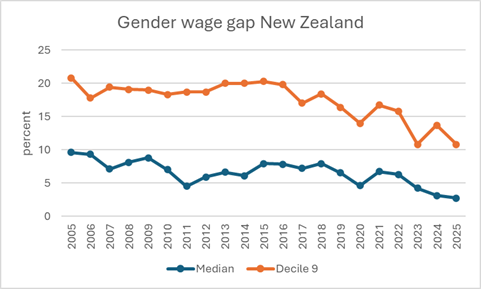
OECD data explorer
Women’s willingness to trade work-life balance for lower wages and fewer promotions is a big driver of the gender wage gap and the channelling of women into family friendly occupations. The wages of men and women at all levels are similar in the years leading up to motherhood then everything changes.
Top American labour economist Claudia Goldin found that some careers severely penalise any time off such as for motherhood or working less than punishingly long or rigid hours. Goldin refers to these jobs as greedy jobs. Women’s preference for family friendly occupations that can pay less and a tendency to avoid greedy jobs will mean that the gender wage gap may always be with us at least at the big end of town.
Did the Sewing Machine Reduce the Workload for Women?
10 Sep 2026 1 Comment
in discrimination, economic growth, economic history, economics of education, gender, history of economic thought, human capital, industrial organisation, labour economics, labour supply, macroeconomics, occupational choice, poverty and inequality, technological progress Tags: creative destruction, The Great Enrichment
Is new technology that replaces a worker a good thing? We have a tendency, it seems to me, to believe that most previous inventions turned out to have overall net social benefits, but to be worried that all future inventions will instead have overall net social costs. Philipp Ager and Davide Coluccia tackle the question of…
Did the Sewing Machine Reduce the Workload for Women?
Disappointing
01 Sep 2026 1 Comment
in human capital, labour economics, labour supply, politics - New Zealand, population economics Tags: economics of immigration
The ACT Party has announced a new policy that would:Remove the existing Permanent Resident visa category;Require all Resident Visa holders to receive a 5 year travel facility, replacing the current two-year initial travel condition;Require all Resident Visa holders to be physically present in New Zealand for at least 730 days within any rolling five-year period,…
Disappointing
Elon Musk did well for a penniless immigrant
31 Aug 2026 Leave a comment
in economics of education, energy economics, human capital, labour supply, poverty and inequality

College-educated women have maintained stable marriage rates by partnering with high-earning non-college men, shrinking the pool of economically viable partners available to non-college women
24 Aug 2026 Leave a comment
in applied price theory, discrimination, econometerics, economics of love and marriage, gender, human capital, labour economics, labour supply, law and economics, occupational choice, population economics, poverty and inequality
See Gender Disparities in College Enrollment and Marriage Patterns by Clara Chambers, Benjamin Goldman & Joseph Winkelmann.”Over the past half-century, the gender composition of American college campuses has shifted from predominantly male to predominantly female. Today, 1.6 million more women than men attend four-year colleges in the US. Over the same time period, the economic status…
College-educated women have maintained stable marriage rates by partnering with high-earning non-college men, shrinking the pool of economically viable partners available to non-college women
The effects of remote work on the disability employment gap
17 Aug 2026 Leave a comment
in discrimination, gender, human capital, labour economics, labour supply, transport economics, urban economics Tags: gender wage gap, sex discrimination
A rise in work from home explains most of the postpandemic gain in full-time employment among people with physical disabilitiesBy Tyler Smith. “Employment among people with disabilities has remained well below that of the broader population, with an average disability employment gap of 27 percentage points across OECD countries. In the United States, this low disability…
The effects of remote work on the disability employment gap
Alex Tabarrok: Britain’s equal pay madness
16 Aug 2026 Leave a comment
in applied price theory, Austrian economics, discrimination, economics of education, gender, health and safety, human capital, industrial organisation, labour economics, labour supply, occupational choice, poverty and inequality Tags: affirmative action, gender wage gap, pay equity, sex discrimination
The Taliban, Women and the Far Left
15 Aug 2026 1 Comment
in defence economics, discrimination, economics of education, economics of religion, gender, human capital, labour economics, labour supply, war and peace Tags: Afghanistan
It is five years today since the Taliban took control of Afghanistan. On 15 August 2021, its forces entered Kabul as the Afghan government collapsed and the long Western intervention came to an ignominious end. Five years later, the consequences for Afghan women are appalling. The Taliban has issued more than 100 decrees restricting the […]
The Taliban, Women and the Far Left
Immigration and Macroeconomic Outcomes in OECD Countries
10 Aug 2026 Leave a comment
in applied price theory, econometerics, economic history, human capital, labour economics, labour supply Tags: economics of immigration
OECD countries experienced declining native population growth and rising net immigration over 1990-2024. We compile a new dataset of net immigration rates to OECD countries from all origins and show that most of the increase came from non-OECD countries and was predominantly high-skilled. Push factors, network effects, and policy indices explain little of the large…
Immigration and Macroeconomic Outcomes in OECD Countries
New Zealand shows how to solve the equal pay crisis
07 Aug 2026 Leave a comment
in applied price theory, discrimination, economic history, economics of regulation, gender, human capital, labour economics, labour supply, occupational choice, poverty and inequality Tags: gender wage gap
Outgoing governments often try to craft a legacy for themselves by introducing policy traps that incoming governments find hard to undo, such as Rishi Sunak’s National Insurance cuts in 2024 or Gordon Brown’s introduction of the 50p top rate of income tax in 2010. Keir Starmer just did something similar by initiating a huge expansion in the […]
New Zealand shows how to solve the equal pay crisis
The New McCarthys: Forty Percent of Professors Would Vote Against Hiring a Trump Voter
06 Aug 2026 Leave a comment
in discrimination, economics of education, human capital, labour economics, politics - USA Tags: free speech, political correctness, regressive left
According to a new survey, roughly 40 percent of college faculty would “oppose hiring a Trump supporter.” The results of…
The New McCarthys: Forty Percent of Professors Would Vote Against Hiring a Trump Voter
The Most Depressing Chart about Germany
31 Jul 2026 Leave a comment
in applied price theory, fiscal policy, human capital, labour economics, labour supply, macroeconomics, poverty and inequality, welfare reform Tags: Germany

I’ve used the “most depressing chart” approach when writing about the United States, about Europe, about Japan, and about the western world. Today, let’s focus on Germany. And I’ll start with a caveat. I wrote about Germany earlier this month and that column included several charts that might qualify. Especially the last visual which showed […]
The Most Depressing Chart about Germany
New Research Further Confirms Anti-Growth Impact of Wealth Taxation
30 Jul 2026 1 Comment
in applied price theory, economic growth, entrepreneurship, fiscal policy, human capital, income redistribution, labour economics, liberalism, macroeconomics, Marxist economics, poverty and inequality, Public Choice, public economics Tags: taxation and entrepreneurship, taxation and investment, taxation and labour supply

I’ve shared multiple studies about the harmful impact of wealth taxes (see here, here, here, here, and here). Today, let’s add to the body of evidence. I’ll start by calling attention to a column I wrote in 2019 that warned how wealth taxes mean very high – even confiscatory – taxes on saving and investment. […]
New Research Further Confirms Anti-Growth Impact of Wealth Taxation
Occupational Licensing: US and International
25 Jul 2026 Leave a comment
in applied price theory, economics of information, economics of regulation, human capital, income redistribution, labour economics, labour supply, occupational choice, occupational regulation, politics - USA, Public Choice, rentseeking

The potential benefit of having the government require that certain jobs require an official license is quality control and protection. Personally, I rather like knowing that my nurse or doctor or dentist has gone through courses and training. The potential cost is that requirement to have a government license can become a way for those…
Occupational Licensing: US and International


Recent Comments