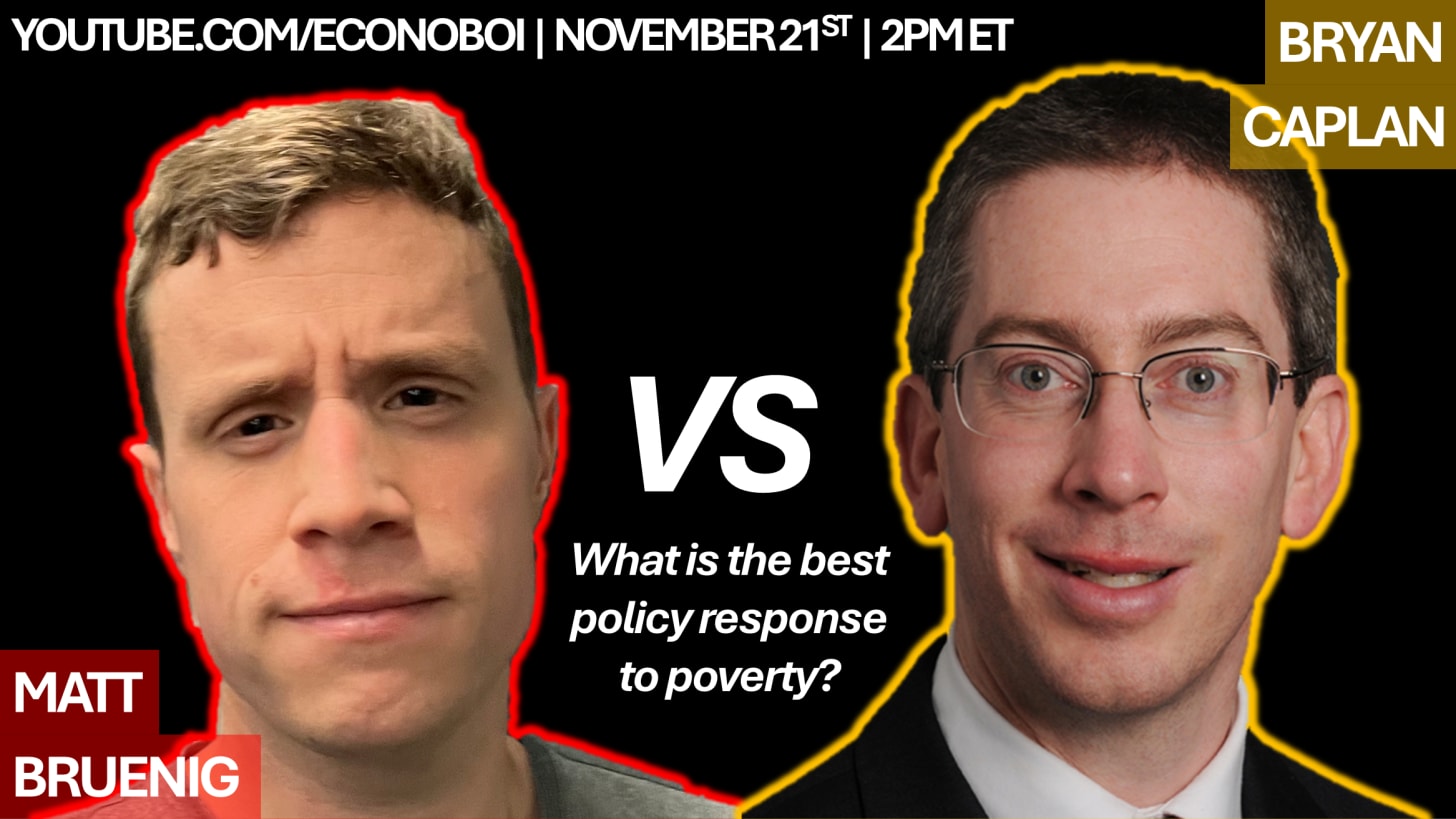
Tomorrow at 2 PM ET, I’ll be debating “What is the best policy response to poverty?” versus Matt Bruenig. Venue: Econoboi channel P.S. You might recall that… 9 more words
My Econoboi Poverty Debate vs. Matt Bruenig
Celebrating humanity's flourishing through the spread of capitalism and the rule of law
04 Dec 2025 Leave a comment
in applied price theory, human capital, labour economics, labour supply, occupational choice, politics - USA, poverty and inequality, welfare reform Tags: child poverty, family poverty, social insurance
Tomorrow at 2 PM ET, I’ll be debating “What is the best policy response to poverty?” versus Matt Bruenig. Venue: Econoboi channel P.S. You might recall that… 9 more words
My Econoboi Poverty Debate vs. Matt Bruenig
15 Nov 2025 Leave a comment
in applied price theory, economics of crime, economics of education, human capital, labour economics, labour supply, law and economics, occupational choice Tags: criminal deterrence
The author is economist Jennifer Doleac, and the subtitle is A Revolution in Criminal Justice. Excerpt: We found that adding anyone charged with a felony to the law enforcement DNA database in Denmark reduced future criminal convictions by over 40 percent. Again, people responded to the higher probability of getting caught by committing fewer cimres. …
*The Science of Second Chances*
15 Nov 2025 Leave a comment
in discrimination, economics of education, gender, human capital Tags: gender gap
09 Nov 2025 Leave a comment
in applied price theory, economics of education, human capital, labour economics, labour supply, politics - USA
TweetPhil Magness and Mike Ferguson discuss the recent oral arguments in the U.S. Supreme Court case against Trump’s use of IEEPA to impose tariffs. National Review‘s Dan McLaughlin dives deeply into what’s now on the U.S. Supreme Court’s plate regarding Trump’s IEEPA tariffs. Two slices: There are, however, two related problems for the government with…
Some Links
22 Oct 2025 Leave a comment
in applied price theory, fiscal policy, human capital, labour economics, labour supply, macroeconomics, Public Choice, public economics Tags: taxation and entrepreneurship, taxation and investment, taxation and labour supply

There can be honest and constructive debates about the size of government, such as when I cross swords with someone on the left who understands Arthur Okun’s efficiency-equity tradeoff. Another legitimate debate is about the impact of tax policy, specifically whether higher or lower tax rates have big effects or small effects. But to have […]
Part IV: Yes, Taxes Change Behavior
17 Oct 2025 Leave a comment
in applied price theory, discrimination, economics of crime, economics of education, gender, human capital, labour economics, labour supply, law and economics, occupational choice, politics - USA Tags: gender wage gap

An anonymous Swiftian guest essay
Ten Modest Proposals to End the Gender Pay Gap
09 Oct 2025 Leave a comment
in applied price theory, economics of education, human capital, income redistribution, labour economics, labour supply, occupational choice, Public Choice, public economics, welfare reform Tags: taxation and labour supply
This policy has been so popular with economists on a bipartisan basis, yet a recent piece in ReStud raises some doubts, as the wage subsidies induce many to drop out of school: As a complement to the federal earned income tax credit (EITC), some states offer their own EITC, typically calculated as a percentage of […]
Is the earned income tax overrated?
08 Oct 2025 Leave a comment
in applied price theory, economics of education, human capital, labour economics, labour supply, politics - New Zealand, poverty and inequality

This week, my ECONS102 class covered inequality, and social security. Which is timely, because I have been meaning to blog about this Treasury Analytical Note from 2024, by Tod Wright and Hien Nguyen, for some time. Wright and Nguyen look at the distributional impact of taxes, transfers, and government spending (on healthcare and education).Importantly, they distinguish…
The impact of taxes and transfers on inequality in New Zealand
26 Sep 2025 Leave a comment
in applied price theory, economic growth, entrepreneurship, fiscal policy, human capital, labour economics, labour supply, macroeconomics, Public Choice, public economics Tags: taxation and entrepreneurship, taxation and investment, taxation and labour supply
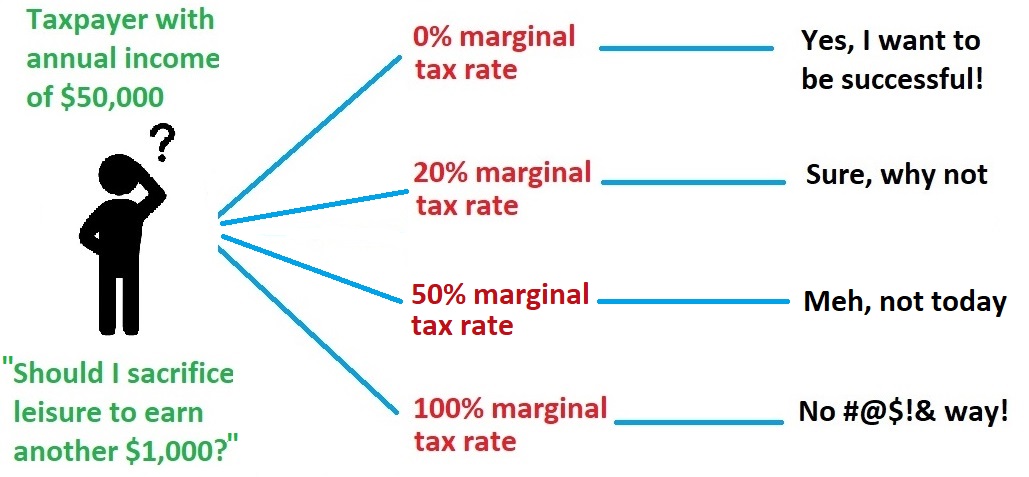
From a big-picture economic perspective, I worry most about the damage of high tax burdens on innovation, entrepreneurship, and investment. Those are things that generate enormous benefits for society, yet also things that are very sensitive to bad tax policy (specifically high marginal tax rates and the tax code’s bias against saving and investment). Sadly, […]
Part I: Yes, Taxes Change Behavior
25 Sep 2025 1 Comment
in applied price theory, human capital, income redistribution, labour economics, labour supply, occupational choice, Public Choice, public economics Tags: taxation and entrepreneurship, taxation and investment
The super-rich are super-mobile. So, if a country decides to increase taxes on the super-rich (for example, with a wealth tax), some (but not all) of the super-rich will simply move elsewhere. This should not be a surprise to anyone. And yet, simplistic proposals to tax the super-rich are a favourite policy for some political…
Newsflash! The super-rich are mobile, and higher taxes incentivise them to move away
24 Sep 2025 1 Comment
in applied price theory, econometerics, economic growth, economic history, entrepreneurship, human capital, international economics, labour economics, labour supply, macroeconomics, politics - USA Tags: economics of immigration
From 1990 to 2010, rising numbers of H-1B holders caused 30–50 percent of all productivity growth in the US economy. This means that the jobs and wages of most Americans depend in some measure on these workers. The specialized workers who enter on this visa fuel high-tech, high-growth sectors of the 21st century economy with skills like computer […]
Michael Clemens on H1-B visas
24 Sep 2025 Leave a comment
in economics of education, human capital, labour economics, labour supply, managerial economics, occupational choice, organisational economics, personnel economics
In the halcyon days of 2015-19, openings on the economics job market hovered at around 1900 per year. In 2020, Covid was a major shock, but the market bounced back quickly in 2021 and 2022. Since then, though, the market has clearly been in a funk. 2023, my job market year, saw a sudden dip […]
The evolution of the economics job market
23 Sep 2025 Leave a comment
in budget deficits, business cycles, economic growth, fiscal policy, human capital, labour economics, macroeconomics, occupational choice Tags: forecasting errors
20 Sep 2025 Leave a comment
in economics of education, human capital, poverty and inequality
An excellent speech by the President of the University of Austin on inequality: But on the heels of America’s quarter-millennium since the Declaration of Independence, I want to do something a bit unfashionable: I want to defend inequality. Of course, all men are created equal. But all men are not the same. We have unequal…
In defence of inequality
18 Sep 2025 Leave a comment
in applied price theory, economics of education, human capital, labour economics, poverty and inequality, welfare reform
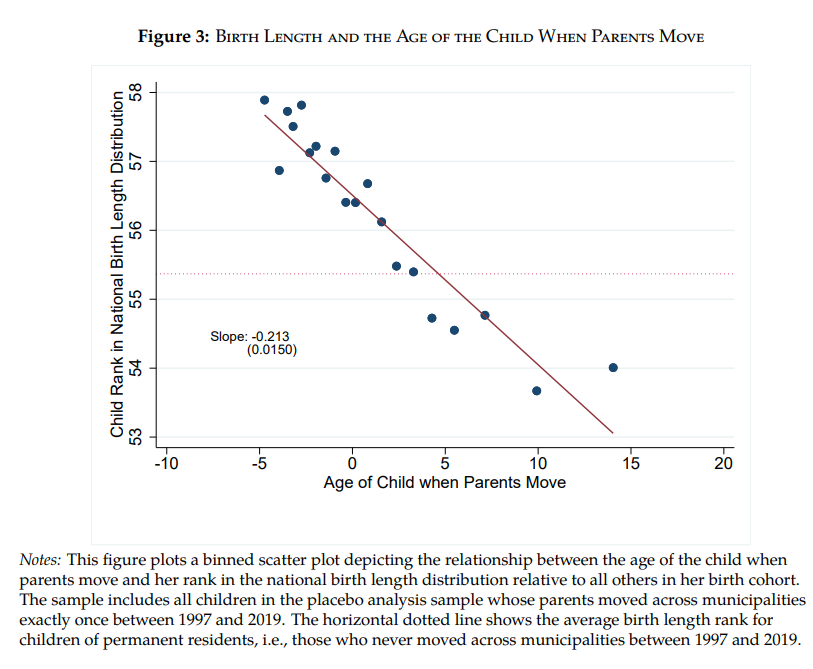
James Heckman and Sadegh Eshaghnia have launched a broadside in the WSJ against the Chetty-Hendren paper The Impacts of Neighborhoods on Intergenerational Mobility I: Childhood Exposure Effects. It’s a little odd to see this in the WSJ but since the Chetty-Hendren paper has been widely reported in the media, I suppose this is fair game. […]
Moving on Up
Celebrating humanity's flourishing through the spread of capitalism and the rule of law
Celebrating humanity's flourishing through the spread of capitalism and the rule of law
Celebrating humanity's flourishing through the spread of capitalism and the rule of law
Celebrating humanity's flourishing through the spread of capitalism and the rule of law
Celebrating humanity's flourishing through the spread of capitalism and the rule of law
Celebrating humanity's flourishing through the spread of capitalism and the rule of law
Celebrating humanity's flourishing through the spread of capitalism and the rule of law
Celebrating humanity's flourishing through the spread of capitalism and the rule of law
Celebrating humanity's flourishing through the spread of capitalism and the rule of law
A History of the Alt-Right
Econ Prof at George Mason University, Economic Historian, Québécois
Celebrating humanity's flourishing through the spread of capitalism and the rule of law
Scholarly commentary on law, economics, and more
Beatrice Cherrier's blog
Celebrating humanity's flourishing through the spread of capitalism and the rule of law
Celebrating humanity's flourishing through the spread of capitalism and the rule of law
Celebrating humanity's flourishing through the spread of capitalism and the rule of law
Why Evolution is True is a blog written by Jerry Coyne, centered on evolution and biology but also dealing with diverse topics like politics, culture, and cats.
Celebrating humanity's flourishing through the spread of capitalism and the rule of law
A rural perspective with a blue tint by Ele Ludemann
DPF's Kiwiblog - Fomenting Happy Mischief since 2003
Celebrating humanity's flourishing through the spread of capitalism and the rule of law
The world's most viewed site on global warming and climate change
Tim Harding's writings on rationality, informal logic and skepticism
A window into Doc Freiberger's library
Let's examine hard decisions!
Commentary on monetary policy in the spirit of R. G. Hawtrey
Thoughts on public policy and the media
Celebrating humanity's flourishing through the spread of capitalism and the rule of law
Politics and the economy
A blog (primarily) on Canadian and Commonwealth political history and institutions
Reading between the lines, and underneath the hype.
Economics, and such stuff as dreams are made on
"The British constitution has always been puzzling, and always will be." --Queen Elizabeth II
Celebrating humanity's flourishing through the spread of capitalism and the rule of law
Celebrating humanity's flourishing through the spread of capitalism and the rule of law
WORLD WAR II, MUSIC, HISTORY, HOLOCAUST
Undisciplined scholar, recovering academic
Celebrating humanity's flourishing through the spread of capitalism and the rule of law
Res ipsa loquitur - The thing itself speaks
In Hume’s spirit, I will attempt to serve as an ambassador from my world of economics, and help in “finding topics of conversation fit for the entertainment of rational creatures.”
Researching the House of Commons, 1832-1868
Reflections on books and art
Posts on the History of Law, Crime, and Justice
Celebrating humanity's flourishing through the spread of capitalism and the rule of law
Exploring the Monarchs of Europe


Recent Comments