@asymmetricinfo paper:"How Far Are We From The Slippery Slope? The Laffer Curve Revisited" bit.ly/1HMhmqu http://t.co/D9IffNhd92—
Old Whig (@aClassicLiberal) April 20, 2015
Who is where on the Laffer curve?
20 Jun 2015 Leave a comment
in economic growth, fiscal policy, human capital, labour economics, labour supply, macroeconomics, politics - USA, public economics Tags: endogenous growth theory, EU, Eurosclerosis, laffer curve, optimal tax theory, taxation and entrepreneurship, taxation and investment, taxation and the labour supply
There is a lot of truth in this
19 Jun 2015 Leave a comment
in economics of education, human capital Tags: endogenous growth theory, learning externalities
The rise and rise of educational attainment
18 Jun 2015 Leave a comment
in economics of education, human capital, labour economics, labour supply, occupational choice Tags: educational attainment
Average years of schooling in US over time. Rise slowed in the 1970s. brook.gs/14C4Kmo http://t.co/abs2A8BvAx—
Richard V. Reeves (@RichardvReeves) January 09, 2015
How to argue against employment protection laws while arguing for additional employment regulation
17 Jun 2015 Leave a comment
in human capital, job search and matching, labour economics, labour supply, macroeconomics, minimum wage, unions Tags: climate law, efficiency wage, employment at will, employment protection law, fixed costs of employment, fixed costs of working, flexible working hours, living wage, paid leave, Richard Ebstein
The Centre for American Progress recently published an excellent survey of the costs to employers of hiring and training new recruits. As the paper notes:
it is costly to replace workers because of the productivity losses when someone leaves a job, the costs of hiring and training a new employee, and the slower productivity until the new employee gets up to speed in their new job.
Our analysis reviews 30 case studies in 11 research papers published between 1992 and 2007 that provide estimates of the cost of turnover, finding that businesses spend about one-fifth of an employee’s annual salary to replace that worker.
The purpose of the research published by the Centre for American Progress was to argue there were large costs to employers from replacing even low paid workers and there are a workplace policies such as paid family leave and workplace flexibility will reduce these job turnover costs to employers.
Similar arguments are used to justify a living wage on efficiency grade wage grounds. A living wage would reduce job turnover and therefore the costs to employers of job turnover in the jobs.
The research published by the Centre for American Progress also illustrates the bargaining power of workers. Employers who failed to treat workers fairly and pay them the going wage risk an increase in job quit rates. These large costs of job turnover have been carefully documented by the Centre for American Progress.
Beyond jobs data: Industries w/ better pay have lower worker turnover rates equitablegrowth.org/news/looking-b… http://t.co/gug33EbYy3—
Equitable Growth (@equitablegrowth) July 03, 2015
Employers incur fixed costs of employment when they recruit and train new employees. These recruits must be expected to stay long enough to work sufficient hours for the firm to expect to recover these investments (Oi (1962, 1983a, 1990), Idson and Oi (1999), Hutchens (2010), Hutchens and Grace-Martin (2006)).
These costs are fixed costs because they do not vary with how many hours the employee works or with how long an employee stays with their employer. These fixed employment costs must be recouped over the expected job tenure of the employee with the firm. Employers will not hire an additional worker unless they anticipate recovering the costs of doing do including fixed employment costs and other overheads.
Central to arguments such as by Richard Epstein for employment at will is the threat of the employee to quit imposes a real cost on employers which the employer will seek to avoid by treating their employees well.
The best way to prevent exploitation of workers is to make hiring and firing easy, facilitate new entry by firms into all markets and promote full employment – a worker with other available job opportunities is difficult to exploit.
With large fixed costs of recruitment and training, employers cannot afford to behave whimsically if they wish to survive in competition with the rival firms with more competitive wage and employment policies.
By the same token, the large fixed costs of employment documented by the Centre for American Progress illustrate the large investments employers must risk to recruit a new employee.
If this large investment in recruitment doesn’t turn out well, but is difficult to get out of because of strict employment laws, employers will be more reluctant in the first instance to risk this investment because they are risking several months wages in fixed costs of employment. As Richard Epstein explained:
A second great advantage of the at-will system is that it supplies an informal method of bonding that keeps both sides in line.
The employer who tries to take advantage of the employee by altering working conditions for the worse will be met by the threat to quit, for now the deal is worth less to the employee than the wage received.
So long as markets are competitive the switching costs will be relatively low – lower in fact than they are in a highly regulated world where employers have to think twice before taking on a worker whom they may be unable to fire if things do not work out.
Yet on the other side, the employee who takes it easy on the job is faced with dismissal because he is no longer worth his wages.
But even here management will hesitate to dismiss for good reasons. One is the very substantial costs of recruiting and training a replacement who might or might not turn out to be better than the worker who was dismissed. The second is that unjust dismissals could induce other workers to leave while the going is good, thereby compounding the problem of recruitment and retention.
The Centre for American Progress was good enough to document the very substantial costs of recruiting and training a replacement employee. As the Centre for American Progress explained in their paper, employers have every reason to protect their investments in training and recruitment by minimising job turnover costs.
Every 20 years we worry about losing jobs to technology
17 Jun 2015 Leave a comment
in economics of education, entrepreneurship, human capital, industrial organisation, labour economics, labour supply, occupational choice, Public Choice, rentseeking, survivor principle Tags: antimarket bias, creative distraction, expressive voting, make-work bias, rational ignorance, rational irrationality, technological unemployment
Every 20 years we worry about losing jobs to tech. books.google.com/ngrams/graph?c… http://t.co/KW47Iwzsp9—
James Bessen (@JamesBessen) August 10, 2014
The education premium has immediate effects
17 Jun 2015 Leave a comment
in economics of education, human capital, labour economics, labour supply, occupational choice, poverty and inequality Tags: College premium, education premium, graduate premium, high school dropouts
http://t.co/t1Pym23Wgv—
EPI Chart Bot (@epichartbot) May 27, 2015
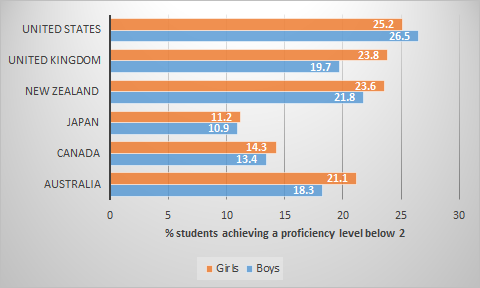
Gender differences in PISA scores, 2012, UK, USA, New Zealand and Australia
16 Jun 2015 Leave a comment
in economics of education, human capital, labour economics, occupational choice, politics - Australia, politics - New Zealand, politics - USA Tags: economics of personality traits, gender gap, PISA, reversing gender gap
Boys’ dominance just about endures in maths: at age 15 they are, on average, the equivalent of three months’ schooling ahead of girls. In science the results are fairly even.
But in reading, where girls have been ahead for some time, a gulf has appeared. In all 64 countries and economies in the study, girls outperform boys. The average gap is equivalent to an extra year of schooling.
Figure 1: : Gender differences (boys – girls) in student performance in reading, mathematics and science in PISA 2012
Source: OECD family database.
The reverse gender tertiary education gap for ages 25–34, Anglo-Saxon countries
14 Jun 2015 Leave a comment
in discrimination, economics of education, gender, human capital, labour economics, labour supply, occupational choice, politics - Australia, politics - New Zealand, politics - USA Tags: Australia, British economy, Canada, College premium, education premium, gender wage gap, Ireland
Figure 1: % population who have attained at least tertiary education, age 25 – 34 by gender (2012)
Source: OECD family database.
Figure 2 shows that the stark reversing of the gender gap in educational attainment shown in figure 1 was somewhat more recent in the US, UK and to a lesser extent in Ireland and Australia. In the UK and USA, educational attainment by gender was pretty equal for the earlier generation of graduates as compared to today’s 25 to 34-year-olds. The reversing of the gender gap in educational attainment dates back several decades in Canada and New Zealand.
Figure 2: % population who have attained at least tertiary education, age 45 – 54 by gender (2012)
Source: OECD family database.
Another rather stunning illustration of the size of the graduate premium in the USA
14 Jun 2015 Leave a comment
in economics of education, human capital, labour economics, occupational choice, politics - USA Tags: College premium, education premium, graduate premium
Gender wage gaps for tertiary educated and high school educated full-time workers in Anglo-Saxon countries
13 Jun 2015 Leave a comment
in discrimination, gender, human capital, labour economics, labour supply, occupational choice, politics - Australia, politics - New Zealand, politics - USA, poverty and inequality Tags: asymmetric marriage premium, Australia, British economy, Canada, gender wage gap, Ireland, labour demographics, maternal labour supply
In another blow for the inherent inequality of bargaining power between workers and employers, and for the patriarchy, the wage gap is larger for tertiary educated female full-time workers aged 35-44 than it is for female full-time workers who just finished high school.
Figure 1: gender wage gap for mean full-time, full-year earnings for tertiary educated workers aged 35 – 44, 2012
Source: OECD family database.
To add insult to injury, the gender wage gap further tertiary educated female workers is quite large in the USA but quite small for high school graduates.
Figure 2: gender wage gap for mean full-time, full-year earnings for below upper secondary educated workers aged 35 – 44, 2012
Source: OECD family database.
Canada seems to be a bit of a patriarchal hellhole while New Zealand does pretty well in gender wage gaps.
The gender gap in figure 1 and in figure 2 are unadjusted and calculated as the difference between mean average annual full-time, full-year earnings of men and of women as a percentage of men’s earnings.
What are the Anglo-Saxon gender wage gaps for the bottom, median and top deciles?
12 Jun 2015 Leave a comment
in discrimination, gender, human capital, labour economics, labour supply, occupational choice, politics - Australia, politics - New Zealand, politics - USA Tags: Australia, British economy, Canada, gender wage gap, Ireland
If there is an inherent inequality of bargaining power between workers and employers, as we are so frequently lectured by those in the self appointed know, why is the gender wage gap so small at the bottom of the earnings distribution?
Figure 1: % Gender gap in full-time earnings at the bottom decile of earnings distribution, 2012
Source: OECD family database
Figure 2: % Gender gap in full-time earnings at the median decile of earnings distribution, 2012
Source: OECD family database
Figure 3: % Gender gap in full-time earnings at the top decile of earnings distribution, 2012
Source: OECD family database
The gender gaps are unadjusted, and are calculated as the difference between the earnings of men and women for their respective earnings percentile.
Prison incarceration rates by race and education
12 Jun 2015 1 Comment
in discrimination, economics of crime, economics of education, human capital, labour economics, labour supply, law and economics, occupational choice, politics - USA Tags: compensating differentials, crime and punishment, criminal deterrence, law and order, racial discrimination, racism
Male African American high school dropouts facing a nearly 70% cumulative risk of imprisonment by their early 30s. However, the increase in incarceration rates among high school graduates appeared to be much the same for both blacks and whites.
This hints that racism is not as good explanatory of high rates of African-American male incarceration. Police do not know whether the people they arrest have high school diplomas or not but most of the people they arrest are high school dropouts. This suggests that the opportunity cost and rewards of crime over lawful occupational pursuits is a driver of the supply of crime.
What are the Anglo-Saxon gender wage gaps?
11 Jun 2015 Leave a comment
in discrimination, gender, human capital, labour economics, labour supply, occupational choice, politics - Australia, politics - New Zealand, politics - USA Tags: Australia, British economy, Canada, gender wage gap, Ireland
Why no (top 1% driven) middle class wage stagnation in (non-unionised) technologically progressive industries?
11 Jun 2015 Leave a comment
.@CEAChair: Higher productivity needed for increases in income on.wsj.com/1E4jGDQ @MarkMuro1 Agreed. Proof here http://t.co/oZ76aeQdiq—
Jonathan T. Rothwell (@jtrothwell) March 11, 2015
Wages & productivity are growing together in high R&D-STEM industries brook.gs/1D5Pqxc @CEAChair @MarkMuro1 http://t.co/fe5MDomJqE—
Jonathan T. Rothwell (@jtrothwell) March 11, 2015
The reversing gender gap in one chart
11 Jun 2015 Leave a comment
in discrimination, economics of education, gender, human capital, labour economics, labour supply, occupational choice, poverty and inequality Tags: gender wage gap, lost boys, reversing gender gap
Gender gap in bachelor's is 6 percentage points. Men now where women were a decade ago.
nces.ed.gov/programs/diges… http://t.co/u9rAsIcfY0—
S Dynarski (@dynarski) June 01, 2015
Recent Comments