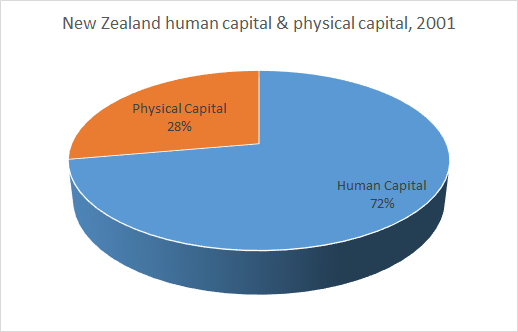
Nature versus nurture

image

HT: Phil Hill

What Are The Hardest Languages To Learn? | Voxy Blog

via What Are The Hardest Languages To Learn? [INFOGRAPHIC] | Voxy BlogVoxy Blog.

Who in Europe speaks English

Image

Gary Becker summarises the analysis of human capital

Human capital analysis starts with the assumption that individuals decide on their education, training, medical care, and other additions to knowledge and health by weighing the benefits and costs. Benefits include cultural and other non-monetary gains along with improvement in earnings and occupations, while costs usually depend mainly on the foregone value of the time spent on these investments.

Image

The slow diffusion of modern human resource management

Modern human resource management gained ground in the 1980s, slowly replaced the centralising of people management in personnel departments that was widespread by the 1960s.

Modern human resource management stressed rigorous selection and recruitment, more training at induction and on-the-job, more teamwork and multi-skilling, better management-worker communication, the use of quality circles, and encouraging employee suggestions and innovation.

The aim is a highly committed and capable workforce that pulls toward common goals. This drive for employer-employee unity is in contrast to the old days of detachment and formality with managers directing and controlling workers.

Modern human resource management replaced compliance with rules with genuine employee commitment and a unified corporate culture.

Modern human resource management is a technology and there is a long lag on the widespread adoption of any new technology.

The lag on the intra-industry diffusion of new technologies from 10% to 90% of users is 15 to 30 years long (Hall 2003; Grubler 1991). The literature on technology transfer is full of examples of the slow and costly diffusion of new technologies even with the on-site help of the original innovator and experienced consultants (Boldrin and Levine 2008).

New management practices are often complex and they are often slow and costly to introduce successfully without the assistance of consultants with prior experience with the new practices (Bloom and Van Reenen 2007, 2010).

Managerial innovations such as Taylor’s scientific management, Ford’s mass production, Sloan’s M-form corporations, Deming’s quality movement and Toyota’s lean manufacturing diffused slowly over decades. These technologies required large investments in learning, retraining, reorganisation, trial and error and adaptation and there were many failures (Bloom and Van Reenen 2010).

Bryson, Gomez, Kretschmer and Willman (2007) found that workplace voice and modern, high-commitment human resource management practices diffused unevenly across British workplaces. More employees, larger multi-establishment networks, public or for-profit ownership and network effects all increased the rates of diffusion of the new practices.

Large firms may invest more in skills because they are the early adopters of new management practices. Large firms are organisationally complex and they require more structured, explicit management practices to survive. Higher levels of worker skills have been linked with firms having better management practices (Bloom and Van Reenen 2007, 2010).

Employers who pay higher wages lose more if they mismanage or under-utilise well-paid workers. Large firms pay more, on average, so they lose more if they do not adopt good management practices in a timely fashion.

There are fixed costs to adopting new technologies and management practices, so large firms may be the first to find them profitable (Hall 2003). Later adopters may follow this lead when the new practices are more proven and, through experience and adaptation, cheaper to adopt.

The organisational disruption from switching to any new technology can reduce production and profits for several years and the new way of doing business may fail perhaps at a great cost (Holmes, Levine, and Schmitz 2012; Atkeson and Kehoe 2007; Roberts 2004).

These costs and uncertainties slow technology diffusion and explain why smaller firms use seemly out-of-date management practices. The new ways are not yet profitable for them. The pace of adoption of new technologies is driven by changes in the profitability of using the new technology as compared to the old (Karshenas and Stoneman 1993).

Firms of different sizes will invest in skills development and new management practices to the extent that is profitable to their circumstances.

On some occasions, large firms will find it profitable to invest in more skills development because this is part of the costs of investing in more capital per worker. On other occasions, skills development is necessary to reduce the costs of a growing corporate hierarchy.

No firm cannot invest in more skills development unless this growth is buoyed by market demand. Precipitate investments in skills development are fraught with risks.

Men (No Longer) At Work

Dish Staff's avatarThe Dish

by Dish Staff

Screen Shot 2014-12-16 at 5.33.21 PM

Binyamin Appelbaum looks into the causes of the decline in America’s male work force:

Working, in America, is in decline. The share of prime-age men — those 25 to 54 years old — who are not working has more than tripled since the late 1960s, to 16 percent. … Many men, in particular, have decided that low-wage work will not improve their lives, in part because deep changes in American society have made it easier for them to live without working. These changes include the availability of federal disability benefits; the decline of marriage, which means fewer men provide for children; and the rise of the Internet, which has reduced the isolation of unemployment. …

The resulting absence of millions of potential workers has serious consequences not just for the men and their families but for the nation as a whole. A smaller work force is likely to…

View original post 372 more words

The Gender-Pay Gap Is Largest for the Highest-Paying Jobs – The Atlantic

via Why the Gender-Pay Gap Is Largest for the Highest-Paying Jobs – The Atlantic.

Edmund Phelps on economic growth and skill shortages

Image

Political Calculations: What Drives CEO Pay?

Xavier Gabaix and Augustin Landier found back in 2008 that what a major company’s CEO earns is directly proportional to the size of the firm that they are responsible for running.

The chart below shows the correlation between firm size and CEO compensation for the top 500 public firms in 2010.

Executive Compensation vs Firm Size for Top 500 Firms, 2010

Executive compensation closely track the evolution of average firm value. During 2007 – 2009, firm value decreased by 17%, and CEO pay by 28%. During 2009-2011, firm value increased by 19% and CEO pay by 22%.

Executive Compensation and Firm Size for Top 500 Firms, 1992-2011

via Political Calculations: What Drives CEO Pay?.

Why Lefties Make Less – The Atlantic

Why Lefties Make Less – The Atlantic.

Charles Murray and the OECD’s Trends in Income Inequality and its Impact on Economic Growth – IQ, signalling, over-education and plain bad career advice

Charles Murray has been cooking with gas lately – on fire. One of his points is too many go to college. Murray points out that succeeded at college requires an IQ of at least 115 but 84% of the population don’t have this:

Historically, an IQ of 115 or higher was deemed to make someone “prime college material.”

That range comprises about 16 per cent of the population.

Since 28 per cent of all adults have BAs, the IQ required to get a degree these days is obviously a lot lower than 115.

Those on the margins of this IQ are getting poor advice to go to college. Murray argues that other occupational and educational choices would serve them better in light of their abilities and likelihood of succeeding at college. Moreover, Murray is keen on replacing college degrees with certification after shorter periods of study such as in the certified public accountants exam.

Murray believes a lot of students make poor investments by going on to College, in part, because many of them don’t complete their degrees:

…even though college has been dumbed down, it is still too intellectually demanding for a large majority of students, in an age when about 50 per cent of all high school graduates are heading to four-year colleges the next fall.

The result is lots of failure. Of those who entered a four-year college in 1995, only 58 per cent had gotten their BA five academic years later.

Murray does not want to abandon these teenagers:

Recognizing the fact that most young people do not have ability and/or the interest to succeed on the conventional academic track does not mean spending less effort on the education of some children than of others.

…Too few counsellors tell work-bound high-school students how much money crane operators or master stonemasons make (a lot).

Too few tell them about the well-paying technical specialties that are being produced by a changing job market.

Too few assess the non-academic abilities of work-bound students and direct them toward occupations in which they can reasonably expect to succeed.

Worst of all: As these students approach the age at which they can legally drop out of school, they are urged to take more courses in mathematics, literature, history and science so that they can pursue the college fantasy. Is it any wonder that so many of them drop out?

To add to that, he is in the Bryan Caplan School: education is often an elaborate former of signalling for many degrees. Murray says that college is a waste of time because:

Outside a handful of majors — engineering and some of the sciences — a bachelor’s degree tells an employer nothing except that the applicant has a certain amount of intellectual ability and perseverance.

Even a degree in a vocational major like business administration can mean anything from a solid base of knowledge to four years of barely remembered gut courses.

If the OECD is to be believed, that not enough people are going to college from lower middle class families, obviously IQ is not one of the constraints on access to college Charles Murray suggested it to be.


The growing strength of the case that education is a form of signalling is a literature that the now famous OECD paper reviewed, found wanting, but did not have time to discuss in the working paper.

Another contemporary theme the OECD paper reviewed, found wanting, but did not have time to discuss is a large number of graduates who end up holding jobs that do not require a university education – going to college:

About 48 per cent of employed U.S. college graduates are in jobs that the Bureau of Labor Statistics (BLS) suggests requires less than a four-year college education.

Eleven per cent of employed college graduates are in occupations requiring more than a high-school diploma but less than a bachelor’s, and 37 per cent are in occupations requiring no more than a high-school diploma.

The proportion of overeducated workers in occupations appears to have grown substantially; in 1970, fewer than one per cent of taxi drivers and two per cent of fire-fighters had college degrees, while now more than 15 per cent do in both jobs

All in all, the OECD has gone into the dragons den by backing the accumulation of human capital as its mechanism to link inequality with lower growth. No matter how you spin it, this linking of lower economic growth to greater inequality through financial constraints on the accumulation of human capital by the lower middle class was a bold hypothesis.

The case for investing more in education is not a slam dunk. Higher education – university or polytechnic – is a rat race that many don’t need to join.The case for the government paying a great many more to join that rat race is rather weak.

Trends in Income Inequality and its Impact on Economic Growth – OECD – is it all about not enough graduates – updated?

The analysis of the OECD published overnight depends crucially upon how greater inequality reduces the ability of the lower income families to invest in human capital.

The OECD theory of inequality and lower growth is there is a financing constraint because of inequality that reduces economic growth because of less human capital accumulation by lower income families.

Proportion of adults aged 25–64 years with an educational qualification of at least upper secondary level and tertiary level, 1991–2009

Figure K4.1 Proportion of adults aged 25–64 years with an educational qualification of at least upper secondary level and tertiary level, 1991–2009

In a nutshell, not enough people are going to university. Apparently,  the explosion in tertiary educational attendance over the last generation, an increase of about 150%  for the adult population aged 25 to 64, was just not good enough.

But what about adults aged 25 to 34, recent graduates, how many of them are there?

image

There was an explosion of young New Zealanders in the late 1990s who qualified for a degree from a university or diploma from a Polytech.

Under the hypothesis of the OECD about financial constraints retarding the accumulation of human capital among the lower middle class – the fourth decile of the income distribution –  even more young New Zealanders should have gone to university or Polytech.

Are there many New Zealanders left who are qualified and suited to tertiary education who do not go?

That is the crux of the OECD position: not enough lower-middle-class New Zealanders go on to obtain higher education and upgrade their skills because of financial constraints in a country was in interest free student loans,  means tested student allowances, and the government subsidises for 75% of all tuition fees. Tuition fees only equal 25% of the actual cost  and any one can get a student loan to cover this fee.

Richard Posner described the engines of women’s liberation

Image

The economics of parenting | VOX, CEPR’s Policy Portal

across OECD economies parents in more unequal countries place more emphasis on hard work, and consider imagination and independence to be less important.


via The economics of parenting | VOX, CEPR’s Policy Portal.

Claudia Goldin’s pollution theory of sex discrimination

Claudia Goldin argues that it is  difficult to rationalise sex segregation and wage discrimination on the basis of men’s taste for women in the same way as discrimination based on race or ethnicity. Goldin developed a pollution theory of discrimination in which new female hires may reduce the prestige of a previously all-male occupation.

When work took more brawn than brain, the distributions of skills and natural talents of men and women were further apart. Women were not as physically strong as men. This counted for more both before the Industrial Revolution and at the height of the Industrial Revolution when most factory work involved a considerable amount of brawn.

As machines substituted for strength, as brain replaced brawn and as educational attainment increased, the distributions of attributes, skills and natural talents narrowed by sex.

Because there is asymmetric information regarding the value of the characteristic of an individual woman, a new female hire may reduce the prestige of a previously all-male occupation.

Prestige is conferred by some portion of society and is based on the level of a productivity-related characteristic (e.g., strength, skill, education, ability) that originally defines the minimum needed to enter a particular occupation. People had to have a minimum amount of the socially prestigious strength or skill before they are hired.

Male fire fighters or police officers, to take two examples, may perceive their occupational status to depend on the sex composition of their police station or firehouse. These occupations are socially prestigious because of the strength and courage of police and fire-fighters. Men in an all-male occupation might be hostile to allowing a woman to enter their occupation even if the woman meets the qualifications for entry.

A reason for this hostility of the existing male members of the occupation is the rest of society may be slow to learn of the qualifications of these female newcomers. Their entry against this background of ignorance in the wider society  may downgrade the occupation as still carrying prestigious characteristics such as physical strength. As Goldin explains:

Because they feel that the entry of women into their occupations would pollute their prestige or status in that occupation. Very simply, some external group is the arbiter of prestige and status.

Let’s take an example of firemen, and let’s say we begin not that long ago when there were no women who were firemen—which is why they’re called firemen.

And to become a fireman you have to take a test, lifting a very heavy hose and running up many flights of stairs. And every night, the firemen get off from work and go to the local bar.

Everyone slaps them on the back and says what great brawny guys they are and what a great occupation they are in, and everybody knows that to be a fireman requires certain brawny traits and lots of courage.

But nobody knows when there’s a technological shock to this occupation. And in this case it might be that fire hoses become really light or the local fire department changes the test. There are information asymmetries. But they do note that for this “brawny” characteristic, the median woman is much lower.

So if we observe a woman entering the occupation and we don’t know how to judge women, we’re going to assume that her skills are those of the median woman. Or it may be that we can observe something having to do with her muscles and that may up it a little bit.

But chances are we’re going to assume that some technological shock has happened to this occupation. And so her entry into the occupation is going to pollute it.

Then when they go to the bar, people will say, “oh you’ve got a woman in the firehouse; now fire fighting has become women’s work.” That’s where the pollution comes in.

Union rules also played a role in preventing the entry of women into some occupations

Many occupations have changed sex over time e.g., librarians, bank tellers, teachers, telephone operators, and sales positions. New occupations  and industries are less like to be segregated on the basis of sex  because they have not developed a social image regarding the prestige of workers.

Occupational segregation came to an end because credentialisation, which spreads information about individual women’s productivities and shatters old stereotypes, can help expunge this pollution of the prestige of specific occupations and jobs both within the industry and in wider society .

The visibility successful women today and in the past may help shatter old stereotypes and increase knowledge about the true distribution of female attributes in this prestigious occupation.

Goldin found that  when typists were primarily men, it was claimed that typing required physical stamina so woman need not apply.

But later, when the occupational sex segregation reversed, when typing became a female occupation, it was said that typing required a woman’s dexterity, which men did not have! When I was at school, only women were taught to type.

Previous Older Entries Next Newer Entries

Bassett, Brash & Hide

Celebrating humanity's flourishing through the spread of capitalism and the rule of law

Truth on the Market

Scholarly commentary on law, economics, and more

The Undercover Historian

Beatrice Cherrier's blog

Matua Kahurangi

Celebrating humanity's flourishing through the spread of capitalism and the rule of law

Temple of Sociology

Celebrating humanity's flourishing through the spread of capitalism and the rule of law

Velvet Glove, Iron Fist

Celebrating humanity's flourishing through the spread of capitalism and the rule of law

Why Evolution Is True

Why Evolution is True is a blog written by Jerry Coyne, centered on evolution and biology but also dealing with diverse topics like politics, culture, and cats.

Down to Earth Kiwi

Celebrating humanity's flourishing through the spread of capitalism and the rule of law

NoTricksZone

Celebrating humanity's flourishing through the spread of capitalism and the rule of law

Homepaddock

A rural perspective with a blue tint by Ele Ludemann

Kiwiblog

DPF's Kiwiblog - Fomenting Happy Mischief since 2003

The Dangerous Economist

Celebrating humanity's flourishing through the spread of capitalism and the rule of law

Watts Up With That?

The world's most viewed site on global warming and climate change

The Logical Place

Tim Harding's writings on rationality, informal logic and skepticism

Doc's Books

A window into Doc Freiberger's library

The Risk-Monger

Let's examine hard decisions!

Uneasy Money

Commentary on monetary policy in the spirit of R. G. Hawtrey

Barrie Saunders

Thoughts on public policy and the media

Liberty Scott

Celebrating humanity's flourishing through the spread of capitalism and the rule of law

Point of Order

Politics and the economy

James Bowden's Blog

A blog (primarily) on Canadian and Commonwealth political history and institutions

Science Matters

Reading between the lines, and underneath the hype.

Peter Winsley

Economics, and such stuff as dreams are made on

A Venerable Puzzle

"The British constitution has always been puzzling, and always will be." --Queen Elizabeth II

The Antiplanner

Celebrating humanity's flourishing through the spread of capitalism and the rule of law

Bet On It

Celebrating humanity's flourishing through the spread of capitalism and the rule of law

History of Sorts

WORLD WAR II, MUSIC, HISTORY, HOLOCAUST

Roger Pielke Jr.

Undisciplined scholar, recovering academic

Offsetting Behaviour

Celebrating humanity's flourishing through the spread of capitalism and the rule of law

JONATHAN TURLEY

Res ipsa loquitur - The thing itself speaks

Conversable Economist

In Hume’s spirit, I will attempt to serve as an ambassador from my world of economics, and help in “finding topics of conversation fit for the entertainment of rational creatures.”

The Victorian Commons

Researching the House of Commons, 1832-1868

The History of Parliament

Articles and research from the History of Parliament Trust

Books & Boots

Reflections on books and art

Legal History Miscellany

Posts on the History of Law, Crime, and Justice

Sex, Drugs and Economics

Celebrating humanity's flourishing through the spread of capitalism and the rule of law

European Royal History

Exploring the Monarchs of Europe

Tallbloke's Talkshop

Cutting edge science you can dice with

Marginal REVOLUTION

Small Steps Toward A Much Better World

NOT A LOT OF PEOPLE KNOW THAT

“We do not believe any group of men adequate enough or wise enough to operate without scrutiny or without criticism. We know that the only way to avoid error is to detect it, that the only way to detect it is to be free to inquire. We know that in secrecy error undetected will flourish and subvert”. - J Robert Oppenheimer.

STOP THESE THINGS

The truth about the great wind power fraud - we're not here to debate the wind industry, we're here to destroy it.

Lindsay Mitchell

Celebrating humanity's flourishing through the spread of capitalism and the rule of law

Alt-M

Celebrating humanity's flourishing through the spread of capitalism and the rule of law

croaking cassandra

Economics, public policy, monetary policy, financial regulation, with a New Zealand perspective

The Grumpy Economist

Celebrating humanity's flourishing through the spread of capitalism and the rule of law

International Liberty

Restraining Government in America and Around the World