Women and WW II – Rosie the Riveter
10 Sep 2016 Leave a comment
in economics, labour economics, labour supply, occupational choice, politics - USA, population economics, war and peace Tags: female labour force participation, female labour supply, World War II

20 Years Ago, Welfare Reform Was Signed Into Law
07 Sep 2016 Leave a comment
in applied price theory, applied welfare economics, comparative institutional analysis, economic history, labour economics, labour supply, politics - USA Tags: 1996 US welfare reforms
The gender commuting gap between mothers and fathers
28 Aug 2016 Leave a comment
in discrimination, economics of love and marriage, gender, human capital, labour economics, labour supply, occupational choice, poverty and inequality, transport economics Tags: asymmetric marriage premium, commuting times, compensating differentials, female labour force participation, gender gap, gender wage gap
The first three bars in each cluster of bars are for men. in almost all countries mothers with dependent children spend less time commuting than childless women. This might suggest that working mothers have found workplaces closer to home than women without children. The gender gap in commuting where it is present in the country is larger than the gap between mothers and other women in their commuting time.
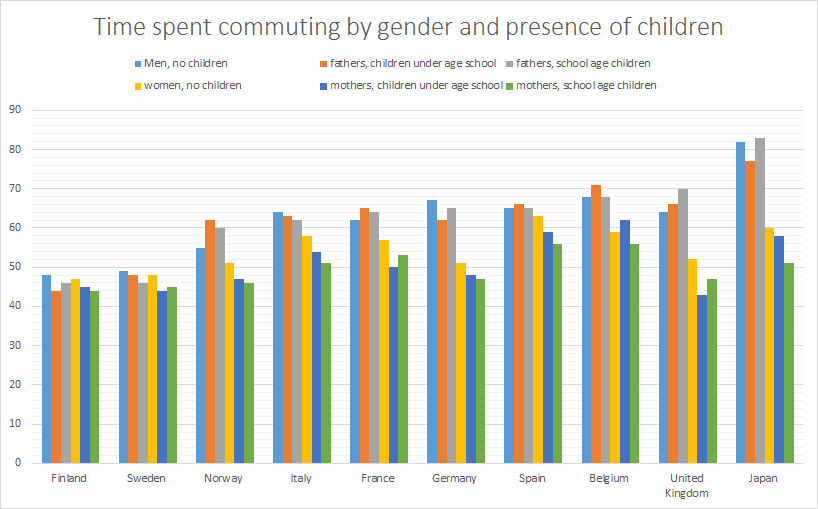
Source: OECD Family Database – OECD, Table LMF2.6.A.
Poverty Has Declined a Lot Over the Past 30 Years in the USA
27 Aug 2016 Leave a comment
in economic history, labour economics, labour supply, politics - USA, poverty and inequality, welfare reform Tags: 1996 US welfare reforms, child poverty, family poverty, single parents, social insurance, welfare state
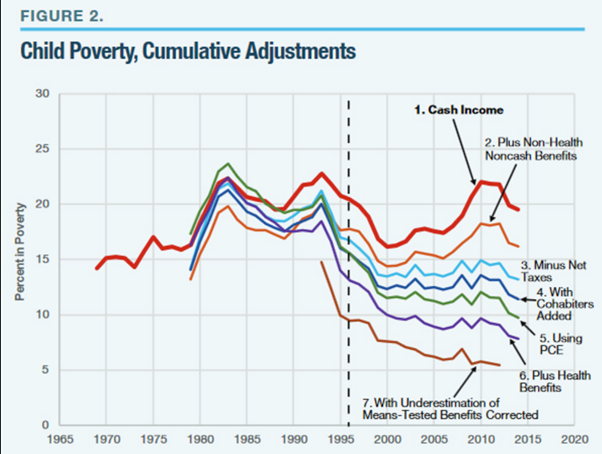
Source: Poverty Has Declined a Lot Over the Past 30 Years | Mother Jones from Poverty After Welfare Reform | Manhattan Institute.
But @EleanorAingeRoy child poverty has not changed much in 20 years
16 Aug 2016 Leave a comment
in applied welfare economics, labour economics, labour supply, politics - New Zealand, poverty and inequality, urban economics, welfare reform Tags: child poverty, family poverty, housing affordability, RMA
Today in the Guardian writing on trends in family poverty New Zealand, Eleanor Roy said that
The fact that twice as many children now live below the poverty line than did in 1984 has become New Zealand’s most shameful statistic.
Roy goes back to the 1980s as her base because child poverty has not gone up or down by that much since that sharp rise in the late 1980s.
Child poverty among single-parent households has doubled since 1990 and tripled since 1988. Poverty in families with two parents present is not much higher now than it was in 1988.

Source: Bryan Perry, Household Incomes in New Zealand: trends in indicators of inequality and hardship 1982 to 2014 – Ministry of Social Development, Wellington (August 2015), Table H.4.
Child poverty rates among single-parent families that live with other adults is one-quarter that of single-parent families who live alone. The reasons behind that should be explored more by those concerned with child poverty.

Source: Bryan Perry, Household Incomes in New Zealand: trends in indicators of inequality and hardship 1982 to 2013 – Ministry of Social Development, Wellington (2014), Tables F.6 and F.7.
The evidence is overwhelming that the main driver of the increases in the child poverty since the 1980s is rising housing costs.
In the longer run, after housing costs child poverty rates in 2013 were close to double what they were in the late 1980s mainly because housing costs in 2013 were much higher relative to income than they were in the late 1980s.
– Bryan Perry, 2014 Household Incomes Report – Key Findings. Ministry of Social Development (July 2014).
Any policy to reduce child poverty must increase the supply of houses by reducing regulatory restrictions on the supply of land.
Rather than blame the callousness of government in accepting higher rates of child poverty, Roy should blame its inability to take on the restrictions on land supply in the Resource Management Act that drive up housing costs for the poor. Increased child poverty in New Zealand is a by-product of housing unaffordability.
% employees working more than 50 hours per week, 2014 OECD area
15 Aug 2016 6 Comments
in labour economics, labour supply, occupational choice, public economics Tags: hours worked, taxation and labour supply
Not coincidentally, countries with high marginal income tax rates have low levels of long hours worked per week.
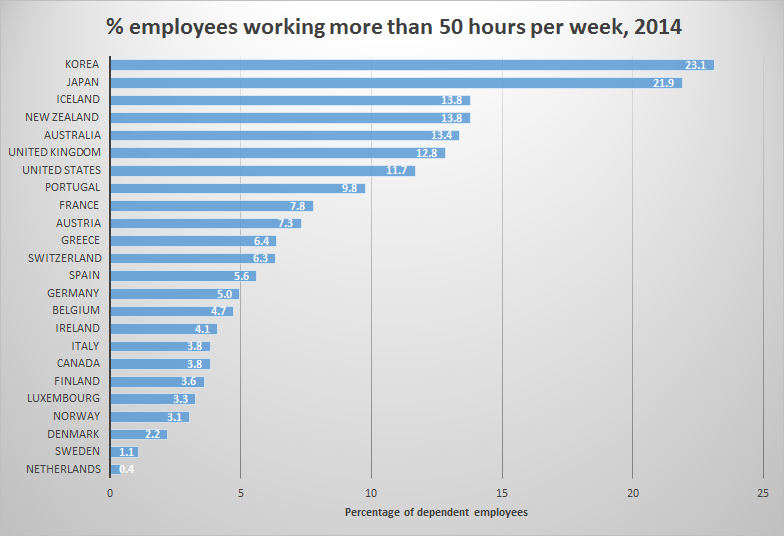
Data extracted on 14 Aug 2016 01:52 UTC (GMT) from OECD.Stat; Data does not include the self-employed.
Time spent in paid and unpaid work across the OECD by gender
30 Jul 2016 1 Comment
in economics of love and marriage, gender, labour economics, labour supply Tags: asymmetric marriage premium, female labour force participation, household production, marital division of labour
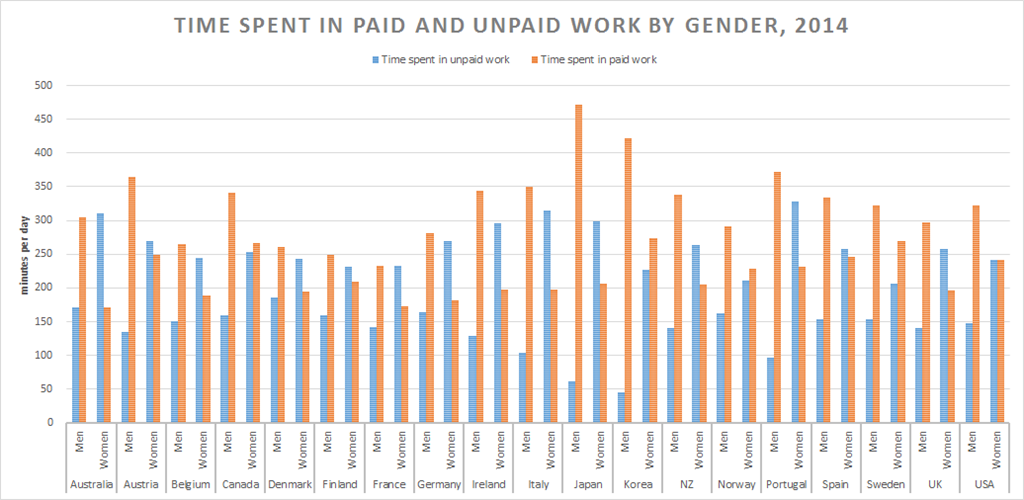
% women age 25 to 54 working full-time in USA, UK, Canada, Germany, France, Italy, Australia, New Zealand, Ireland, Sweden, Norway and Denmark
11 Jul 2016 Leave a comment
in gender, labour economics, labour supply Tags: female labour force participation, female labour supply, part-time work, social insurance, taxation and labour supply
To account for full-time work being 35 hours per week in some countries but 40 hours others I have included both in the chart below. Not many Dutch women work full-time.
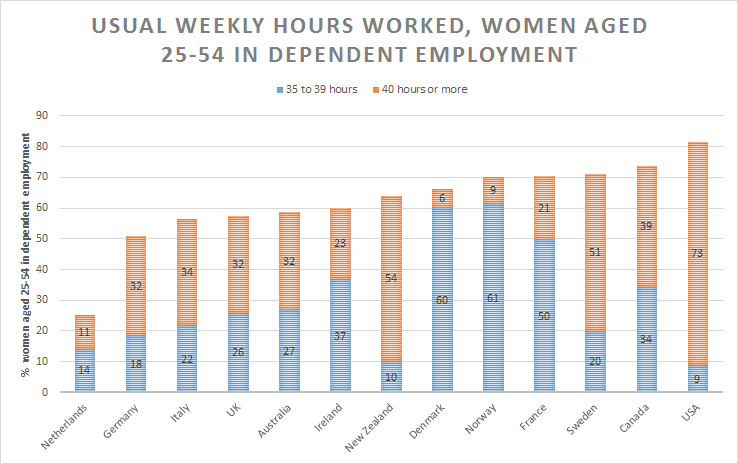
Data extracted on 11 Mar 2016 14:08 UTC (GMT) from OECD.Stat.
Child poverty in single parent and two-parent households in New Zealand
06 Jul 2016 Leave a comment
in economics of love and marriage, labour economics, labour supply, poverty and inequality, welfare reform Tags: child poverty, family poverty, single mothers, single parents
Looks like the greed of the top 1% was targeted exclusively as single parents since the 1980s. Child poverty in two-parent families has not risen much at all. These households often have jobs and will presumably be under the jackboot of neoliberalism stripping away their bargaining power through the decimation of unions and the introduction of the Employment Contracts Act. Despite these horrors, family poverty did not increase much if there are two parents in the house.
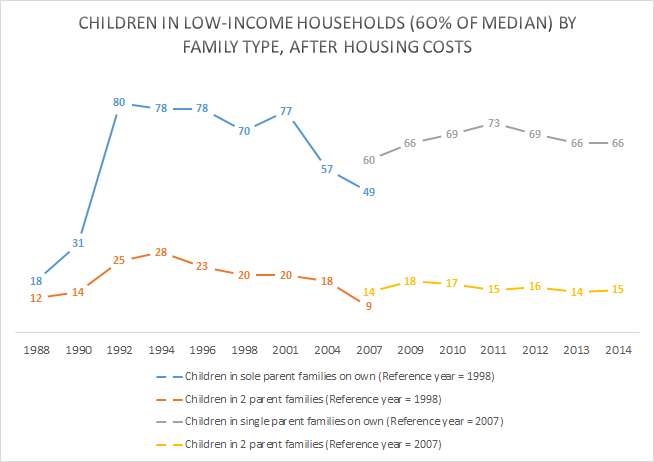
Source: Bryan Perry, Household Incomes in New Zealand: trends in indicators of inequality and hardship 1982 to 2014 – Ministry of Social Development, Wellington (August 2015), Table H.4.
Bryan Caplan argues that there is an undeserving poor if they fail to follow the following reasonable steps to avoid poverty and hardship:
- Work full-time, even if the best job you can find isn’t fun;
- Spend your money on food and shelter before cigarettes and cable TV; and
- Use contraception if you can’t afford a child.
Average top incomes in New Zealand
05 Jul 2016 Leave a comment
in human capital, labour economics, labour supply, occupational choice, poverty and inequality Tags: creative destruction, entrepreneurial alertness, top 1%
The average top income in New Zealand is that of a professional, executive or entrepreneur.
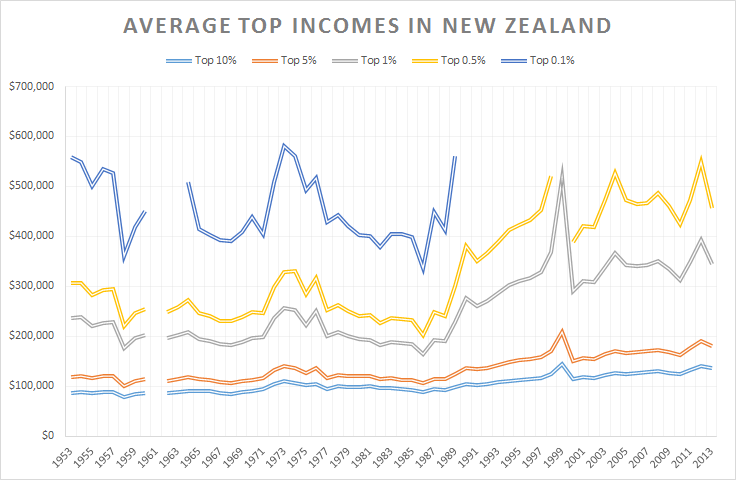
Source: The World Wealth and Income Database.
Wage gaps by gender, race and ethnicity persist in the USA
03 Jul 2016 Leave a comment
in discrimination, economics of education, gender, human capital, labour economics, labour supply, occupational choice, politics - USA Tags: employer discrimination, ethnic wage gap, gender wage gap, racial discrimination, racial wage gap

Robots Are Really Bad At Folding Towels
25 Jun 2016 Leave a comment
in economics, economics of media and culture, entrepreneurship, human capital, labour economics, labour supply Tags: creative destruction, robots

Source: Robots Are Really Bad At Folding Towels : Planet Money : NPR.
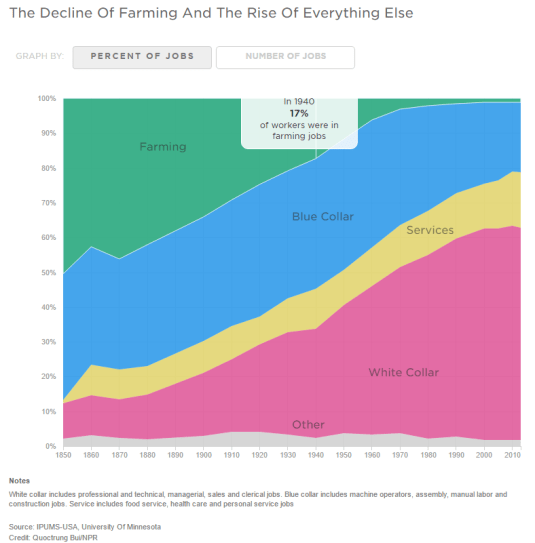
 Utopia, you are standing in it!
Recent Comments