Gary Becker – The Challenge of Immigration: A Radical Solution
17 Feb 2017 Leave a comment
in Gary Becker, human capital, labour economics, labour supply Tags: economics of immigration
Unmanned air force drones beset by labour shortage
16 Feb 2017 Leave a comment
in defence economics, labour economics, labour supply

It takes up to 300 people to keep an unmanned drone in the sky verses about 100 for an air force fighter jet.
The tractors are coming, the tractors are coming for all the horses
16 Feb 2017 Leave a comment
in economic history, industrial organisation, labour economics, labour supply Tags: agricultural economics, creative destruction, technological unemployment, technology diffusion
Many new technologies display long adoption lags, and this is often interpeted as evidence of frictions inconsistent with the standard neoclassical model. We study the diffusion of the tractor in American agriculture between 1910 and 1960 — a well known case of slow diffusion — and show that the speed of adoption was consistent with the predictions of a simple neoclassical growth model.
The reason for the slow rate of diffusion was that tractor quality kept improving over this period and, more importantly, that only when wages increased did it become relatively unprofitable to operate the alternative, labor-intensive, horse technology
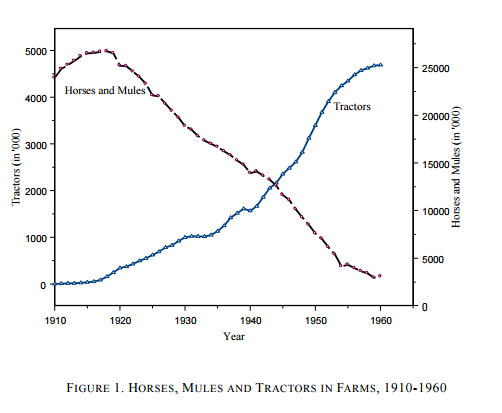
Source: Frictionless Technology Diffusion: The Case of Tractors By RODOLFO E. MANUELLI AND ANANTH SESHADRI
Bryan Caplan on “The Economics of Immigration”
11 Feb 2017 Leave a comment
in applied price theory, applied welfare economics, economic history, human capital, labour economics, labour supply Tags: economics of immigration
Speaking of the equality of the sexes
06 Feb 2017 Leave a comment
in discrimination, economics of education, gender, labour economics, labour supply, occupational choice Tags: behavioural genetics, compensating differentials, educational psychology, gender gap, reversing gender gap
More on the emergence of a working rich
06 Feb 2017 Leave a comment
in entrepreneurship, financial economics, human capital, industrial organisation, labour supply, occupational choice, poverty and inequality, survivor principle Tags: superstars, top 1%


Information costs in the labour market
31 Jan 2017 Leave a comment
in job search and matching, labour economics, labour supply, minimum wage, unions Tags: inequality of bargaining power, job matching, job search, monopsony

Every worker, even the low-paid worker, is alert to their opportunities and take the best jobs that come to their notice but it is gaps in their information is the sand in the wheels of this search. As Manning (2005) observed in his superb Monopsony in Motion:
That important frictions exist in the labor market seems undeniable: people go to the pub to celebrate when they get a job rather than greeting the news with the shrug of the shoulders that we might expect if labor markets were frictionless. And people go to the pub to drown their sorrows when they lose their job rather than picking up another one straight away. The importance of frictions has been recognized since at least the work of Stigler (1961, 1962) (Manning 2005, p. 4).
The left has a certain view of how the labour market works and how to best move workers into better paying jobs. Standing against this are arguments that it is a want of information rather than weak bargaining power is what slows workers down from moving to a better job. As Stigler (1961, 1962) argued, information is costly to obtain in the labour market:
No worker, unless his degree of specialization is pathological, will ever be able to become informed on the prospective earnings which would be obtained from every one of these potential employers at any given time, let alone keep this information up to date. He faces the problem of how to acquire information on the wage rates, stability of employment, conditions of employment, and other determinants of job choice, and how to keep this information current (Stigler 1962, p. 94).
The left accepts that low-paid workers respond actively to news of better paying job opportunities. They do this by arguing that a living wage improves the quality of recruitment pools. More workers apply for the living wage vacancies on the news of a living wage policy. Fewer employees quit and they work harder in response to a living wage.

Activists should mind how they go by stressing an inequality of bargaining power but also letting through the door even one market discipline such as a sensitivity of wage offers and profits to job turnover rates:
Let us consider the extreme case of highly specialized, non-versatile labor. If we consider (a) the continuous replacement of personnel who gradually leave through competing employment openings, retirement and death, and (b) (in an expanding industry) the recruitment needed for expansion, we must recognize that the probability of the workers’ exploitation is remote. The observable labor turnover between firms suggests indeed that collusive action to reduce the price of labor has virtually never been regarded as profitable (Hutt 1973, p. 4).
But not every worker knows there are better paying options which may be even just a few steps away from their current job. Information costs are a better explanation than pinning everything on an inequality in bargaining power. This is because information costs have a profound impact on labour market workings (Stigler 1962; Alchian 1969; Alchian and Allen 1967, 1983). For unequal bargaining power to keep the wages of the low-paid down, collusion must succeed between a great many employers recruiting across many industry and occupational labour markets (Hutt 1973, Alchian and Allen 1983).

More insight is gleaned from the fact that job seekers do not initially know the location of suitable vacancies, the wages for various skills, differences in job security and other factors. They must find this knowledge, keep it current and forecast whether better vacancies may open soon. Employers must learn the location, availability and asking wages of suitable applicants.
Long-term contracts arise to share risks and curb opportunism over sunken investments in specialised human capital. These factors lead to queues, unemployment, spare capacity, layoffs, shortages, inventories and non-price rationing in conjunction with wage rigidity (Alchian 1969; Alchian and Allen 1967, 1983). Labour market analysis must stay within McCloskey’s maxim that
Every piece of economic analysis is not complete until everyone is earning only normal profits, or at least the analyst can identify a reason why not (McCloskey 1985).
The labour market has good and bad jobs, the jobs that can pay more than or less than the going rate, resulting from the costs of job search and matching. These good and bad jobs arise from the element of chance in every job search and job match rather than betting it all on an enduring employer conspiracy to keep wages down. Some workers are paid less than the going rate because they are down on their luck rather than under the thumb.
The robots came in the 1950s for all our jobs
23 Jan 2017 Leave a comment
in economic history, industrial organisation, labour economics, labour supply, movies, survivor principle Tags: Apollo 13, automation, technological unemployment
The robots are coming have got nothing on the mid 20th century in terms of man being replaced by a machine.
One of my favourite scenes from Apollo 13 happens to be online. Tom Hanks and the Apollo 13 crew and ground control were using slide rules to make the critical calculations about re-entry trajectories. That had not been automated in 1969.
I went to high school just after slide rules were replaced by simple calculators.
I am reading some great essays from the 1960s at the moment about the great fear that people had from the computer entering the factory.
The reason for claiming that this time it was different was computed could automate calculations millions of times faster than people could. The computer could monitor and react to events without human intervention as Yale Brozen explained in the mid-60s
The hallmarks of automation, to distinguish it from mechanization or automatic
methods, are its sensing, feed-back, and self-adjusting characteristics. Because it senses changing requirements and adjusts without human intervention, it presumably does away with the need for human attendants or human labor. This is very fearful indeed to those who depend upon jobs for their livelihood.
Tyler Cowen – The Great Stagnation
21 Jan 2017 Leave a comment
in applied price theory, development economics, economic history, entrepreneurship, human capital, labour supply Tags: creative destruction, great stagnation
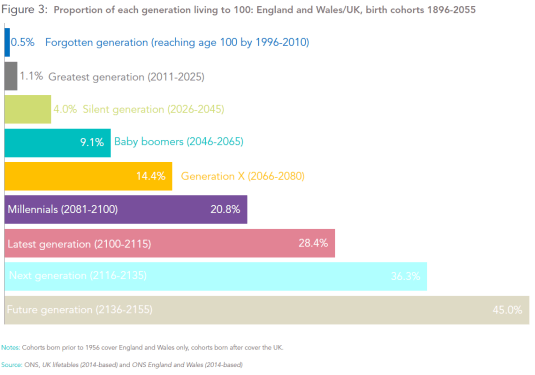
By 2140, a lot of people are going to get birthday telegrams from the Queen
16 Jan 2017 Leave a comment
in health economics, labour supply, population economics
The robots have been coming from longer than you think
16 Jan 2017 Leave a comment
in economic history, industrial organisation, labour economics, labour supply, unemployment
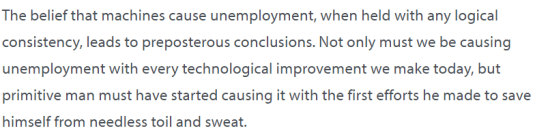
Source: Henry Hazlitt, Economics in One Lesson.
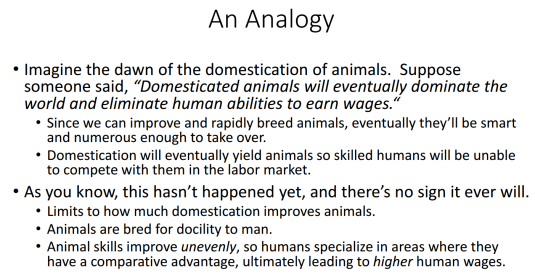
Source: Against Robotic Panic, Bryan Caplan | EconLog | Library of Economics and Liberty.
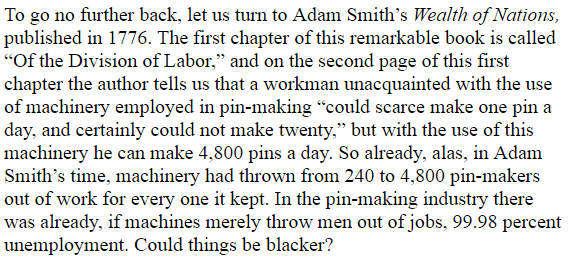


Recent Comments