Baumol’s cost disease
17 Oct 2016 Leave a comment
in applied price theory, labour economics, labour supply Tags: Baumol's disease
A.J.P. Taylor said something similar
15 Oct 2016 Leave a comment
in economic history, international economic law, international economics, labour economics, labour supply Tags: age of empires, age of migration, economics of immigration, George Orwell, great migrations

The rise of a working rich in Australia
12 Oct 2016 Leave a comment
in economic history, human capital, industrial organisation, labour economics, labour supply, politics - Australia, poverty and inequality, survivor principle Tags: superstar wages, superstars, top 1%, top incomes
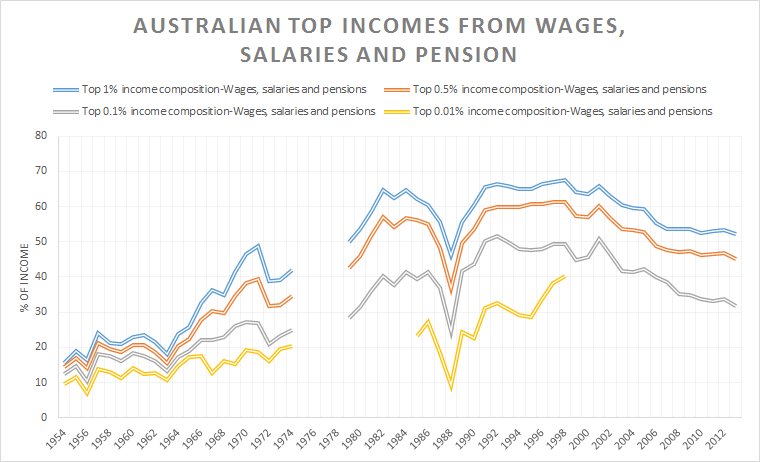
Source: The World Wealth and Income Database.
Robert Lucas on the voluntary and involuntary unemployment distinction
05 Oct 2016 Leave a comment
in job search and matching, labour economics, labour supply, macroeconomics, Robert E. Lucas, unemployment Tags: involuntary unemployment, job search, search and matching
Robert Lucas in a famous 1978 paper argued that all unemployment was voluntary because involuntary unemployment was a meaningless concept:
“The worker who loses a good job in prosperous time does not volunteer to be in this situation: he has suffered a capital loss. Similarly, the firm which loses an experienced employee in depressed times suffers an undesirable capital loss.
Nevertheless the unemployed worker at any time can always find some job at once, and a firm can always fill a vacancy instantaneously. That neither typically does so by choice is not difficult to understand given the quality of the jobs and the employees which are easiest to find.
Thus there is an involuntary element in all unemployment, in the sense that no one chooses bad luck over good; there is also a voluntary element in all unemployment, in the sense that however miserable one’s current work options, one can always choose to accept them.”
I agree that we all make choices subject to constraints. To say that a choice is involuntary because it is constrained by a scarcity of job-opportunities information is to say that choices are involuntary because there is scarcity. Alchian said there are always plenty of jobs because to suppose the contrary suggests that scarcity has been abolished.
Lucas elaborated further in 1987 in Models of Business Cycles:
A theory that does deal successfully with unemployment needs to address two quite distinct problems. One is the fact that job separations tend to take the form of unilateral decisions – a worker quits, or is laid off or fired – in which negotiations over wage rates play no explicit role.
The second is that workers who lose jobs, for whatever reason, typically pass through a period of unemployment instead of taking temporary work on the ‘spot’ labour market jobs that are readily available in any economy.
Of these, the second seems to me much the more important: it does not ‘explain’ why someone is unemployed to explain why he does not have a job with company X. After all, most employed people do not have jobs with company X either. To explain why people allocate time to a particular activity – like unemployment – we need to know why they prefer it to all other available activities: to say that I am allergic to strawberries does not ‘explain’ why I drink coffee.
Neither of these puzzles is easy to understand within a Walrasian framework, and it would be good to understand both of them better, but I suggest we begin by focusing on the second of the two.

Homer Simpson: An economic analysis
28 Sep 2016 Leave a comment
in economics, human capital, labour economics, labour supply, occupational choice, television Tags: The Simpsons
What people miss about the gender wage gap
22 Sep 2016 Leave a comment
in applied price theory, discrimination, gender, human capital, labour economics, labour supply, occupational choice Tags: gender wage gap
How to show that unions & income inequality are unrelated when attempting to show a link
22 Sep 2016 Leave a comment
in human capital, labour economics, labour supply, politics - USA, unions Tags: superstar wages, superstars, top 1%
Fight for $15 tried to show a link between unions and rising income inequality but all it managed to show that unions went into decline several decades before inequality started to rise.
Ethnic differences in household incomes in the USA
16 Sep 2016 Leave a comment
in discrimination, human capital, labour economics, labour supply, politics - USA Tags: racial discrimination, racial wage gaps
Viagers as a way of funding retirements
12 Sep 2016 Leave a comment
in labour economics, labour supply, poverty and inequality, welfare reform Tags: economics of retirement, French law, old age pensions, property law, reverse mortgages, social insurance
A Viager is a French way of buying and selling property. We just watched the Kelvin Klein – Maggie Smith movie about it.
Not only does the seller remain as a life tenant of the property they sold, the buyer pays them an annuity as well as a down payment. The buyer gambles as all annuity providers do on the life expectancy of the vendor. One such vendor lived to 123 in France.
Back in 1965, when Mrs Calment was aged 90, she sold her apartment in Arles to a 44-years old man, on contract-conditions that seemed reasonable given the value of the apartment and the life-expectancy statistics that prevailed at the time.
The man turned out to be unlucky since Jeanne Calment lived a very long life. He died in 1995, two years before Mrs Calment, after having paid about FFr900,000 (twice the market value) for an apartment he never lived in.
The viager system is similar to the equity release and reverse mortgage systems more familiar in Anglo-Saxon countries. The viager shares the risk of running out of equity with the buyer. The contract is between two private parties and does not involve banks or insurance companies.

Sellers are typically widows, or widowers, who want to cash out the value of their property with a lump sum – the bouquet – and a monthly payment from the buyer for the rest of their lives. The seller remains as a life tenant. The bouquet is normally 15-30% of the value of the property.
French viager investors tend to be in their late 40s and early 50s wanting to set themselves up with a retirement home and hopefully get a good deal. If the buyer dies before the seller his children will be obliged to carry on paying the viager if they want to maintain the deal. In that sense, the vendor is gambling on the buyer’s life expectancy is well.
I have no information on who is responsible for payment of rates and the maintenance of the property. The maintenance of the property would be a bigger moral hazard problem than with tenants because of the difficulties with eviction and repair. The market for Viagers is fairly small.
Should the buyer default on the monthly instalments, he is warned to pay up. After a second warning, normally within weeks, he will get a further warning and one month to get up to date with payments. If this does not happen the seller keeps keeps the bouquet, all money received so far and gets back absolute ownership of the property they sold.
This home annuity option for selling the house could be away of getting around the rather small to non-existent annuity market in New Zealand for retirees. They have the advantage of sharing the risk of exhausting the equity of the property at the price of the buyer sometimes gets a really good deal. Sellers have on average shorter survival times than the general French population.
Women and WW II – Rosie the Riveter
10 Sep 2016 Leave a comment
in economics, labour economics, labour supply, occupational choice, politics - USA, population economics, war and peace Tags: female labour force participation, female labour supply, World War II

20 Years Ago, Welfare Reform Was Signed Into Law
07 Sep 2016 Leave a comment
in applied price theory, applied welfare economics, comparative institutional analysis, economic history, labour economics, labour supply, politics - USA Tags: 1996 US welfare reforms
The gender commuting gap between mothers and fathers
28 Aug 2016 Leave a comment
in discrimination, economics of love and marriage, gender, human capital, labour economics, labour supply, occupational choice, poverty and inequality, transport economics Tags: asymmetric marriage premium, commuting times, compensating differentials, female labour force participation, gender gap, gender wage gap
The first three bars in each cluster of bars are for men. in almost all countries mothers with dependent children spend less time commuting than childless women. This might suggest that working mothers have found workplaces closer to home than women without children. The gender gap in commuting where it is present in the country is larger than the gap between mothers and other women in their commuting time.
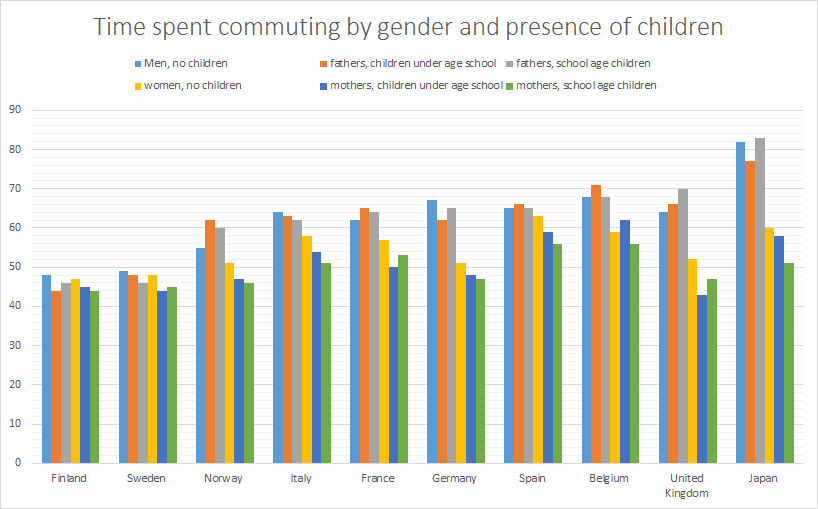
Source: OECD Family Database – OECD, Table LMF2.6.A.


Recent Comments