Why isn’t everyone on a zero hours contract?

I was chatting with a friend in the pub the other night about the proliferation of contractors in New Zealand in the government sector. It was observed that many of them simply perform the jobs of employees and bring no special skills for them but are very expensive to hire. They are paid a premium because that they are supposedly hired on short notice for short periods of time to fill gaps. They are paid a premium for their availability and willingness to leave on short notice without fuss.

I had no experience of contractors in Australia. If a gap needed to be filled within an agency quickly, you went to a manager higher up the hierarchy. The decision was made then to reallocate through secondments staff from another part of the agency from an area that was less busy than normal at the moment. In the interim, staff are recruited to fill any gap that is anything more than short-term with the secondments filling the gap until the recruits arrive.

The conversation then turned to the issues as to why any employees are guaranteed a minimum number of hours or continuity of employment. Why isn’t everyone on a zero hours contract and only come in when they are needed and are paid accordingly.

The reason for long-term employment agreements with fixed hours and weekly wages irrespective of how busy the business is arises from the fixed costs of employment, and the costs of search and matching in the labour market.

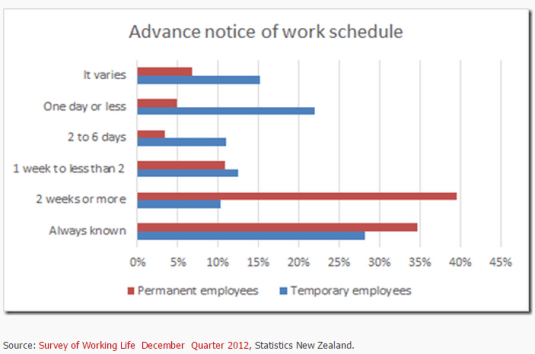
The difference between zero hours contracts and permanent employment may be a overstated. Advance notice of work schedules is always known only to a minority of temporary and permanent employees in New Zealand. There is not much difference between that advance notice between temporary and in permanent employees.
Critics overplay their hand if they suggest that somehow workers a very much disadvantaged and employers are holding all the cardsJob turnover and recruitment problems are a serious cost to a business. Workers will not sign contracts, such as zero hours contracts or casual work contracts if they are not to their advantage.

The question that must always be asked is why do people who are deemed competent to vote and drive cars sign zero hours contract? What is in it for them? David Friedman asked this question about the economics of restraint of trade agreements for employees:

…the employer who insists on an employee signing a non- competition agreement will find that he must pay, in additional wages or other terms of employment, the cost that the agreement imposes upon the employee, as measured by the employee and revealed in his actions. It follows that the employer will insist on such an agreement only if he believes that its value to him is greater than its cost to the employee… The contract is designed, after all, with the objective of getting the other party to sign it. If I am designing the contract and offering it to many other parties, that may put me in a position to commit myself to insisting on terms that give me a large fraction of the benefit that the contract produces. But it is still in my interest to maximize the size of that net benefit-which I do by only insisting on terms that are worth at least as much to me as they cost the other party.

Critics overplay their hand if they suggest that somehow workers are very much disadvantaged and employers are holding all the cards. Job turnover and recruitment problems are a serious cost to a business. Workers will not sign zero hours contracts if they are not to their advantage.

Unless labour markets are highly uncompetitive with employers having massive power over employees, employers should have to pay a wage premium if zero-hour contracts are a hassle for workers.

The fixed costs of employment are such that you shouldn’t expect zero-hour contracts: you’ll typically do better with one 40-hour worker over two 20-hour workers because of these costs. Zero hour contracts would be most likely in jobs with low recruitment costs and where specialised training needs are low. Workers with low fixed costs of working will move into the zero-hour sector while those with higher fixed costs would prefer lower hourly rates but more guaranteed hours. Again, read lower here as meaning relative to what they could elsewhere earn.

Most workers, the majority of workers are on conventional employment agreements. They work five days a week, 40 hours a week for a fixed pay.

Anyone I know who decides to work as a contractor expects to be paid much more than a conventional employee. They command a large premium for not having certainty of hours and ongoing employment. The same goes for any job that is particularly risky, has unsocial hours or involves weekend work or anything else that departs from the standard working week. All these jobs command a wage premium.

Employers incur fixed costs of employment when they recruit and train new employees. These recruits must be expected to stay long enough to work sufficient hours for the firm to expect to recover these investments [Oi (1962, 1983a, 1990), Idson and Oi (1999), Hutchens (2010), Hutchens and Grace-Martin (2006)].

These costs are fixed costs because they do not vary with how many hours the employee works or with how long an employee stays with their employer. On-going supervision, office space and other overheads can increase with the number of employees, not the hours they work per week. These fixed employment costs must be recouped over the expected job tenure of the employee with the firm.

Employers will not hire an additional worker unless they anticipate recovering the costs of doing do including fixed employment costs and other overheads.

Hiring one more worker for 40 hours per week is cheaper than hiring two workers to work 20 hours per week each. These two part-timers would about double the recruitment and training costs to secure the same total additional supply of hours worked per week. Profits are a small share of the revenue earned on selling the output of each worker.

Zero hour contracts would be most likely in jobs with low recruitment costs and where specialised training needs are low. Workers with low fixed costs of working will move into the zero-hour sector while those with higher fixed costs would prefer lower hourly rates but more guaranteed hours. Again, read lower here as meaning relative to what they could elsewhere earn.

The literature on the economics of the fixed costs of work arose out of the economics of retirement and the economics of the labour supply of married women, and in particular of young mothers. This literature was attempting to explain why older workers, or young mothers either worked a minimum number of hours, or not at all.

Fixed costs of working constrain the choices that employees make about how many hours and days that are worthwhile working part-time. For employees, the fixed costs of going to work limit the numbers of days and number of hours per day that a worker is willing to work part-time. The timing costs of working at scheduled times and a fixed number of days per week can make working fewer full-time days, rather than fewer hours per day less disruptive to the leisure and other uses of personal time.

The fixed costs of working induced older workers to retire completely, and young mothers to withdraw from the workforce for extended periods of time, unless these workers worked either full-time or enough hours part-time each day and through the week to justify the costs of commuting and otherwise disrupting their day and week.

There are fixed costs to workers and employers finding each other as a suitable job match. They commit to a long-term relationship rather than risk that good job match dissolving and they are not able to recruit the fixed cost of initially finding such a good match.

Employers choose not to lay off workers during recessions because they want to retain their job specific human capital and recoup the fixed costs of employing them. If the employer lets them go in a downturn that is mild, they risk having to spend considerable money on finding our suitable replacement down the road.

It’s costly for employers to lose good employees. It’s equally costly for them to find good employees and quickly lose them again because they are unhappy or not as well-paid as elsewhere. There is much to be made on both sides of the employment relationship through long-term relationships. That’s why not everyone is on a zero-hours contract.

Zero hours contract doesn’t make it any cheaper for an employer to find a suitable recruit then train that recruit. A wage premium must be paid to induce the would-be recruit to prefer that working arrangement with no fixed hours over the others available to them including staying in their existing job.

Regulation of zero hours contracts will deny workers the option of higher wages by accepting uncertain hours. Hundreds of thousands of New Zealanders already work on employment agreements where there hours are not fixed but a variable on relatively short notice.

Percentage of females employed part-time and USA, UK and Canada

A lot more British women work part-time than in the USA or Canada. Is that good or bad?

Data extracted on 13 Oct 2015 01:59 UTC (GMT) from OECD.Stat

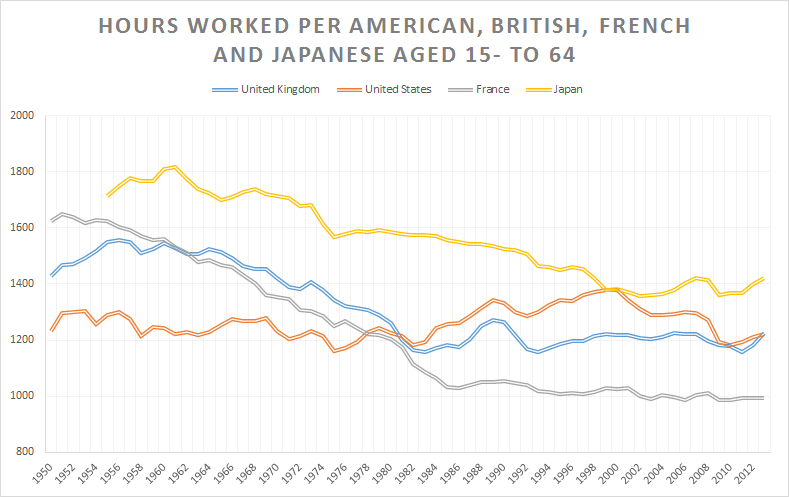
Hours worked per working age American, British, French and Japanese since 1950

image

Source: Data extracted on 05 Oct 2015 22:01 UTC (GMT) from OECD.Stat and The Conference Board. 2015. The Conference Board Total Economy Database™, May 2015, http://www.conference-board.org/data/economydatabase/

What is so flash about #Singapore as an expat destination

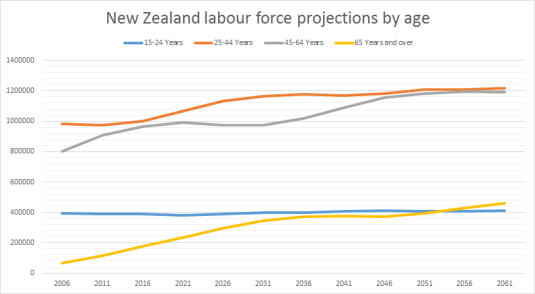
New Zealand labour force projections by age and sex

The common theme in New Zealand labour force projections is the number of plus age 65 workers is to increase for next to nothing a mere 10 years ago, barely 65,000 plus 65 workers in all, to knock on the door of the number to population aged 15 to 24 in a mere 15 years from now.

Source: NZ.Stat.

Prime age male workers will continue to be the most predominant male worker but there will be many more +65 male workers. The retirement of baby boomer male workers is the reason why mature age working population is static for some time.

Source: NZ.Stat.

The working age female population aged 45 to 64 has already overtaken the 25 to 44 female working age population. The number of female workers aged 65 and over is also exploding.

Source: NZ.Stat.

Most labour force projections are based on the premise that we are all going to work to we drop. That is not unreasonable assumption given healthy ageing and the great number of service jobs that are available which are not physically taxing.

All population projections scenarios are for the 50th percentile projection.

The IMF’s Causes and Consequences of Income Inequality: A Global Perspective

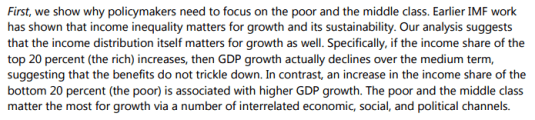
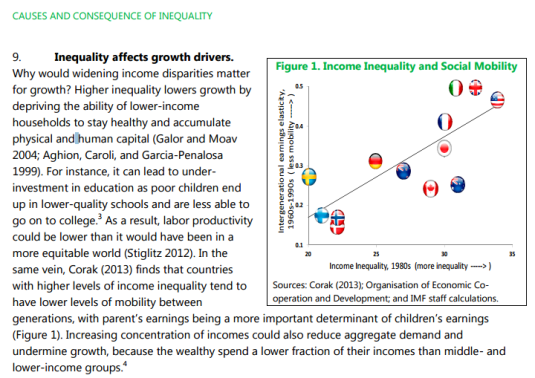
The IMF has joined the OECD in arguing there is an important connection between inequality and who gains from economic growth.

To reach the conclusion that the income distribution matters, the IMF had to tie its master the exact same weak moorings that the OECD did. Specifically the ability of the lower middle class to finance investments in school and higher education.

The IMF has articulated a specific hypothesis that can be confronted with facts and logic.

Many critics of inequality are extremely vague about what exactly is the process that grinds the proletariat down. The withering away of the proletariat in the 20th century has been discussed elsewhere on this blog.

The impact of low income on the ability to accumulate physical and human capital sounds like an interesting question. Not surprisingly, the top labour economists have looked into it.

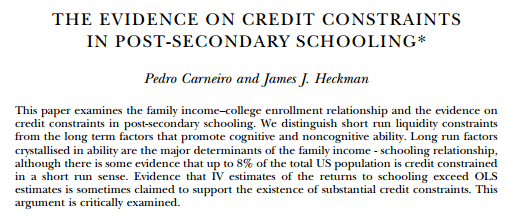
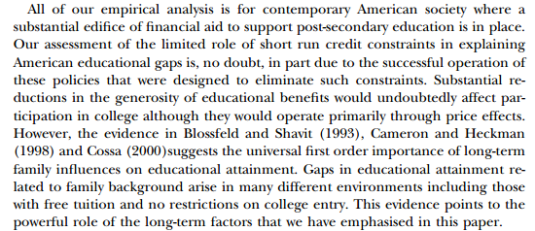
Short-term factors such as the ability to borrow to fund higher education has been found to be seriously wanting. Only a small percentage of people are in any way constrained from going on to higher education because of the lack of money. This is not surprising in any society with student loans freely available at low or zero rates without any need to post collateral.

The notion that the rich are just replicating the good fortunes of their parents has also fallen on hard times despite the persistence of the OECD and the IMF in championing this old Marxist fantasy.

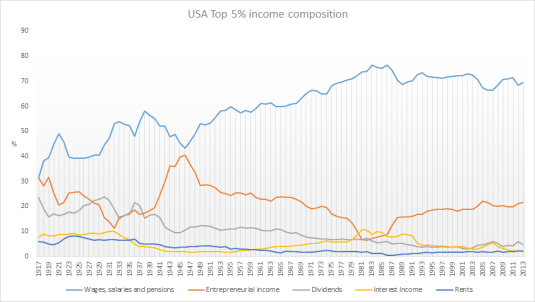
Source: The World Top Incomes Database.

If you look at the income composition of the top 5% of the USA, for example, it is a disappointing story for the IMF and the OECD. Today’s rich are working rich with the majority of their income from wages and salaries and much of the rest from entrepreneurial income. There is no passive rich earning incomes from their inherited investments and grinding the proletariat down.

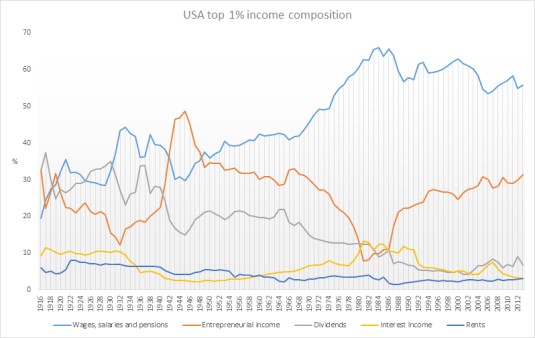
Source: The World Top Incomes Database.

It is the same story with the top 1%. They are working rich with the majority of their incomes paid in wages and salaries and running a business. They are top executives, managers and leading professionals that go to work every day.

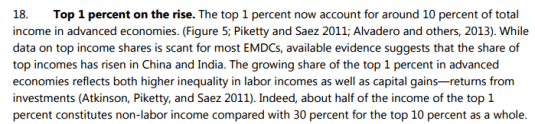
The IMF was simply wrong to claim that at least half the income of the top 1% in the USA was not labour income.

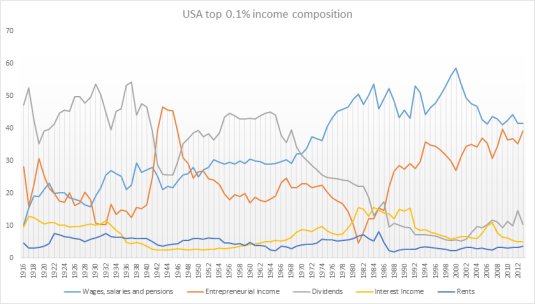
Before 1940, most of the income of the top 0.1% of income earners in the USA was income from investments. By the end of the 20th century, the top 0.1% were earning their incomes as wages and salaries, business incomes and capital gains. Very little of that income of the top 0.1% was in the form of passive income from capital. The top 0.1% of the USA are now working rich – entrepreneurs.

Source: The World Top Incomes Database.

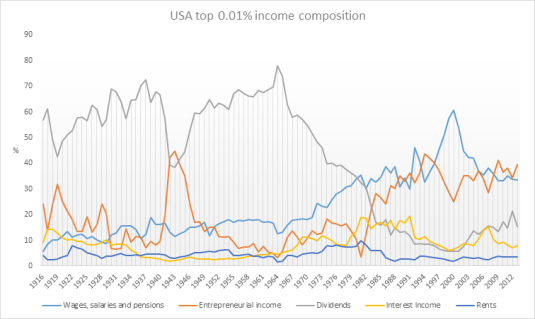
In the good old days of high taxes, the top 0.01% did earn the great majority of their income from passive investment.

Only under the scourge of neoliberalism starting in the 1970s and then massive tax cuts in the Reagan Revolution did the top 0.01% join the working rich. Even the super super-rich have to work for their money these days.

Source: The World Top Incomes Database.

The IMF and before it the OECD were batting from a weak position when they argued that human capital investments of ordinary families is held up by inequality. Student loans to pay for subsidised tuition fees and living expenses solve that problem long ago.

It was simply wrong of the IMF to claim that the top 5%, 1% and 0.1% of for example the USA are living off the rest of society. In the USA, is usually put forward as the worst-case, the rich and super-rich are working rich making their fortunes by building and running businesses. In The Evolution of Top Incomes: A Historical and International Perspective (NBER Working Paper No. 11955), Thomas Piketty and Emmanuel Saez concluded that:

While top income shares have remained fairly stable in Continental European countries or Japan over the past three decades, they have increased enormously in the United States and other English speaking countries. This rise in top income shares is not due to the revival of top capital incomes, but rather to the very large increases in top wages (especially top executive compensation). As a consequence, top executives (the “working rich”) have replaced top capital owners at the top of the income hierarchy over the course of the twentieth century…

Steven Kaplan and Joshua Rauh make a number of basic points backed up by detailed evidence about top CEO pay:

  • While top CEO pay has increased, so has the pay of private company executives and hedge fund and private equity investors;
  • ICT advances increase the pay of many – of professional athletes (technology increases their marginal product by allowing them to reach more consumers), Wall Street investors (technology allows them to acquire information and trade large amounts more easily), CEOs and technology entrepreneurs in the Forbes 400; and
  • Technology allows top executives and financiers to manage larger organizations and asset pools – a loosening of social norms and a lack of independent control of CEO pacesetting does not explain similar increases in pay for private companies–  technology explains it.

The report SuperEntrepreneurs shows that:

  • SuperEntrepreneurs founded half the largest new firms created since the end of the Second World War
  • There is a strong correlation between high rates of SuperEntrepreneurship in a country and low tax rates
  • a low regulatory burden and high rates of philanthropy both correlate strongly with high rates of SuperEntrepreneurship
  • Active government and supranational programmes to encourage entrepreneurship – such as the EU’s Lisbon Strategy – have largely failed.
  • Yet governments can encourage entrepreneurialism by lowering taxes (particularly capital gains taxes which have a particularly high impact on entrepreneurialism while raising relatively insignificant revenues); by reducing regulations; and by vigorously enforcing property rights.
  • High rates of self-employment and innovative entrepreneurship are both important for the economy.
  • Yet policy makers should recognise that they are not synonymous and should not assume policies which encourage self-employment necessarily promote entrepreneurship.

John Rawls is often put forward by political progressives as the starting point for political philosophy. Rawls pointed out that behind the veil of ignorance, people will agree to inequality as long as it is to everyone’s advantage. Rawls was attuned to the importance of incentives in a just and prosperous society. If unequal incomes are allowed, this might turn out to be to the advantage of everyone.

Steven Kaplan and Joshua Rauh’s “It’s the Market: The Broad-Based Rise in the Return to Top Talent”, Journal of Economic Perspectives (2013) found that:

  • Rising inequality is due to technical changes that allow highly talented individuals or “superstars” to manage or perform on a much larger scale.
  • These superstars can now apply their talents to greater pools of resources and reach larger numbers of people and markets at home and abroad. They thus became more productive, and higher paid.
  • Those in the Forbes 400 richest are less likely to have inherited their wealth or have grown up wealthy.
  • Today’s rich are working rich who accessed education in their youth and then applied their natural talents and acquired skills to the most scalable industries such as ICT, finance, entertainment, sport and mass retailing.
  • The U.S. evidence on income and wealth shares for the top 1% is most consistent with a “superstar” explanation. This evidence is less consistent with the gains in earnings of the top 1% coming from greater managerial power over the determination of their own pay in the corporate world, or changes in social norms about what managers could earn.

Today’s super-rich are highly productive because they produce new and better products and services that people want and are willing to pay for. These rewards for entrepreneurship and hard work guide people of different talents and skills into the occupations and industries where their talents are valued the most. The efficient allocation of talent and income maximising occupational choices were important to Rawls’ framework.

The IMF and World Bank should look for policies that remove barriers to riches. Instead, the IMF and OECD are giving support to those who want to tax and regulate the super-rich that drive much of the innovation, entrepreneurship and creative destruction in modern economies.

Poverty traps in America

There are a lot of foreign trained doctors in New Zealand

Image

The explosion in health workers supply

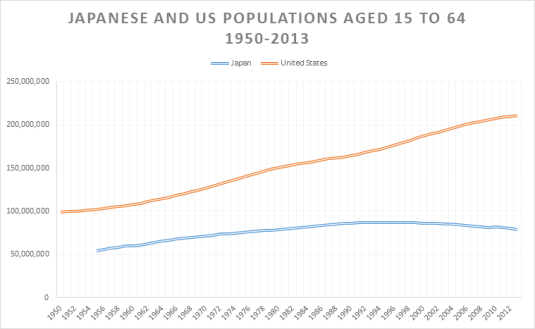
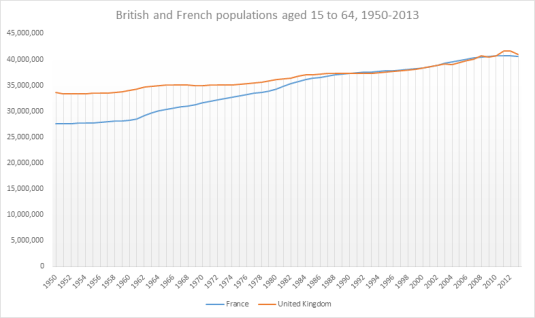
US, British, French and Japanese working age populations, 1950 – 2013

Source: Data extracted on 27 Sep 2015 02:23 UTC (GMT) from OECD.Stat

Source: Data extracted on 27 Sep 2015 02:23 UTC (GMT) from OECD.Stat

Income tax burdens of workers across the OECD

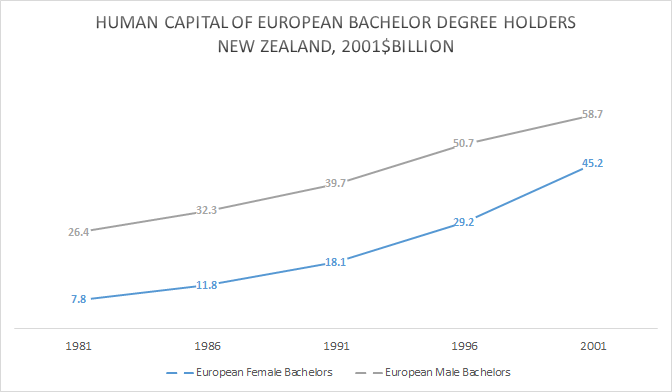
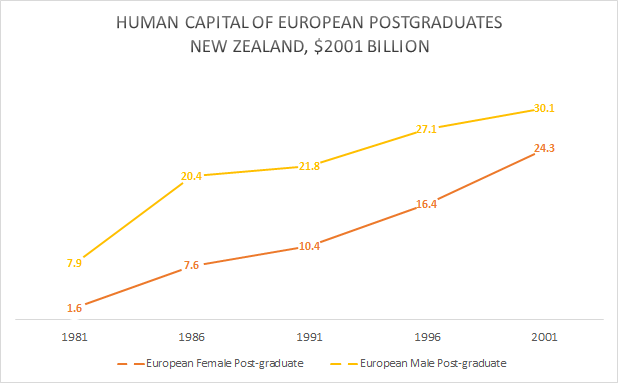
Aggregate New Zealand European human capital of graduates, 1981-2001

There was rapid growth in the human capital of graduates and postgraduates in New Zealand between 1981 and 2001 according to the census data. The growth in female human capital was particularly rapid and especially so at the postgraduate level.

image

Source: Lˆe Thi. Vˆan Tr`ınh, Estimating the monetary value of the stock of human capital for New Zealand, thesis submitted in partial fulfilment of the requirements for the Degree of Doctor of Philosophy at the University of Canterbury (September 2006).

image

Source: Lˆe Thi. Vˆan Tr`ınh, Estimating the monetary value of the stock of human capital for New Zealand, thesis submitted in partial fulfilment of the requirements for the Degree of Doctor of Philosophy at the University of Canterbury (September 2006).

Big gaps in life expectancy by gender in former USSR countries

Check out @FactTank’s Tweet: https://twitter.com/FactTank/status/632183329635307520?s=09

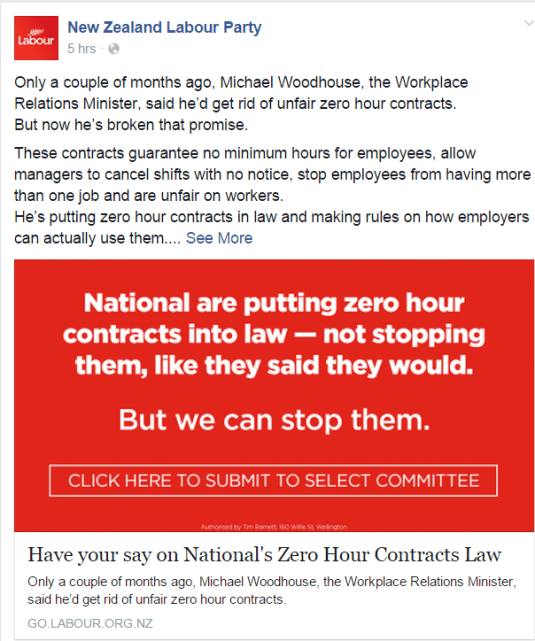
@nzlabour @FairnessNZ My first Parliamentary submission – opposing regulation of zero hours contracts

This Labour Party link made it very easy for me to submit to the Select Committee of Parliament to oppose the Bill on regulating zero hours contracts. I oppose the Bill for the exact opposite reasons that the Labour Party opposes the Bill.

I encourage others to make a submission to Parliament as well opposing this draft amendment that will lower the wages of workers. My submission is as follows:

I do not support the proposed changes to the legislation governing zero hour contracts in the Employment Standards Legislation Bill. There should be no regulation of zero hours contracts.

Zero hours contracts is creative destruction at work in the labour market, sweeping away obsolete working time arrangements, mostly in the retail services sector. Plenty of new ways of working have emerged in recent years that include the proliferation of part-time work, temporary workers, leased workers, working from home, teleworking and sub-contracting. Employment laws were built on the now decaying assumption that workers had career-long, stable relationships with single employers.

Advance notice of work schedules is always known only to a minority of temporary and permanent employees in New Zealand, and there’s not much difference between that advance notice between temporary and permanent employees.

Critics overplay their hand if they suggest that somehow workers are very much disadvantaged and employers are holding all the cards. Job turnover and recruitment problems are a serious cost to a business. Workers will not sign zero hours contracts if they are not to their advantage.

Unless labour markets are highly uncompetitive with employers having massive power over employees, employers should have to pay a wage premium if zero-hour contracts are a hassle for workers.

The fixed costs of employment are such that you shouldn’t expect zero-hour contracts: you’ll typically do better with one 40-hour worker over two 20-hour workers because of these costs. Zero hour contracts would be most likely in jobs with low recruitment costs and where specialised training needs are low. Workers with low fixed costs of working will move into the zero-hour sector while those with higher fixed costs would prefer lower hourly rates but more guaranteed hours. Again, read lower here as meaning relative to what they could elsewhere earn.

Unless we have a good idea about why firms are moving to zero hours contracts, which we don’t, and why employees sign these contracts rather than work for other employers who offer more regular hours, meddling in these novel working time arrangements is risky.

Employers must pay a wage premium to induce in workers to sign zero hours contracts. This Bill seeks to deny workers the right to seek higher wages.

Feel free to use the above text as the basis for your own submission to Parliament.

Young people run faster, but seniors know the shortcuts

Source: Young people run faster, but seniors know the shortcuts | Eurasian Perspectives

Previous Older Entries Next Newer Entries

Bassett, Brash & Hide

Celebrating humanity's flourishing through the spread of capitalism and the rule of law

Truth on the Market

Scholarly commentary on law, economics, and more

The Undercover Historian

Beatrice Cherrier's blog

Matua Kahurangi

Celebrating humanity's flourishing through the spread of capitalism and the rule of law

Temple of Sociology

Celebrating humanity's flourishing through the spread of capitalism and the rule of law

Velvet Glove, Iron Fist

Celebrating humanity's flourishing through the spread of capitalism and the rule of law

Why Evolution Is True

Why Evolution is True is a blog written by Jerry Coyne, centered on evolution and biology but also dealing with diverse topics like politics, culture, and cats.

Down to Earth Kiwi

Celebrating humanity's flourishing through the spread of capitalism and the rule of law

NoTricksZone

Celebrating humanity's flourishing through the spread of capitalism and the rule of law

Homepaddock

A rural perspective with a blue tint by Ele Ludemann

Kiwiblog

DPF's Kiwiblog - Fomenting Happy Mischief since 2003

The Dangerous Economist

Celebrating humanity's flourishing through the spread of capitalism and the rule of law

Watts Up With That?

The world's most viewed site on global warming and climate change

The Logical Place

Tim Harding's writings on rationality, informal logic and skepticism

Doc's Books

A window into Doc Freiberger's library

The Risk-Monger

Let's examine hard decisions!

Uneasy Money

Commentary on monetary policy in the spirit of R. G. Hawtrey

Barrie Saunders

Thoughts on public policy and the media

Liberty Scott

Celebrating humanity's flourishing through the spread of capitalism and the rule of law

Point of Order

Politics and the economy

James Bowden's Blog

A blog (primarily) on Canadian and Commonwealth political history and institutions

Science Matters

Reading between the lines, and underneath the hype.

Peter Winsley

Economics, and such stuff as dreams are made on

A Venerable Puzzle

"The British constitution has always been puzzling, and always will be." --Queen Elizabeth II

The Antiplanner

Celebrating humanity's flourishing through the spread of capitalism and the rule of law

Bet On It

Celebrating humanity's flourishing through the spread of capitalism and the rule of law

History of Sorts

WORLD WAR II, MUSIC, HISTORY, HOLOCAUST

Roger Pielke Jr.

Undisciplined scholar, recovering academic

Offsetting Behaviour

Celebrating humanity's flourishing through the spread of capitalism and the rule of law

JONATHAN TURLEY

Res ipsa loquitur - The thing itself speaks

Conversable Economist

Celebrating humanity's flourishing through the spread of capitalism and the rule of law

The Victorian Commons

Researching the House of Commons, 1832-1868

The History of Parliament

Articles and research from the History of Parliament Trust

Books & Boots

Reflections on books and art

Legal History Miscellany

Posts on the History of Law, Crime, and Justice

Sex, Drugs and Economics

Celebrating humanity's flourishing through the spread of capitalism and the rule of law

European Royal History

Exploring the Monarchs of Europe

Tallbloke's Talkshop

Cutting edge science you can dice with

Marginal REVOLUTION

Small Steps Toward A Much Better World

NOT A LOT OF PEOPLE KNOW THAT

“We do not believe any group of men adequate enough or wise enough to operate without scrutiny or without criticism. We know that the only way to avoid error is to detect it, that the only way to detect it is to be free to inquire. We know that in secrecy error undetected will flourish and subvert”. - J Robert Oppenheimer.

STOP THESE THINGS

The truth about the great wind power fraud - we're not here to debate the wind industry, we're here to destroy it.

Lindsay Mitchell

Celebrating humanity's flourishing through the spread of capitalism and the rule of law

Alt-M

Celebrating humanity's flourishing through the spread of capitalism and the rule of law

croaking cassandra

Economics, public policy, monetary policy, financial regulation, with a New Zealand perspective

The Grumpy Economist

Celebrating humanity's flourishing through the spread of capitalism and the rule of law

International Liberty

Restraining Government in America and Around the World