Time with kids is a normal good rather than means to improve child quality? @tylercowen @bryan_caplan @MargRev http://t.co/8ICuUFdv2A—
Ian (@ianmichaelbrown) March 29, 2015
The demand and supply of quality family time
09 Apr 2015 Leave a comment
in economics of love and marriage, labour economics, labour supply Tags: child rearing, economics of family, family demographics, household division of labour
Another gender wage gap that dare not speak its name
09 Apr 2015 Leave a comment
in discrimination, gender, labour economics, labour supply, occupational choice Tags: compensating differentials, gender wage gap, part-time work, reversing gender gap


Unemployment in the UK since 1860
07 Apr 2015 Leave a comment
Does money buy happiness?
07 Apr 2015 Leave a comment
in labour economics, labour supply, occupational choice Tags: compensating differentials, revealed preference
Life satisfaction rising with income – but interesting differences between different jobs.
( bit.ly/1xDklbn) http://t.co/b8ihg4LwVC—
Max Roser (@MaxCRoser) March 31, 2015
Immigration to the USA since 1820
06 Apr 2015 Leave a comment
in economic history, international economics, labour economics, labour supply, politics - USA Tags: economics of immigration
The origin of immigrants to the US since 1820
Source: bit.ly/1xjTubs http://t.co/km98cdAvTO—
Max Roser (@MaxCRoser) March 19, 2015
What if McDonald’s workers were paid $15 per hour
06 Apr 2015 Leave a comment
in industrial organisation, labour economics, labour supply, minimum wage, occupational choice, survivor principle Tags: activists, compensating differentials, do gooders, Leftover Left, living wage
Why Did Wal-Mart Raise Its Wages?
03 Apr 2015 Leave a comment
in industrial organisation, labour economics, labour supply, minimum wage, politics - USA, survivor principle Tags: Paul Krugman, supply and demand, Walmart
Why Did Walmart Raise Its Wages?
forbes.com/sites/realspin… http://t.co/0LRQQcKGKm—
Benn Steil (@BennSteil) April 02, 2015
The retail sector quits rate, the number of people quitting jobs as a per cent of total employment, is also considerably higher than the quits rate in the private sector broadly: 2.9% versus 2.2%.
Not surprisingly, Gap and Ikea have made wage-hike announcements similar to Wal-Mart’s. Retailers are clearly having more and more trouble finding and keeping workers at the federal minimum wage.
In short, Krugman’s story of Wal-Mart raising wages in response to political pressure simply flies in the face of the evidence. Wal-Mart is just being Wal-Mart: making a rational decision to lure and retain workers in a tightening retail labour market through greater compensation.
The problem with ignoring this evidence is that it encourages the notion that we can make wages, in Krugman’s words, “a political choice,” with no concern for its effect on employment.
The impact of US 1996 welfare reforms on single mothers’ employment
03 Apr 2015 Leave a comment
in gender, labour economics, labour supply, poverty and inequality, welfare reform Tags: 1996 US welfare reforms, female labour force participation, single parents
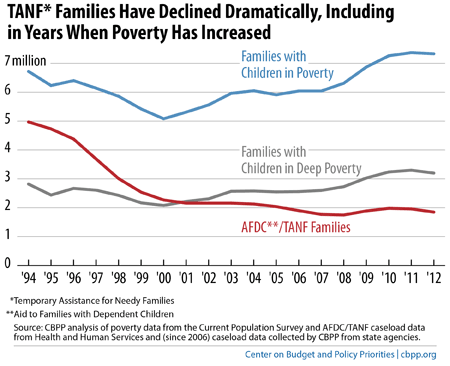
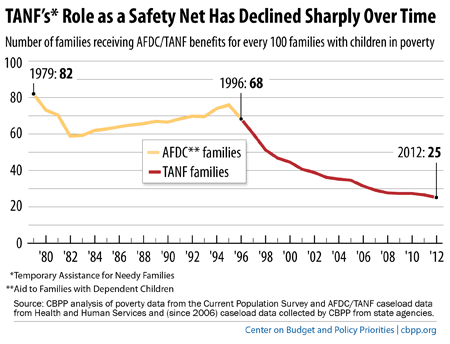
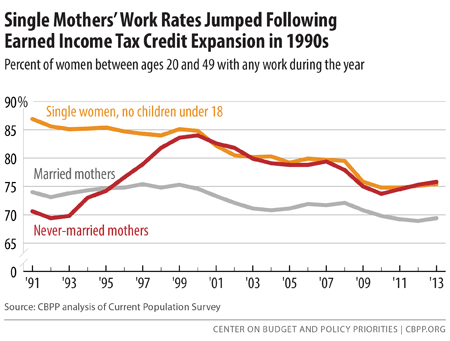
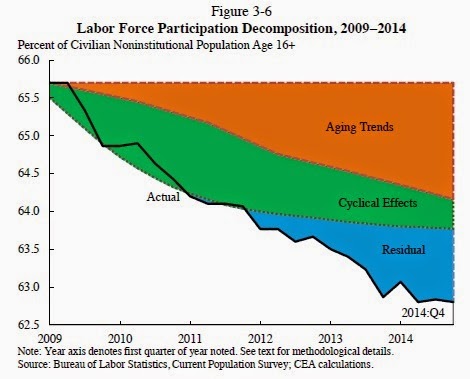
Putting U.S. Labor Force Participation in Context
02 Apr 2015 Leave a comment
in gender, labour economics, labour supply, politics - USA Tags: cross-country comparisons, female labour force participation, labour force participation, male labour force dissipation
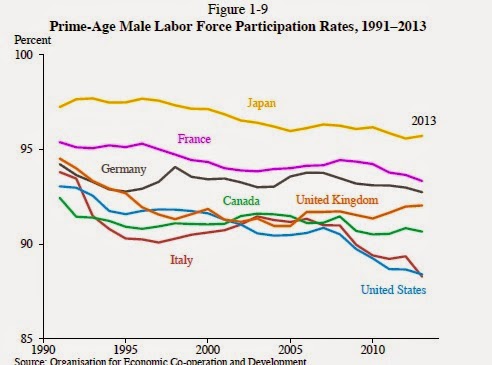


Causes of death of pop musicians and the general population
01 Apr 2015 Leave a comment
in health and safety, health economics, labour economics, labour supply, Music, occupational choice Tags: life expectancy

The rising educational attainment of the poor
01 Apr 2015 Leave a comment
in economics of education, human capital, labour economics, labour supply, poverty and inequality, welfare reform Tags: educational attainment
@mattyglesias poverty trends a good example of why americanprogress.org/issues/poverty… http://t.co/tgn7RzBKzw—
Shawn Fremstad (@inclusionist) March 28, 2015

A tale of two parents
30 Mar 2015 Leave a comment
in human capital, labour economics, labour supply, occupational choice, politics - USA, population economics, poverty and inequality, welfare reform Tags: child poverty, family demographics, family structures, single parents
Whitlam’s curse – How higher education drives inequality among the bottom 99%
30 Mar 2015 Leave a comment
in economics of education, human capital, labour economics, labour supply, occupational choice, politics - Australia, politics - USA Tags: David Autor, education premium, Gough Whitlam, top 1%
Gough Whitlam abolished tuition fees at Australian universities in 1972. The idea was to reduce inequality. He entrenched it instead, and gave a flying start to those of already above-average talents.
David Autor in a recent paper has illustrated how the gap between the highly educated and the less educated is growing at a far faster rate than the gap between the top 1% in the bottom 99% in the USA. David Autor argues that
a single minded focus on the top 1% can be counterproductive given that the changes to the other 99% have been more economically significant.

- since the early 1980s, the earnings gap between workers with a high school degree and those with a college education has become four times greater than the shift in income during the same period to the very top from the 99%.
- Between 1979 and 2012, the gap in median annual earnings between households of high-school educated workers and households with college-educated ones expanded from $30,298 to $58,249, or by roughly $28,000.
- If the incomes of the bottom 99% are grown at the same pace as the top 1% their incomes would have increased by $7000 per household.
Autor argues that the growth of skill differentials among the other 99% is more consequential than the rise of the 1% for the welfare of most citizens.

via How Education Drives Inequality Among the 99% – Real Time Economics – WSJ.
 Utopia, you are standing in it!

Recent Comments